This is a peacock in the snow from Amarcord directed by Federico Fellini
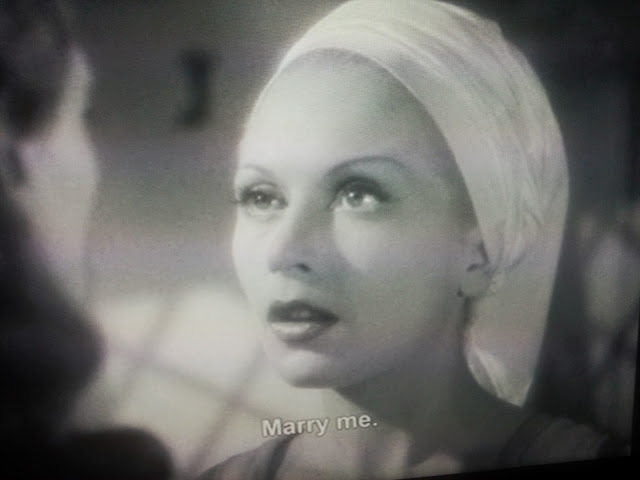 | | Josette Day as Belle in the Jean Cocteau version of Beauty and the Beast (1946) |
Published 5/18/13
Beauty and the Beast (1946)
d. Jean CocteauCriterion Collection #6 Yeahhh... who I told I was watching this movie both thought I was talking about the Disney piece of s***. Anything sadder then the co-option by Disney of our public domain fairy tales? Sad but true. The Disneyfication of the fairy tale obscures the different origination of fairy tales in their "moden" form. Of course, the main vehicle has been the seminal work of the Brothers Grimm, but there is also a solid French contribution. The modern version of Beauty and the Beast has an actual author, Mme. Leprince de Beaumont.  | | Jean Marais as the Beast in Jean Cocteau's Beauty and the Beast (1946) |
Jean Cocteau is another director who I know I should have watched but have not because of not having access to the Criterion Collection, but now I'm on the road to correcting that- Cocteau has four films in the Criterion Collection: The Blood of a Poet, Orpheus, Testament of Orpheus and this one.  | | Jean Marais as the Beast in Jean Cocteau's Beauty and the Beast (1946) |
This edition of Beauty and the Beast was of course superb, particularly the quality of the film restoration and the "uncompressed" score by George Auric- both aspects of the release brought Beauty and the Beast to life and made watching it a pleasurable experience.  | | Striking exterior wall with stone deer on top from Beauty and the Beast directed by Jean Cocteau |
I spent plenty of time in college and afterwards watching scratchy VHS copies of non-restored classics, spent time in law school and after watching scratched up non-restored DVD's of classics and earlier in this decade, before Netflix lost the Criterion Collection to Hulu Plus, I would get their scratchy copies of the Criterion Collection movies- but they would always skip and not come with the bonus features. Honestly, the streaming function of Hulu Plus vis a vis the Criterion Collection is literally the greatest breakthrough in a decade. Cocteau's Beauty and the Beast is a world with real suffering intermixed with dreamlike/surreal qualities. It's quite a package for 1946 and easy to see why the Criterion Collection would release it in the first ten releases of the Collection.
 | | The Australian desert is a lead character in Nicolas Roeg's Walkabout (1971) |
Published 5/20/13
Walkabout (1971)
d. Nicolas RoegCriterion Collection #10 The more Criterion Collection films I watch the more I realize that my interest lies just as much with the Criterion Collection itself as the individual films in the collection. I'm interested in the order of release, why they chose the films they released as well as the business side of the Criterion Collection. At the same time, though having all these Criterion Collection titles available via streaming on Hulu plus is almost like a relief, particularly since I only need to invest a couple hours in a film (vs. 2-20 hours on a book depending on the length.)  | | Jenny Agutter plays the unnamed "girl" in Walkabout by Nicolas Roeg. |
Walkabout is a stunning outing by director/cinematographer Nicolas Roeg (Australia), produced by the guy who made Clockwork Orange. It tells the story of a teenage girl and her kid brother, who are abandoned in the outback when there Father commits suicide on a after school outing. After they are abandoned, they come across an Aborigine who is actually on a real Walkabout- an Aboriginal coming of age ritual that involves the young Aborigine roughing it in the desert for six months.  | | Lucien John plays the unnamed "boy"- the younger brother of the girl in Walkabout (1971) by Nicolas Roeg |
The source material is a short story that is a kind of Australian analogue to Swiss Family Robinson. In the original story, they are the sole survivors of a plane crash, here Roeg chose the suicide of the father as the catalyst, making the film a good deal darker then the book in the very first act. The desert functions as an additional character- and a striking one at that- Roeg intersperses the story of the two children with beautiful shots of the sky and desert wild life. It makes Walkabout an unforgettable journey, and a journey I would highly recommend, especially if you are wasting your life binge watching network television on Netflix.
 | | Katherine Hepburn in Summertime by David Lean |
Published 5/22/13
Summertime
d. David Lean w/ Katharine Hepburn
1955Criterion Collection #22 One of the attributes of people I've learned about from the internet is that it is easier to get people to like another person then a thing. People are more likely to "like" a band/artist then a record label. People are more likely to "like" Jesus then Christianity. People like to like other people. When you apply that principle to works of Art that are group efforts, it means that inevitably the Audience will be more interested in the specific people involved: the star Actor/Direction then the craft of an extremely complicated production. In music, when a new record comes out, people are interested in the novelty of it and what it tells the Audience about the Artist. Audience members do not care about how the record was produced Summertime presents two obvious focal points: the director David Lean and the star actress Katherine Hepburn. I should say it now: I have nothing but contempt for actors and their so-called "art." I can recognize and affirm great Actors but I don't think it's a worthwhile avocation for an amateur artist, specifically that it's inferior to being an author, musician or studio artist. I have more respect for Directors and the most for the system of movie production itself, but of course, no one wants to hear about that last one. David Lean is most known for his epics: Lawrence of Arabia and Doctor Zhivago, but the Britiish director had a "long and eclectic career" and this vintage 1950s Rom with a dash of Com is a good example of his eclecticism. Katharine Hepburn stars as Jane Hudson, a "fancy secretary" from Akron Ohio who is on a once of a lifetime trip to Venice...solo. While there she befriends an orphan and has a brief love affair with Renato De Rossi a (married) antiques dealer who may or may not have defrauded her when she bought an "antique" vase from him. Ah, Italy. Besides Hepburn doing her thing as a lonely, over-educated white lady from the 50s, Venice takes center stage. Having been to Venice during the off season, I can only contemplate with horror what a nightmare it must have been to shoot this film, in Venice, during the high season for tourism. It seems literally insane/impossible not to mention like literally the most expensive undertaking outside of shooting a feature film on the Moon or at the bottom of the ocean- just my impressions from a visit to Venice during the dead of winter in 2010. I wasn't a huge fan of Venice at the time, but it's hard not to like how Lean shows her off: the bridges, the canals, the plazas, the Churches, the other plazas. Honestly, it seems like not much has changed in Venice since the mid 1950s. Once again, the restored Criterion Collection edition was a sheer delight to behold. Also, this is not a Criterion Collection edition where you need the special features, which are listed on the web page as "Original Theatrical Trailer" END OF LIST- so this is a good title to knock out without regard to missing the DVD only features.
Published 5/24/13
Shock Corridor
d. Samuel Fuller
1963Criterion Collection #19 This is the second Samuel Fuller film in a row I've watched. The other was The Naked Kiss. Both have Constance Garnett as the female lead. In The Naked Kiss she plays a reformed prostitute who murders here pedophile fiance. In Shock Corridor she plays the cabaret singer fiance of the newspaper reporter who goes undercover into an insane asylum to solve a murder and pays... with his sanity.  | | Shock Corridor |
Seeing the two films back to back in the their glorious Criterion Collection editions it is easy to see what contemporary critics saw in his movies. First of all, there is his outre treatment of mental illness- Shock Corridor has a black character who thinks he is white and repeatedly talks about lynching "niggers." The Naked Kiss was the first movie to directly discuss pedophilia as a mental illness. Fuller was clearly interested in the subject as a hook to sell movie tickets in the 1960s. This psychological angle is something that has lasting interest to the film scholar community, but these are not dry, academic films, they are pulpy b movies and rewarding for reasons outside of their long term value- in the same way that you can watch a Quentin Tarantino or Richard Rodriguez film as a genre exercise or a film that plays with the conventions of genre. Same thing with Fuller, in fact it seems like Samuel Fuller was likely an inspiration to Tarantino. I could probably look that up. It certainly feels right. There is a sort of studied artificality that surrounds Fuller's films that recalls the work of David Lynch, as well. Think of Kyle McLaughlin in Blue Velvet
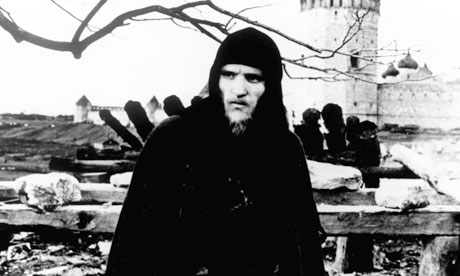 | | Andrei Rublev d. Andrei Tarkovsky |
Published 5/27/13
Andrei Rublev (1969)
d. Andrei TarkovskyCriterion Collection #34185 minutes/Russian subtitles From one perspective, watching a 3 hour film with Russian subtitles seems totally insane, but is it any more insane then watching six episodes of "Cheers" back-to-back on Netflix? Andrei Rublev is a quality example of a work of art I would literally have never seen were it not for its inclusion within the Criterion Collection. Director Andrei Tarkovsky is best known in the west for his sci-fi epic Solaris, but this is has to be his masterwork, Andrei Rublev is theoretically the biography of Russian Icon Painter Andrei Rublev, who lived in the 14th and 15th century. Little is actually known about the guy, and his biography is simply a cover for sweeping- SWEEPING- historical drama about Russian life in the Middle Ages. The black and white film used to shoot Andrei Rublev makes you think it was shot in the 1920s, and then Tarkovsky pulls away for an epic crane shot with hundreds of Russians and Tartars on horses and you're like, "Ah- no- not made in the 1920s."  | | Andrei Rublev d. Andrei Tarkovsky |
Watching Andrei Rublev is like watching a film from another universe- only a Communist country would both fund such a work AND ruthlessly suppress it prior to release. One of the benefits of state funded art I suppose. Over the three hours I spent watching Rublev- and you have to actually watch it because it is in Russian, with English subtitles, I was trying to imagine what it must have been like being an Artist in Communist Russia- there must have been pros and cons. The stand out moments in the epic are the scenes of wanton cruelty of the Czar and Tartars alike towards the peasants. The cruelty is depicted so matter of factly that it can reach even people who have been desentizied to depictions of cruelty and violence. It's like seeing Birth of a Nation only the troops are raping people and gouging their eyes out before the heroic Klan arrives to save the day. The final chapter of Andrei Rublev tells the story of Fyodor, who is drafted by the Czar to make an enormous bell for a church based on his representation that his dead father, the bellmaker, had imparted his secrets to Fyodor before death. Then you watch this kid make this enormous church bell- essentially on pain of death- and then when it works, he breaks down and confesses that his father never told him the secret of making large bells, and he basically made it up as he went. It's a rare cinematic moment, equal to anything that Hollywood has thrown out there, and the fact that it comes at the end of this dark, savage movie about life in the Russian Middle Ages makes it all the more exceptional.
Diabolique (1955) d. Henri Georges Clouzot (5/29/13)
 | | Simone Signoret as Nicole Horner in Diabloique (1955) d. Henri Georges Clouzot |
Movie Review Diabolique (1955) d. Henri Georges Clouzot Criterion Collection #35 OMG this movie is so good, but unfortunately it's got a plot twist that makes talking about it almost impossible without ruining the film for someone who hasn't seen it. Henri Georges Clouzot is a good example of a film maker who benefits from Criterion Collection editions of his work. I realized while reading an article Terrence Rafferty wrote about this release that I had see another of his films, La corbeau, about the impact of anonymous gossip in a small town, in a non Criterion Collection version and it was scratchy and unrestored. The tag to get you to watch this movie is that this was a story that Hitchcock wanted to film and "got away." It has elements of film noir, suspense and horror that are characteristic of what would become "Hitchcockian" film making, but was made before Hitchcock himself had rounded into full, mature, artistic form. The plot of Diabolique: A spurned wife and beat-up mistress conspire to murder the brutal man they share in common, if classic film noir but as Diabolique moves through it's nearly two hour run time, elements of the supernatural begin to creep in, leading to the blow up ending. It is quite a ride, and the performances of the lead characters: Paul Meurisse as the brutal husband/love Michel Delassalle, Simone Signoret as the scheming blond mistress Nicole Horner & Vera Clouzot as Christina the spurned wife- are all top notch. The value of the Criterion Collection Edition here is that Clouzot was a filmmaker who was very much a victim of the rise of the Nouvelle Vague- it was unfortunate, he was targeted mostly because he was on top vs. being an embodiment of the film culture that Truffaut, Godard etc despised. Making a Criterion Collection of Diabolique cements his proper place in the canon of film. Fun movie- worth a watch on Hulu Plus for sure
Branded to Kill (1967) d. Seijun Suzuki (5/30/13)
Movie Review Branded to Kill (1967) d. Seijun Suzuki Criterion Collection #38 It's clear six movies in that one of the primary purposes of the Criterion Collection is to canonize films that are, at time of publication, outside the canon of generally recognized classics. This is a well established tactic of the marketing of cultural products, whether it be anthologies with critical notes or reissues of out of print records, the resuscitation of a product that has either a minimal market or is currently unavailable in the the market is always attractive because the acquisition costs are low relative to the production of a new art product in the same format.  | | Annu Mari as Misako Nakajo in Branded to Kill (1967)l d. Siejun Suzuki |
It makes sense that so many of the Criterion Collection films are either foreign or from "B-Movie" genres, because these are the films that are most often going to be ignored by the American critical/popular Audience for movies. One characteristic foreign and b-movies have in common is less-then-perfect distribution, including, frequently, lags of years between production and distribution. If an art product is produced in year 1, and not shown to any Audience until year 3, there is less of a chance of the work connecting with that initial Audience. But one of the things I've learned already is that I've actually seen many/most of the Criterion Collection films already: Grand Illusion, Seven Samurai, The Lady Vanishes, 400 Blows, The Killer, Hard Boiled, Spinal Tap, Silence of the Lambs, Sid and Nancy, Dead Ringers, Robocop, Alphaville, M, Nanook of the North, Time Bandits, Armageddon, Fishing With John (TV Show.) That takes me up to this movie, Branded To Kill, Criterion Collection #38.  | | Annu Mari as Misako Nakajo in Branded to Kill (1967)l d. Siejun Suzuki |
Anyone can see from that very partial list that there are a bunch of films that are hardly traditional classics: two John Woo movies, Spinal Tap, Silence of the Lambs, Sid and Nancy, Dead Ringers, Time Bandits- and... AND- Armageddon- directed by Michael Bay- in the first 50 titles. Clearly what we're dealing with here is what the Criterion Collection could get the rights for. That set, Branded to Kill, directed by Seijun Suzuki is a solid Criterion Collection gem, one of two Seijun Suzuki films that appear back-to-back 38-39 in the Criterion Collection. Seijun Suzuki is known as a great rebel of Japanese cinema and kind of seems like the Japanese equivalent of the New Wave bad boys of French Film or more recent Auteurs like Quentin Tarantino or perhaps even Eli Roth. Suzuki is so well known that I think it's warranted to quote the Criterion Collection biography of Seijun Suzuki itself: According to critic Manohla Dargis, “To experience a film by Japanese B-movie visionary Seijun Suzuki is to experience Japanese cinema in all its frenzied, voluptuous excess.” Suzuki played chaos like jazz in his movies, from the anything-goes yakuza thrillers Tokyo Drifter and Branded to Kill to the daring postwar dramas of human frailty Gate of Flesh and Story of a Prostitute to the twisted coming-of-age story Fighting Elegy; he never concerned himself with moderation, cramming boundless invention into his beautifully composed frames, both color and black-and-white. Accurate description. One of the most interesting aspects of Suzuki, besides the cinematography of this purportedly "B" movies, is their status AS B-Movies. Film makers are almost always working as employees of a film producing company, and this can lead to artistic disputes and outre behavior on the part of the Artists. For example, Suzuki was famously fired after Branded to Kill came out because the movie "made no sense." That is pretty epic. Watching Branded to Kill is a sequence of "gee whiz" moments as you recognize the enormous influence that Suzuki has had on a generation of Hollywood directors. As it turns out I've already seen Tokyo Drifters, but I would also write an amazing review of that film as well, if asked.
Taste of Cherry (1997) d. Abbas Kairostami (6/2/13)
 | | Taste of Cherry: Iranian landscape |
Movie Review Taste of Cherry (1997) d. Abbas Kiarostami Criterion Collection #45 Iran is a cultural blind-spot in the west. Even well educated American typically only know this history of Iran post Iranian Revolution. Few know that the Farsi language is part of the Indo-European linguistic family (alongside English, Spanish, French, German, etc.) or that the first Monotheistic religion (Zoroastrianism) was the state religion of Persia when the ancient Hebrews were exiled there. Iran is typically defined today by its religion: Shia Islam and almost never by ethnicity/language. Taste of Cherry actually won the Palme D'Or at Cannes in 1997 and the Criterion Collection edition followed shortly in 1999. Obviously, a film coming out of Iran in 1997 is going to have distribution issues, so it makes sense that this movie would basically go straight from theaters to Criterion Collection with no intermediaries. The story sounds like a parody of depressing indie films: Middle-aged Mr. Badii (Homayoun Ershadi) drives through the hilly outskirts of Tehran—searching for someone to rescue or bury him.  | | This is director Abbas Kiarostami shooting Taste of Cherry. |
That's it- that is the whole story. Specifically he interacts with four people, a solider, a gatekeeper, a seminarian and a taxidermist, and tries to convince each of them to help him commit suicide by covering him with dirt after he dies. Although Taste of Cherry is only 90 minutes long it is a lengthy 90 minutes. I think I stopped it a half dozen times to get up and do something. Many of the shots are long static head shots of Mr. Badii driving, because the director was in the passenger seat shooting the film. The lengthy conversations are interspersed with breathtaking images of Iran- I'm just assuming this movie was shot near Tehran- perhaps in an industrial suburb- rather then Tehran proper.
The Most Dangerous Game (6/4/13)
Movie Review The Most Dangerous Game (1932) d. Ernest B. Schoedsack & Irving Pichel Criterion Collection #46 The Most Dangerous Game was a welcome respite after the slow-moving, elegaic & Iranian language Taste of Cherry. The Most Dangerous Game was the movie made by the group who would make King Kong the very next year, and even features King Kong leading lady Fay Wray playing another damsel in distress. Prior to watching this movie I knew of it mostly by pop culture references made in tv shows like the Simpsons. Who can't imagine Simpsons character/Arnold Schwarzenegger parody Rainer Wolfcastle gravely intoning, "I will hunt the most dangerous game...man." in his faux Austrian parody accent?  | | Fay Wray- sexy pre code babe |
But, it actually is a film- this film- and it does tell the story of an insane Russian count living in an old Portugese castle in the Pacific who does, in fact, hunt the most dangerous game... that game being man. His foil is leading man Joel McCrea, but it's hard too take your eyes away from Count Zaroff, who turns in a crazy Russian bad guy for the ages. The impact is heigtened by the less-then-subtle camera techniques and a score that litereally goes bonkers every time the film makers are trying to hint at something. There is one scene where Zaroff is talking to Fay Wray and she is standing at the top of a lengthy stair case, and he is standing beneath, and he says something menacing, and the camera zooms in- it has to be- 50 feet, across the room to focus in on his menacing expression. It comes off as corny in 2013, but only because filmmakers have been using the same technique for almost a hundred years. The action sequences have the same clumsy, stop-motion quality that they have in King Kong but it doesn't detract from an enjoyable, and brief ( The Most Dangerous Game is only an hour long) viewing experience. It's certainly more fun then Taste of Cherry.
Black Orpheus (1959) d. Marcel Camus (6/6/13)
Movie Review Black Orpheus (1959) d. Marcel Camus Criterion Collection #48 Black Orpheus is an outlier. First, it's in Portuguese, but made by a French director. Second, it's a filmic "one hit wonder" Marcel Camus never made another classic film. Third, it won both the Palme D'Or at Cannes and the Academy Award for Best Foreign Film in 1959 so it's not an lost masterpiece. Black Orpheus is the retelling of the Greek myth of Orpheus and Eurydice. In the original, Orpheus is a talented musician and Eurydice is his beloved. She attracts the attention of a malveolent shepard and she dies while in flight from him, bitten by a snake. Orpheus tracks her to the underworld and frees her once, but violates her condition of release by looking at her before they make it back to Earth, so he loses her in the end. Here the action is transposed to the favela's of Rio de Janiero during Carneval. Eurydice is a country girl who has fled into the city- scared of the man in the death costume who is stalking her. Orpheus is a talented guitar player and leader of a significant crew for the upcoming Carneval. When set against other foreign films of the late 50s and early 60s, Black Orpheus is a pageant for the eyes and ears. The sound track, created by Antonio Carlos Jobim and Luis Bonfra, is generally credited, by film scholars at least, with sparking the boom in Brazillian bossa nova that took place around the time the film was released. I'm not sure if this is factually accurate or not, but I can certainly see why it would be true. It's pretty incredible how a single film can start a larger cultural phenomenon, but the fact that this happens over and over again is a testament to the strength of movies as a medium
Yojimbo (1961) d. Akira Kurosawa (6/10/13)
Movie Review Yojimbor (1961) d. Akira Kurosawa Criterion Collection #52 Not particularly looking forward to watching every g d Akira Kurosawa movie, because it seems like every one is in the Criterion Collection. I know he's a master of world cinema but I just have never got into it. But I still prefer watching Yojimbo to any of the about 50 Friends episodes I've got stacked up on my DVR. I can't even contemplate the horror of watching 6 dvr'ed episodes of Friends in a row. It's like thinking about cutting off a limb, for me anyway. At the same time I'm forced to admit that I can't exactly sit down and watch a two hour Akira Kurosawa picture straight, either. What I end up doing is watching Yojimbo like it's an episodic tv show, with two half hour shows and a one hour finale over the course of 3 or 4 days. That way I have time to reflect before the film is over and I'm sitting there going "Ugh so boring." I've never been a Kurosawa fan but that must have something to do with the fact that I haven't seen the Criterion Collection editions of this work. For example, I can remember watching a pan and scan version of Seven Samurais on PBS in high school and not getting what the deal was. The deal is the way Kurosawa uses the wide screen format and translates the filimic components of a Western into his Japanese milleu. Many Americans who haven't seen Yojimbo have seen the Sergio Leon remake/adaptation from 1964, Fist Full of Dollars with Clint Eastwood. Actually probably at this point most people who have heard of one have heard of the other- don't know that the cult of Clint Eastwood really exists these days.  | | Toshiro Mifune as Sanjuro in Yojimbo (1961) d. Akira Kurosawa |
The center of Yojimbo is the incomparable (from the criterion collection website) Toshiro Mifune as Sanjuro, the itinerant Samurai/Cowboy who strolls into the frontier town where two gangs are at war with one another. Sanjuro plays both sides off against one another in his now classic, timeless, manner. Like the Seijun Suzuki films, to watch Yojimbo is to watch a movie that has directly influenced a half century plus of successful Film makers. One Criterion Collection specific observation I have after watching a dozen or so films is that the wide aspect ratio that characterizes Hollywood film was by no means standard on a world wide basis, particularly outside of America. Yojimbo has an aspect ratio of 2.35:1 whereas Amarcord, a Fellini film shot in the early 1970s, only has 1.85:1. The Most Dangerous Game, shot in the pre Code Hollywood era, is only 1.33:1. Same thing with Diablolique, a French film shot in 1955- 1.33:1. In fact, the only other film I can think of that shares the 2.35:1 aspect ratio of Yojimbo is Seijun Suzuki's movies. The 2.35:1 ratio is actually even larger then the current Hollywood standard. For example Robocop, shot in 1987, is 1.66:1. The 2.35:1 aspect ratio gives the filmmaker many possibilities in terms of composing the scene but it makes facial close ups awkward. Not in the hands of Kurosawa, but it's easy to see how a facial close up in a 2.35:1 aspect ratio would actually cut off the top and bottom of the face. But landscapes... or "long" shots- beautiful.
Sanjuro (1962) d. Akira Kurosawa (6/12/13)
 | Toshiro Mifune, star of Sanjuro and Yojimbo
Movie Review Sanjuro (1962) d. Akira Kurosawa Criterion Collection #53 Sometimes I'll be a reading a record review and the reviewer will call the record a "victory lap." That means the Artist who made the record has done well with a prior record and is following up that success with a product that is less ambitious, but features many of the same strengths (and songs) as the prior release. Sanjuro is like a victory lap for the immortal epic Yojimbo. Sanjuro is the name of the Samurai/Ronin at the heart of Yojimbo, and Toshiro Mifune returns to reprise the role in this film. The critical essay by Michael Sragow that accompanies the Criterion Collection page for Sanjuro refers to it as the "sassy kid brother" of Yojimbo and I don't know why you would disagree with that statement. It is a lesser achievement, it is sassier/funnier then Yojimbo (which is also dryly humorous in it's own way) and it does have many of the same pleasures as Yojimbo itself: Namely scenes of Sanjuro being clever interspersed with scenes of Sanjuro being brutal with a sword, and a ton of sneaking around in the bushes spying on people. Seriously, if you had a yen for every time Sanjuro or another character in Yojimbo and Sanjuro peaks out of a knot hole, or a crack in the wall you'd have about a hundred yen because it seems to happen at least- at least- once every 5 minutes in both films.
Carnival of Souls (1962) d. Herk Harvey (6/7/13)
Carnival of Souls (1962) d. Herk Harvey Criterion Collection #63 Manny Farber was an American film critic and painter. In 1962, as luck would have it, he wrote an important essay on B-Movies called "Termite Art vs. White Elephant Art." And basically he was a guy who applied the idea of Auteur theory to B-Movie directors. Carnival of Souls is a fine example of Auteur theory in action in the context of B-Movie. Carnival of Souls was made by "industrial filmmakers on a limited budget." But it survived in true underground fashion for decades after release thanks to bootleg VHS tapes. Finally, Criterion Collection issued this version with a new digital transfer of an original film version. The idea of creating a lasting masterpiece on a limited budget with limited artistic expectations is a concept that is very near and dear to my heart. It is something that my friends bands share in common: Crocodiles, Dum Dum Girls & Dirty Beaches all started as what Manny Farber called "termite art" individual creators, working in isolation from the mainstream of their field, creating something that Audiences responded to. This process of the revival and elevation of B-Movies to "classics" is something I find fascinating, and I think it's those movies within the Criterion Collection- Samuel Fuller's two films I've already seen are another good example- and I think it's critical to have a firm understand of which aesthetic choices made due to a limited budget can be used to generate positive artistic elements: atmosphere, style, depth. The Night Porter (1974) d. Liliana Cavani (6/14/13)
Movie Review The Night Porter (1974) d. Liliana Cavani Criterion Collection #59 The Night Porter was a real Criterion Collection win. It had everything: 70s Vienna, Nazis, S&M sex, concentration camp flash backs and Charlotte Rampling giving an amazing performance. According to the accompanying critical essay at the Criterion web site, this movie was controversial when it was released in 1974. Critics accused it of exploiting the Holocaust. It still packs a punch close to forty years later (in other news, 1974 was 39 years ago so old.)  | | Charlotte Rampling seen in flashback pre-Concentration Camp in The Night Porter |
Truth be told I wasn't that into S&M but I've had some interesting conversations with people and done a little research in the last several months, and now my thought is that if that makes someone happy, they should just do it and not ask too many questions about it. Different strokes for different folks, am I right? The over all impact of The Night Porter is "Last Tango in Paris meets the Holocaust" but I must confess I was absolutely riveted by The Night Porter. Starting with the scenery, continuing with the costumes and performances, and ending with the emotional murder of the star-crossed lovers by the creepy former Nazi's who endlessly harass the couple, The Night Porter is a film that will stick with you and it really, really, stands out on a number of levels from the other Criterion Collection films I've taken in up to this point.
Orpheus (1950) d. Jean Cocteau (6/21/13)
| | Jean Marais place Orpheus in Jean Cocteau's 1950 film. |
Movie Review Orpheus (1950) d. Jean Cocteau Criterion Collection #68 Today, special effects are treated with condescension by most film critics. Candidates for "Auteur" status are often given demerits for a body of work that relies heavily on special effects. Consider the still tentative embrace of Hollywood legend Steven Spielberg by the critical/scholarly film community. Or James Cameron would be another good example. 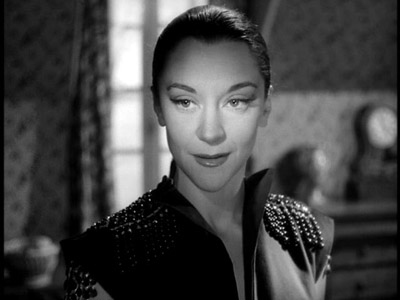 | | Maria Casares as Princess/Death |
And yet twas not always the case. Jean Cocteau relied on cutting edge special effects in Orpheus, his 1950 retelling of the Greek Myth, (and the second such adaptation ALREADY in the Criterion Collection from the 1950s) as well as in Beauty and the Beast (1946). In fact, considering that both were adaptations (1) it seems fair to compare Jean Cocteau to say, a Michael Bay. What exactly is the difference between a special effect driven adaptation of an ancient Greek myth and a special effects driven adaptation of a toy/Saturday morning cartoon. After all, are not Saturday morning cartoons our modern myths? Unlike Black Orpheus, which was a loose adaptation of the myth with no notable underworld sequence, Jean Cocteau delivers the underworld, which, as it turns out, is governed by a kind of administrative tribunal and looks pretty much like the French country side. In this Orpheus, the hero is a pop star of some sort- I imagine him along the same lines as a Serge Gainsbourg. Death is represented by a wealthy Princess (living in suburban Paris in 1950 of course) and her chauffeur, and it is the chauffeur who ferries off Eurydice to the Underworld. Orpheus follows her down and obtains her release after a sort of mini trial, on the condition that he never look at her again. In the original myth, the stipulation is that he not look at her UNTIL HE REACHES the surface, but it's a small difference. I'd like to know how that part of the myth came to be. (2) The two notable features of Orpheus are the special effects and his use of be bop Jazz to score the sequences of mob violence. I'm not sure if he was the first to do that- it may have been the case that American directors had been doing that before 1950, but it seems like a pretty early usage of be bop Jazz in that context. Orpheus was less tedious to watch then Beauty and the Beast- it's a technically more sophisticated production and the pace is business like and not "dreamy." The two films make an interesting contrast. It seems clear from watching both that Beauty and the Beast was a more "shoe string" production, whereas Orpheus is like an "A-list" film from an "A-list" director. NOTES (1) I try to avoid questions of grammar but the adaptation vs. adaption has been haunting me. I think the proper spelling is adaptation though according to this article they are both valid. (2) The non Greek influence on the myth of Orpheus can be seen first, in the fact that Orpheus is from "Thracia" which is an area north and east of the Greek heart land. Second there is the well known Ancient Near Eastern Myth of Inanna an Dumuzi, where Dumuzi (Inanna's husband) rescues her from the Netherworld.
Dead Ringers (1988) d. David Cronenberg (6/24/13)
 | | The Instruments For Operating on Mutant Women from David Cronenberg's 1988 opus Dead Ringers. |
Movie Review Dead Ringers (1988) d. David Cronenberg Criterion Collection #21 I figured out that many of the Criterion Collection titles that are not available for free on Hulu Plus ARE available on Amazon Streaming Video for 2.99 so I'm like "Yeahhhhh." I've been actively trying to watch Dead Ringers since the Netflix revolution, but have been flummoxed. I am heartened that several of Cronenberg's films are available via Amazon streaming video because he's a director where I'd like to say I'd seen all the hits. 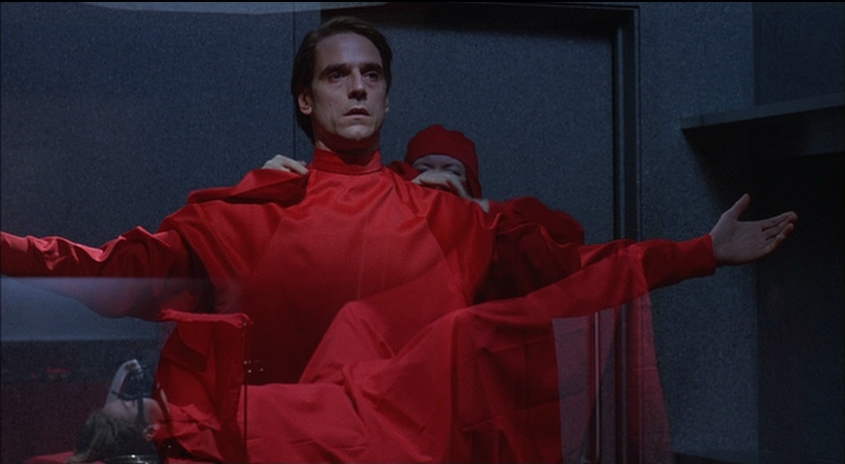 | | Jeremy Irons playing Beverly Mantle right before he goes bananas and tries to use the above Instruments for Operating on Mutant Women on a non mutant woman. |
Dead Ringers was made in 1988. Jeremy Irons turned in his stunning portrayal of accused murdered Claus Von Bulow in Reversal of Fortune the very next year, and it's hard for me to pick which performance is better that one or his role in Dead Ringers as identical twins, Beverly and Elliot Mantle, who are top gynecologists. Basically, Beverly falls for actress Claire Niveau and basically loses his shit, and takes his brother down with him. By "lose his shit" I mean becomes hardcore addicted to drugs, goes crazy and has his own set of macabre and Cronenbergian surgical tools/" Instruments for Operating on Mutant Women" made- and then uses them to ill, ill effect. The not-so-slow decent into insanity by first Beverly and then Elliot and then Beverly and Elliot together is classic Cronenberg and I enjoyed every minute of this classic. If you haven't seen it yet get it on Amazon streaming video for 2.99 WORTH EVERY PENNY. Cleo From 5 to 7(1962) d. Agnes Varda (6/28/13)Movie Review Cleo From 5 to 7(1962) d. Agnes Varda Criterion Collection #73 I'm not a guy who is particularly into the French New Wave. Just because...if you look at the whole universe of art/film, French New Wave is just one thing. There's no reason...to fetishize the French New Wave and Auteur theory. Personally, I think Auteur theory is pretty ridiculous considering how many people work on a typical film. Especially when you consider the number of so-called Auteurs who actually PAY for their films- even the best are usually working for a pay check. But Cleo From 5 to 7 is notable first, because Agnes Varda is a female director and second because the pace is snappy and fresh, and the lead actress, Corinne Marchand playing Cleopatra (or Cleo for short) a Parisian ye-ye girl who is confronting her own mortality while she waits the results of a bopsy for a potentially cancerous tumor. Cleo From 5 to 7 is shot in "real time" complete with title that break the movie into separate scenes of a specific time frame. Cleo hangs out in her pad, goes to a cafe and plays her own song on the jukebox, hangs out with her friend the Artists model, goes to the park, hangs out with a soldier and FIN. But Cleo From 5 to 7 is not dull or boring- and don't tell me that all of Godard's films are actually watchable because THEY AREN'T. Also the character of Cleo the Ye Ye girl is a compelling character- I love when the main character of films are artists.
Collected Criterion Movie Reviews: July-August 2013
When I was in college I took a handful of film classes. Assigned movies would be viewed on video cassette on these tiny 10 inch televisions that my university had installed in a windowless room in the basement of the library. The videos were themselves often in bad shape- it would be another 20 years before I saw Alphaville on a non-scratched up videocassette copy, to give one example. Thus, that first couple of years of streaming seemed like an exciting opportunity to simply view all these great old movies, and that's really what I was doing here, going in numerical order to the best of my ability based on what was available on the Hulu Criterion Collection channel
Vagabond (1985) d. Agnès Varda (7/1/13)
 | | Agnès Varda |
Movie Review Vagabond (1985) d. Agnès Varda Criterion Collection #74 Vagabond is not a "fun" watch. It starts out with the Vagabond in question dead, frozen to death in a ditch so you get to watch the entire movie wondering "is this THE ditch where she dies, or just another ditch that this poor young woman has to trek through in the faceless French landscape. Agnès Varda also directed Cleo From 5 to 7, which was released in 1962 and Vagabond is conclusive prove that Varda did not lose the plot Francis Ford Coppola in the 90s style. Sometimes I watch these Criterion Collection titles and read the accompanying essay at the Criterion Collection site and I'm tempted to simply provide the link and leave it at that because the essay is so good. I wish there was a comparable site for the 1001 Books To Read Before You Die, but of course that series doesn't make critical editions, or editions at all, it's just a list. Varda had a back ground in photojournalism and documentary film when she made Cleo From 5 to 7 and if you look at her IMDB Director credits the documentaries and shorts overwhelm the features. The more titles I watch out of the Criterion Collection, the more I appreciate the revolutionary ramifications of the collaboration between streaming film and the appreciation of the history of cinema. In 2013, we take for granted that all music from all time should be available for free instantly, but when it comes to film that is simply not true. It's certainly not available for free, if it's available at all. The very existence of the Criterion Collection essentially demonstrates the flaws in the existing system for distributing film art, so it's natural that bringing the Criterion Collection to streaming video via Hulu Plus would represent the correction of those flaws. And it does. One of the major reasons I don't like films as much as novels is because the good ones are hard to find and often expensive to watch. Criterion Collection on Hulu Plus solves that, instantly, for eight bucks a month. For me, just trying to sit still and watch reality television with someone is enough to drive me batty. I have to mentally restrain myself from leaving the room. If you're going to suffer through that experience, why not make it a classic movie instead? Bad Girls Club Atlanta and Vagabond: They both make me super uncomfortable, but I feel better at the end of Vagabond.
Sisters (1973) d. Brian De Palma (7/3/13)
 | | This is an example of the split screen technique that Brian De Palma uses in Sisters (1973) to generate narrative tension |
Movie Review Sisters d. Brian De Palma 1973 Criterion Collection #89 Film director Brian De Palma, Auteur? Hollywood Hack? Both? Neither? It's a question which has sorely vexed an entire generation of film critics, but certainly his work during the 1990s, which included Mission Impossible (1993), Snake Eyes (1996) and Mission to Mars (2000) pushed the argument towards the "Hollywood Hack" side of the argument. As someone who essentially formed his taste during that decade, it was hard to square the De Palma of Scarface and Carlito's Ways with the De Palma of MI/Snake Eyes/Mission to Mars. It's not so much that he made those movies, it's that he made those movies with so little passion or flair it was like watching a robot De Palma direct- or not direct, as in the case of Nicolas Cage's lead performance in Snake Eyes. Any auteur who signs up for a Nic Cage action picture set in a Vegas casino is clearly a man who gives exactly no fucks about his critical reputation, so I guess, ultimately, you can't blame him for being involved in a movie that literally embodies every crappy stereotype about Hollywood high concept film making in a single picture.  | | This is what Margot Kidder looked like in 1973 when she was shooting Sisters directed by Brian De Palma. |
I was pleased to watch Sisters (1973), and early pre-Scarface film that brought him to the attention of the mass audience in America. Sisters saw a Quebec-ois accent sporting Margot Kidder as Model/Actress/Recovering Siamese Twin Danielle Breton. When a one night stand she picks up is murdered in her apartment, Danielle, her creepy ex-husband Emil (played by Bill Finley) and local Staten Island investigative newspaper journalist Grace Collier are swept into a psychic horror show. To describe much more would ruin the "twist"- and I do recommend this film to watch. It is easy to see the directorial techniques that brought De Palma to wider attention after this film. Particularly, he uses the split screen to simultaneously show actions taking place in two different places at the same time. This serves to compress the run time and heightens the tension relative to the standard technique of cutting between the two locations in alternating takes.  | | Margot Kidder as erstwhile Siamese twin Danielle Breton in Sisters (1973), directed by Brian De Palma. |
Also notable is the score by frequent Hitchcock collaborator Bernard Herrmann. It's a nice touch that adds some depth to the flat Staten Island location shots. Finally, Sisters goes totally off the rails in the last 1/3rd of the film and it is worth sticking around to that point just to see De Palma go bonkers.
Movie Review: The Harder They Come (1973) d. Perry Henzell (7/10/13)
Movie Review: The Harder They Come (1973) d. Perry Henzell Criterion Collection #83 The Harder They Come is one of those works of art where the concept/identity of the work is better then the reality of the work itself. You get that situation a lot when a mediocre movie has a kick-ass sound track, or kick-ass cinematography or whatever. People associate the film with the best part of the film, even though the film as an over-all work isn't particularly note worthy. Reggae star Jimmy Cliff plays Ivan, a country boy who moves to the city to find work, has trouble finding work, cuts a reggae hit, then gets mixed up with a drug gang during a period of the film where I literally couldn't understand what was going on, then gets killed at the end and becomes a Robin Hood style folk hero. Most of the movie is set in the pungent slums of Kingston Jamaica, and this gives The Harder They Come an almost documentary feel. There is one scene before Ivan really gets going where he is kind of hanging around a dump and there is this long tracking shot where you see scavengers and children playing in the garbage and it's particularly moving. Not until the final shoot out practically does the film leave the city for the country, and by then the country feels like a one-off location shot. Production values are low all around, and the actors are either non-actors or (certainly) local actors- although putatively in English you need to strain to hear the actual lines in the film. I'm not even talking about the accents, I'm talking about the sound quality of the recording.
The Blob (1958) d. Irwin S. Yeaworth Jr. (7/12/13)
 | | Steve McQueen in the Blob directed by Irwin S. Yeaworth Jr. |
Movie Review The Blob d. Irwin S. Yeaworth Jr. 1958 Criterion Collection #91 It's hard to really get into a groove with the Criterion Collection because the numerical sequence on the spine has no relationship to chronology, or really to anything, it just represents the order in which the films were released. One aspect of the Criterion Collection is clearly to provide a solid DVD release for titles which haven't already gotten one. Thus, the early part of the collection (1-100) is filled with older foreign movies and more recent American movies that are almost uniformly what you call "cult classics." One attribute of the Criterion Collection that I infer from the selection of titles available on Hulu Plus is that Criterion obtains different rights for different titles. I get the sense for the more well distributed titles in the Criterion Collection that they only have the right to make the DVD- no permission to stream on line. On the other hand for the more poorly distributed films they "own" the movie- and can do whatever they want. The Blob stars an unknown Steve McQueen as the hero- a borderline "delinquent" teen (in the tradition of James Dean in Rebel Without a Cause, and by "in the tradition" I mean "direct copy of the performance of;") who is the only one who believes that their sleepy town is being terrorized by a gelatinous, slow moving Blob. As the description over at the Criterion Collection helpfully points out: Strong performances and ingenious special effects help The Blob transcend the schlock sci-fi and youth delinquency genres from which it originates. For me, the real joy is in how The Blob features as a cross over between sci fi and the "youth delinquency genre." Were it not for the Criterion Collection, I never would have known the pleasures of this film.
Kwaidan (1965) d. Masaki Kobayashi (7/15/13)
 | | Still from Kwaidan, this shows the Woman in White and the woodcutter |
Kwaidan (1965) d. Masaki Kobayashi Criterion Collection #90 This film is a compilation of four traditional Japanese ghost stories adapted for the big screen. The source material are the writings of Lafcadio Hearn, a folklorist of Greek-Irish ancestry who emigrated to the United States and then moved to Japan n 1869. There he adopted a Japanese name and became a citizen. Each of the four tales centers around ghostly visitations. The first story "The Black Hair" is about a Samurai who leaves his wife in Kyoto because he can't make ends meet. His second wife is a wealthy noblewoman, but he tires of her and returns to Kyoto where he experiences a full reconciliation with wife number one only to find upon waking up the next morning that she is a corpse. The second episode, "The Woman In White" concerns a hunter who sees a ghostly woman take the spirit of his friend when they are marrooned in the wilderness during a snow storm. The spirit spares his life but makes him promise never to tell anyone about his experience. Ten years later, he is happily married with three kids, when he tells his wife the story after thinking that she resembles the Woman in White. As it turns out, he's married to the Woman in White and she is pissed off that he broke his promise. Hoichi the earless is about a talented blind musician who lives in a monastery. One night he is visited by a spirit who summons him to serenade the spirits of a deceased royal lineage, in a grave yard. When the temple priest finds out they explain that he needs to resist their calls the next time the spirit shows up, and they inscribe him with sacred text to make him invisible to the spirit...only they forgot the ears. You can guess the rest. Although the narrative is not particularly moving, the director uses color like a painter, and it is hard not to stop the film just to appreciate the cinematography as one would a painting in a museum. Unfortunately, Kwaidan is almost three hours long and it is a slow, slow, slow three hours. I'm not saying I didn't appreciate it the film, but it took me three days to finish it up- watching one hour a day. The Criterion Collection has already been a brief education in Japanese cinema with literally dozens of films left to go. I can't say that I've ever been interested in the subject of Japanese cinema but it appears that the Criterion Collection has decided that yes, I am interested in Japanese cinema.
Samurai I: Musashi Miyamoto (1954) d. Hiroshi Inagaki (7/19/13)
 | | Toshiro Mifune in Samurai I: Musashi Miyamoto (1954) |
Samurai I: Musashi Miyamoto (1954) d. Hiroshi Inagaki Volume One of the Samurai Trilogy Spine #14 As I mentioned the other day it's a mistake to think of streaming video as some kind of monolithic, unchanging edifice. Not last month I wanted to watch Samurai I: Murashi Miyamoto because it has a low spine number and I was thwarted. I went so far as to go to Amazon Instant Video and put it on my to watch list- but it would have cost four bucks. Then, in early July Hulu Plus updates the Criterion Interface and blammo- there is Samurai I: Murashi Miyamoto, staring me smack in the face. It really makes me think I should watch all the Hulu Plus Crtierion Collection Titles with low spine numbers- there is something about the first 100 of any collection of titles that really sets the tone for the future. Soooo yeah... never thought I'd be one of those guys who watched Samurai movies but here I am. The notable aspects of the Samurai trilogy are one) they are star making performances for Toshiro Mifune who is "the man" of 50s and 60s Samurai pictures and two) Musashi Miyamoto was a real dude who wrote a read-until-today book of Zen buddhist philosophy and military strategy. Chapter 1 is about his awakening, during the film he is transformed from a wild eyed bandit to a zen buddhist master samurai thanks to the helpful guidance of a Buddhist monk, who does helpful things like hanging him from a tree for a week and locking him a prison cell with a library of books for three years. But at the end he walks out enlightened, so it is all worth it. The depth of the spiritual awakening experienced by Miyamoto belies any facile "the Samurai movie is a Western" comparisons.
Samurai II: Duel at Ichijoji Temple (1955) d. Hiroshi Inagaki (7/22/13)
 | | Kaoru Yachigusa as Otsu |
Samurai II: Duel at Ichijoji Temple (1955) d. Hiroshi Inagaki Criterion Collection #15 Yeah so there is a wikipedia entry for " Samurai cinema." The Samurai trilogy by Hiroshi Inagaki was a critical part of the initial break out of the 1950s (despite the fact that Samurai films date back to 1925.) The three films of the Samurai trilogy were 54, 55 and 56. Kurosawa did Rashoman in 1950, Seven Samurai in 1954, and the Hidden Fortress in 1958. That is quite a run. Toshiro Mifune starred as the main character both in Inagaki's Samurai trilogy and most (all?) of Kurosawa's Samurai films. The films of the Samurai trilogy are perhaps not as sophisticated as Kurosawa's, but perhaps it is precisely their conventionality that is the key to their long term value. Here we are looking at Samurai films that were hugely influential and successful in Japan itself- with everyone- not just film fanatics. The Samurai trilogy were not brought to the United States until a decade plus later, so Inagaki has nothing on Kurosawa in America. Episode two of the trilogy finds Musashi Miyamoto as the noted Samurai, juggling the affections of two women: Otsu and Akemi and also trying to best Seijuro Yoshioka and meeting his legendary rival Sasaki Kojiro (who is the focus of the third and concluding film.) So yeah, sword fights, posturing, women being treated with very little respect and tons and tons and tons of kimonos. Is there a different word in Japanese for kimono when a dude is wearing one? Because these dudes are wearing kimono. Another fun fact about this time period is that the Japanese used small blocks of wood as their pillows. Yes, they slept on small wooden blocks. The more you know.
The 400 Blows (1959) d. François Truffaut (7/26/13)
Movie Review The 400 Blows (1959) d. François Truffaut Criterion Collection #5 The story I heard about the origin of The 400 Blows by François Truffaut is that Truffaut was a critic writing for the Parisian film criticism journal Cahiers du Cinema in the 1950s, when a film maker essentially challenged him in print by saying, "If you are so smart, why don't you make a movie." And Truffaut made The 400 Blows in response, which many argue is the greatest movie of all time. That's enough to make you the top Artist/Critic cross-over of all time, especially if you include the fact that as a critic, Truffaut was part of the highly influential avant garde French New Wave, and then he became a leading film maker in the movement which followed the criticism... that he wrote. Godard and Truffaut play an out-size role in the minds of 21st century avant gardes of all nations because they worked in the international medium of film. The 400 Blows may require sub-titles for a non French teacher, but the cutting edge grammar/composition requires no translation, and The 400 Blows remains as fresh and dynamic today as it must have been in 1959. The 400 Blows is the first in a series of films Truffaut made about Antoine Doniel, played here by Jean Pierre Leaud. Doniel would serve as Truffaut's filmic alter ego, and he figured prominently in a whole series of films which reportedly were inspired by Truffaut's actual life story. In The 400 Blows it is Doniel as a child, going to school, embarking on a life of petty crime and eventually getting sent away to juvie and having his Mom tell him that she does't love him anymore. Although the subject matter is heavy, the film itself is anything but; Truffaut dazzles with a variety of techniques that give eternal life to his story of a hard knock youth. It is no wonder that The 400 Blows has such a low spine number within the Criterion Collection. Indeed, one could say that The 400 Blows is a central reason why the Criterion Collection exists in the first place.
The Seventh Seal (1957) d. Ingmar Bergman (7/29/13)
Movie Review The Seventh Seal (1957) d. Ingmar Bergman Criterion Collection #11 Finally, a Criterion Collection title streaming on Hulu Plus that comes with one the featurettes that are a hallmark of the Criterion Collection. The extra is an afterword by Bergman expert Peter Cowie- about ten minutes long. The Seventh Seal is one of those titles without which the Criterion Collection itself likely wouldn't exist. Like The 400 Blows, The Seventh Seal helped to create the Audience for Art House Cinema in the United States. The idea of the a knight playing chess with death on a beach has been so deeply disseminated in American popular culture that I would bet there are tons of people who would be able to recognize that image and not know from whence it came. This chess match opens the movie and throughout we see the Antonious Block (Max Von Sydow) dueling with Death on the chess board during quiet moments during his journey homeward. Cowie's video afterword notes that within Sweden Bergman was not as popular as he was outside Sweden because Swedes could actually understand the dialogue, and the dialogue was terrible. Watching The Seventh Seal for the third or fourth time I tried to listen to the Swedish language dialogue to see I could hear what Cowie was talking about, but of course, I couldn't. Bergman is often stereotyped as being pretentious and dull but there is plenty going on in the Seventh Seal to keep the viewer interested. In fact, I'd rather watch a Bergman films then a Fellini any day. There, I said it.
Häxan (1922) d. Benjamin Christensen (8/2/13)
Movie Review Häxan (1922) d. Benjamin Christensen Criterion Collection #134 Häxan is a Danish film about witches and witch-craft, written with the idea of exposing the ridiculousness of medieval beliefs about witches. While watching this movie I was thinking that it was made less then 30 years after 1895- which is where I'm at in the history of the Novel. In other words, if Häxan was made in 2013, twenty seven years ago it would have been 1986. I think it is fair to say that everyone recognizes the influence that Art in the 1980s has on Art today, so there surely was a similar relationship between Novels of the late 19th century and the developing medium of film. Häxan is interesting because it is more of a "documentary" then a narrative film, and the documentary is something that film essentially brought into literature as a separate art form. Of course, non fiction books dwarf fiction/literature, but they have not been historically considered art/literature. Documentary film, on the other hand, has an artistic status separate and apart from the narrative film, and is recognized as a distinct kind of film literature. Häxan is also interesting because it deals with witches and witch craft. Christensen uses actual illustrations from actual medieval texts that strike pretty close to the pagan roots of witchcraft related beliefs. Of course, in the 1920s, you couldn't talk about witches without talking about the devil, but it is clear today that witch type believes pre-dated Christianity and were hold overs from the Indo-European/pre Christian era. If you consider the "Witches Sabbath" a corner-stone ritual of witch craft trials in the Middle Europes, the description is basically a Dionysian revel of the type common to pre Christian culture with a Satanic spin thrown on top. That connection is made very clear by the narrative portions of Häxan, where Christensen actually shoots a witches sabbath complete with a guy dressed up as the Devil. My take away from Häxan was simply to reinforce how utterly ridiculous religion and religious beliefs are at a basic level, and at how much harm they can do to vulnerable parts of the population. Witches tended to be old, poor, marginalized women who had little or no voice in society. They were inevitably easy targets, and almost by definition had no one to speak up for them. It is a sad chapter in history, though an interesting one, particularly if you focus on the links to pre-Christian/pan Indo European religious rituals.
Ivan the Terrible part 1 (1944) d. Sergei Eisenstein (8/7/13)
.JPG) | | This still from Ivan the Terrible part 1 is a good example of the excellent use of shadow and general influence of German Expressionist films on Eisenstein |
Ivan the Terrible part 1 1944 d. Sergei Eisenstein Criterion Collection #86Box Set, Eisentstein the Sound Years Russia is an interesting place. I can't think of another place that has played such an outsize role in the cultural history of the West without developing into a Western market for Art products. Russia is like a weird bizarro culture that has absorbed all the lessons of Western Art and Culture without becoming the west at all. Even if you compare Russia to Japan- the other major non-Western representative in the World Film Canon, they lag. For many cultural products Japan is the number three or even number two market, Russia is barely top 20. I think that's what makes Russian art so interesting. 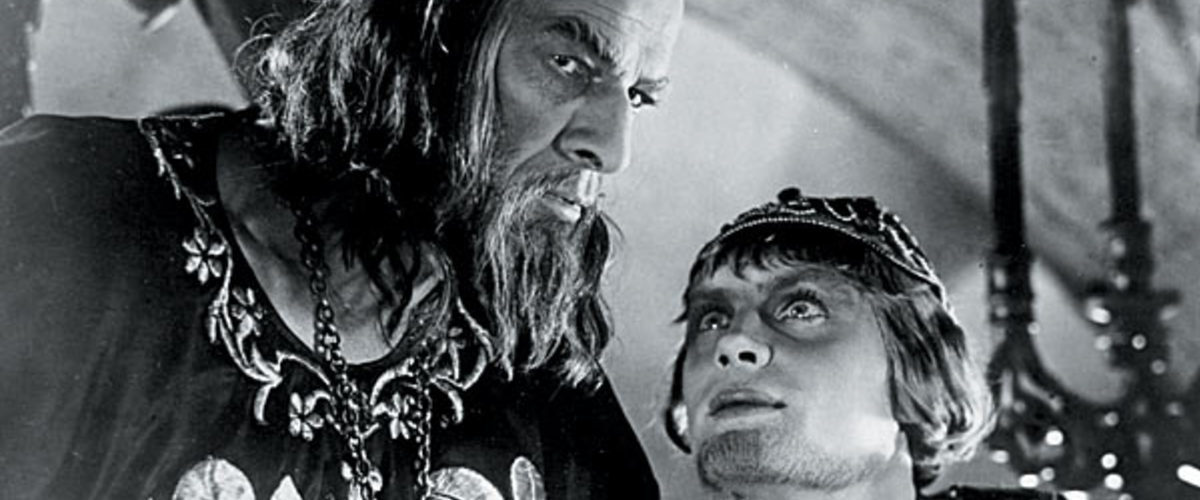 | | Ivan the Terrible with his rival/vassal, the idiot Prince Vladimir |
Take Ivan the Terrible part 1. Russian filmmaker Sergei Eisenstein is best known for his work in the silent era, where he helped to introduce the basics of film editing and grammar to the entire world. In 1944 he was currying favor with dictator/genocidinaire Josef Stalin. Stalin was a huge fan of Ivan the Terrible, and this film is clearly made with a Stalin pleasing agenda. Specifically, the meat of Part 1 concerns Ivan the Terrible's struggle to unify Russia over the opposition of the Boyars. Bear in mind that Stalin had the analogous class in Soviet Russia brutally murdered- all of them- they were called the Kulaks. Thus, watching Ivan the Terrible is probably similar to a viewing of Leni Rifenstahl's Triumph of the Will: A good time at the movies, but raises uncomfortable questions about the intersection of film and totalitarianism. After all, if you look at the great Dictators of the 20th century: Stalin, Hitler, Mussolini- they all had a deep understanding and appreciation for the power of Cinema in modern life, but they were hardly going around promoting different novelists etc. Movies are more powerful because you don't need to read to appreciate a movie- assuming that the technology has been disseminated, the Audience for film is essentially everyone vs. for a novel it's everyone who can read. Leaving aside the queasy making moral implications, Ivan the Terrible is a watchable film despite the mid 1940s creation date. Part of this comes from Eisenstein's skill as a film maker- though his style seems closer the the German Expressionist films of Fritz Lang and FW Murnau then those of his early avant garde/silent period. Eisentstein's use of shadows on the set really stand out in my mind. I should probably reveal at this point at least one of the other blogs that has attempted this same feat of watching all the Criterion Collection titles- the Criterion Contraption- authored by Matthew Dessem- did really thorough work on 1-118 before abandoning work in 2012 (probably got married? had a kid? realized the utter futility of existence in a meaningless world?) But his write ups are super duper thorough and contain a ton of stills- and his entry on this movie is worth a look because he shows all the different set ups that Eisentstein uses- they are quite striking. He talks so much about the movie though it makes me feel like I don't need to watch the movie itself. Ivan the Terrible part 2 (1958) d. Sergei Eisenstein (8/9/13)
Movie Review Ivan the Terrible, Part II (1958) d. Sergei Eisenstein Criterion Collection #88 A huge percentage of education is text selection and guided reading. Any traditional educational scenario involves drastic time constraints, requiring a maximum of attention focusing on the selected texts- whatever they may be. As long as those texts remained primarily in book or paper copied format that represented a huge bottleneck in the path between individuals and education. The nexus of teachers and texts in the field of education is something much darker and deeper then the analogous role that a major label plays in music or a Hollywood studio plays in film.
This didn't use to be the case. Education was fairly dispersed among the population until the growth of the State Research University model that became popular in the mid 20th century. That the American state research university is fundamentally opposed to the diminution of their monopolist role in education is simple to demonstrate- why don't you try taking a look at the pan-Academic JSTOR database? There is nothing free on JSTOR. That hacker, Aaaron Swartz who killed himself after being prosecuted in federal court in Massachusetts? His theft was of these articles- and he was prosecuted by the database. Thus it behooves interested individuals to be interested in the liberation of foundational educational texts whatever the field of learning. In the area of Literature, those texts are now available for free or close to it because of the long history of bringing those works to the market place in new formats created by advances in technology. I would argue that Hulu Plus/Criterion Collection collaboration is perhaps the most far reaching source for a specific area of education (literature/film studies), perhaps followed by the Gutenberg E Book project- or Gutenberg is first and Hulu Plus/Criterion is second. Ivan the Terrible part 2 is a fine, fine example of what this collaboration brings to the table. Here we have a film that was commissioned by Josef Stalin, and shot by Sergei Eisentstein. It was suppressed in Russia and didn't see the light of day until the end of the 1950s. Because of the dramatic Cold War/Dictator glorifying nature of Ivan the Terrible parts 1 & 2, reception in the West was always going to be a dicey affair. So, the Criterion Collection/Hulu Plus arrangement began in February of 2011. Then at some point, probably not on day one, Ivan the Terrible, part 2 was uploaded. Let's say mid 2012. Before that moment, you could buy it on DVD or maybe see it in a film school somewhere if you took a course in Russian Cinema (and good luck with that, dear sir.) The DVD was 30 bucks, and it was rare for video stores to carry even a single Criterion Collection title- remember the Criterion Collection section at Blockbuster? No? I would have never paid 30 bucks- let alone 60 for both- to watch these films, but now I'm so glad I did because in Part 2, Eisenstein dramatically switches from black and white to color and there is this the fucking bonkers dance scene- it's about 55 minutes into this Youtube video, and all of a sudden you realize why everyone compares this movie to a Disney movie. Ha! Win! I like, sat up on my couch when this happened- I had no idea- so great.
Pygmalion (1938) d. Anthony Asquith and Leslie Howard (8/12/13)
Pygmalion (1938) d. Anthony Asquith and Leslie Howard Criterion Collection #85 Yet another thoroughly enjoyable film I would have never, ever watched without the Criterion Collection on Hulu Plus. This play by George Bernard Shaw is better known in America under the name My Fair Lady- which starred Audrey Hepburn as the woman/project at the heart of the film. However, this version was actually written by George Bernard Shaw himself and shows it. The dialogue is sparkling- standing up to 80 years of subsequent film comedy. The idea at the center of Pygmalion: that anyone can be trained to "pass" as something they are not, is a deep subject and one that continues to be relevant today. In this version, there is no dilution of Professor Henry Higgens' aggressive intellectualism. He is a fervent apostle for the know-it-all style of early 20th century science- the attitude that intellectuals had before two World Wars shook their faith in the ability of humans to accomplish anything they wanted. Eliza Doolittle, here played by Wendy Hiller is a Cockney flower girl from Covent Garden who Higgens takes under his wing to win a bet with noted Sanskrit expert Colonel Pickering.
For me, it was Doolittle's initial cockney accent that was worth preserving- it is a true cinematic classic, like the voices I used to do with my ex wife when we wanted to poke fun at something unapologetically English. As Henry Higgens, Leslie Howard is fantastic, he is an arrogant prick to be sure, but he's an arrogant prick who doesn't give a fuck about making waves in English society and that is a winning trait.
Pre World War II English cinema is terra incognita on my cultural map and it is one of the areas where Criterion Collection is active.Pygmalion was very rewarding and easy to watch- it is recommended. L'Avventura (1960) d. Michelangelo Antonioni (8/14/13)
L'Avventura (1960) d. Michelangelo Antonioni Criterion Collection #98 I think it is pretty commonly accepted that there is a well trodden path between the avant garde and canonical status in the world of Art. Today's fringe Artist is tomorrow's Artist selling a work of art for twenty million dollars is next year's Artist being studied by students in school. The other main path to an Artistic canon is having a huge Audience for a specific work and then either initially generating or later generating critical acclaim to accompany the popularity. Two main routes. L'Avventura is an interesting case of Audience reception of a work that begins as Avant Garde and ends up Canonized. Initially shown at Canned in 1960, the Audience booed and the Director and Star (Monica Vitti, va va va vooooom.) stormed out of the theater. Then, as the story goes, the film was shown a second time and ended up winning the special jury prize. Watching L'Avventura today is like seeing what a half century of commercial art directors undoubtedly list as their favorite film. Antonioni's sneaky assault of the grammar of film making up to that point caught the Audience- even a highly educated audience like the one at Cannes, off guard, and it maintains that ability to discomfort till today. I had a rough time sitting through the whole film, though there were moments of beauty and of course Monica Vitti lights up the screen every time she does anything. On the whole though I would argue that L'Avventura is a dark path for film: characters standing around, gazing into the sea. It's boring...on purpose, and that is a troubling development. Worth seeing for Monica Vitti though.
Cries and Whispers (1972) d. Ingmar Bergman (8/16/13)
 | | Liv Ullmann is smoking hot in Cries and Whispers (1972) d. Ingmar Bergman |
Cries and Whispers (1972) d. Ingmar Bergman Criterion Collection #101 Couple of things I'm figuring out via the Criterion Collection. First, if you want to break an art house picture in the US between 1960 and 1970 it helps if you cast a bombshell female in a leading role. In L'Avventura it was Monica Vitti, here you've got Liv Ullmann looking divine. God damn she is fine. I could watch an hour and a half of her face. Second, Ingmar Bergman makes watchable movies. I enjoyed watching Cries and Whispers more then I enjoyed, say, Seven Samurai. Cries and Whispers, in particular, resonated with me. Filmed in color- for once- Cries and Whispers is known and Bergman's most financially successful film. It was also nominated for an Academy Award, oh and it features self mutilation of female genitalia decades before Lars Van Trier did it in Antichrist. The plot of Cries & Whispers is minimal: Three sisters are together in an opulent house in the 19th century, two of them watching the third die a slow, painful death. During the film the two watchful sisters are tormented by memories of the past- including the scene shocking self mutilation of female genitalia. After the third sister dies she returns to life for a spooky coda that leaves the other two sisters wondering, "Hey, what the fuck is going on here?" Clocking in at 93 minutes it's eminently watchable and Bergman's use of color film-specifically his use of the color red- should remind contemporary viewers of the way David Lynch used the same color in Twin Peaks.
The Big City (1963)d. Satyajit Ray (8/19/13)
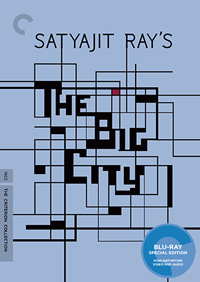 | The Big City d. Satyajit Ray is out 8/20/13 in Criterion Collection edition.
Movie Review The Big City (1963) d. Satyajit Ray Criterion Collection #668Out August 20th, 2013 Major epiphany this weekend when I realized I was going in the wrong direction vis a vis the Criterion Collection Spine numbers. Obviously, there is more interest in the new releases vs. the back catalog DUH. The Big City is actually coming out today, so this is literally a "new release" review. Of course, it's not a review of the Blu Ray DVD since I watched it on the Criterion Channel on Hulu Plus, but surely the day of the release of the Criterion Collection edition is the proper time for a blog post on the film itself. Also being released today is another Satyajit Ray film, Charulata (1964.) I don't think I'm being controversial by saying that Ray is by far the most famous Indian film maker outside of India. Personally, I couldn't name another even though I have an above average level of knowledge about the history and cultures of India. Something specifically Indian to understand about Ray is his Bengali ethnicity. India is a majority Hindu speaking country. Bengali is a separate language, different then Hindu, and speakers are concentrated in Eastern India and Bangladesh. In Bangladesh Bengali is THE language and Bengalis are the absolute majority. Within India Bengali is the majority language in the state of West Bengal but is a minority language in the rest of India. So the fact that the language of Ray's films is Bengali and Hindi is significant, somewhat analogous to a Quebecois film maker making a movie in French, or a Mexican-American film maker making a film in Spanish. The use of language in The Big City is worth pulling out of what is essentially an interesting but conventional "Woman in the work place" melodrama that grapples with issues familiar to any viewer of American movies and television of the 50s and 60s. First of all, the characters themselves speak Bengali but will switch into and out of English when they want to use a phrase that is specific to the English language, "This is none of my business but...." for example.  | | Arati Mazumdar (the first role of Bollywood leading lady Madhabi Mukherjee) |
One of the co-workers of the female star of the film, Arati Mazumdar (the first role of Bollywood leading lady Madhabi Mukherjee) is an Anglo-Indian, which is an actual ethnicity in India, the children of relationships between British workers (often Scottish and Irish industrial workers) and Indians. These Anglo-Indians were citizens of India, but spoke English as their first language- despite having no history in England or outside of India. They were not typically "Upper Class" since the parentage often stemmed from working class relationships. In The Big City, the Anglo Indian character is named Edith, and she speaks to Arati in English, and Arati answers in Bengali. In one scene, Arati goes to Edith's apartment and meets her Mother, and Anglo looking woman who speaks her English with a heavy and distinct "Indian" accent. It is Arati's defense of this Anglo-Indian friend that cues the ultimate resolution at the end of the film, so the appearance is hardly a throw-away. Ray was supposedly inspired to take up Film after seeing the Italian neo-realist film The Bicycle Thief on a visit to London, so it is no surprise that The Big City has a distinctly realist feel. There's none of the cartoonish song and dance routines that exist in the minds of Westerners as a Bollywood stereotype. That being said, I actually lived with a guy from India who was from West Bengal and he endlessly watched Bollywood films and they were all of the song and dance variety- he didn't have any Ray films. The Criterion Collection description of the new release says that the English subtitles are new to this edition. I would argue that it is the use of language by Ray in this film that is the most interesting aspect. That, and the performance of Mukherjee who fairly sparkles with her expressive face and mannerisms. In almost every scene I found myself thinking that she was really nailing the complicated role.
Charulata (1964) d. Satyajit Ray (8/21/13)
 | | Madhabi Mukherjee, screen goddess of India |
Movie Review Charulata (1964) d. Satyajit Ray Criterion Collection #669Release Date: August 20th, 2013 This is the second of two Satyajit Ray classics that Criterion Collection is releasing this week. The other film is The Big City, which was released in 1963. Where The Big City was a film about a contemporary issue, "women in the workplace;" Charulata is a period piece set in the 1870s. Shailen Mukherjee plays Bhupati, a wealthy, liberal newspaper owner who is obsessed with politics. Madhabi Mukherjee plays his bored wife. the Charulata of the title. If this were a Western film you would expect adultery to ensue, but this Indian film in released in 1964 is about as tame as you would expect from a hypothetical movie shot in the 1850s. The plot of Charulata revolves around the heroine's efforts to free her soul from the monotony of existence by writing. It's impossible to understand Charulata without at least knowing that the Bengali Renaissance was a spiritual/political/artistic movement that swept Bengal in the 19th century, that the film maker, Satyajit Ray, was from a family that was part of this movement, and that the characters in Charulata also represent individuals from this movement. Like The Big City, the Bengali-ness of the film is obviously a topic near and dear to the heart of Satyajit Ray. At the same time Ray's subtle, neo-realism influenced style belies the national/ethnic emphasis and creates something that is more universal. Other then the language spoken by the characters, Charulata has a plot that wouldn't be out of place in an English Victorian novel from the 19th century. Charulata has a gentle touch and has none of the edginess or existentialist influence that characterize so much of Auteur type cinema from the the mid to late 20th century, but at the same time it is impossible to deny Ray his well earned Auteur status. Despite the clunky, retro plot I found myself transfixed by Charulata in much the same way I was transfixed by The Big City. There is something about seeing Indian society so well described that I find it impossible to look away. I just want to drink it all in.
Cronos (1993) d. Guillermo del Toro (8/30/13)
Movie Review Cronos (1993) d. Guillermo del Toro Criterion Collection #551Uploaded to Criterion Collection Hulu Streaming on August 26th, 2013. One of the many cool things about Criterion Collection/Hulu Plus is that they pop a new movie up every single day. Not all of them are Criterion Collection titles proper, but every so often you get a big score. Such was the case earlier this week when Guillermo del Toro's first feature, Cronos, went up- along with multiple of the DVD extras. It's clear to me now that one of the things Criterion Collection does is advocate on behalf of some directors who are arguably Auteurs. They are clearly all in on Guillermo del Toro, having now given two of his films the Criterion Collection treatment. The other film is The Devil's Backbone. That films recent release was probably the impetus for Cronos being uploaded this week. If you watch the included DVD extras, you can see the case being made for del Toro as an Auteur. Particularly compelling in that regard is the included interview with Director of Photography Guillermo Navarro, who describes the young del Toro as having "everything ready to go" before production even started. He also discusses how del Toro, working in Guadalajara Mexico, designed his own special effects because there was no one else to do it. I've been a del Toro fan from the drop. I remember watching a regular old VHS version of Cronos back in the 1990s, and I positively leapt at the chance to interview del Toro when he was doing press for the regrettable flop Mimic (starring Mira Sorvino!) Of course, it was Pan's Labyrinth (2006) that really brought him to the attention of the Hollywood elite and then there are a handful of mass market films: Blade II, Hellboy I and II and Pacific Rim from this summer. In his own interview that is included in the Hulu Plus stream package, del Toro discusses how all of the themes from his later work are present in his first feature, and how that's how he wanted it to be- to have everything from his universe present in the first film. Particularly germane to his later success is his connection to the dark side of a fairy tale- how a child can be a part of a dark story (Cronos is about Vampires) and still infuse the proceedings with a gentleness that belies the subject matter. He also discusses how Updated 3/23 I missed several of these films from this period the first time through, but it isn't worth making a whole new post. I extended the range back to July of 2013. I would have started driving back and forth to Los Angeles in September of 2013. Collected Criterion Movie Reviews: July-Dec 2013 By October of 2013 I was already driving up to spends weekends in Los Angeles, and I had less time to watch Criterion Collection movies at home in San Diego. Most of the available movies were foreign- lots of Japanese films from the 1950's and 1960s, and lots of Italian films from the 1950's.

Published 5/23/13
The Naked Kiss (1964)
d. Samuel Fuller
Criterion Collection #18
Wow so the Criterion Collection on Hulu Plus is really showing me how g-d- ignorant I am about film as an art form. Really though I blame the distribution system for movies, which is not well adapted to the internet age. I guess before last night I might have been able to identify Samuel Fuller as a film maker but I'd never seen one of his films and wouldn't be able to name any. Fuller made B-movies but with a certain panache and identifiable stlyle that led to his identification as an auteur by French film critics in the 60s. His peak is generally regarded to be the two Fuller movies that are part of the Criterion Collection: The Naked Kiss and Shock Corridor.
The Naked Kiss is a weird wacky combination of noir and melodrama with a healthy side order of pedophilia. The pedophilia angle is what gives The Naked Kiss, which is, prior to the emergence of the pedophilia angle, a standard issue prostitute with a heart of gold type narrative.
Aspects of The Naked Kiss which stand out to a casual viewer are the cinemtography by Stanley Cortez (who shot the Magnificent Ambersons for Orson Welles) and the lead performance from Constance Garnett as Kelly, who comes across as as a uniquely "Fuller-esque" heroine.
Published 7/5/13
And God Created Woman
d. Roger Vadim
1956
Criterion Collection #77 It's funny how films and novels are both treated with the same level of respect by critics because, let's face it, any moron can watch a movie- even a really hard to understand movie- whereas that same person is roughly one thousand times less likely to read a 400 page 19th century novel. There's just no comparison. Really, you should watch a movie twice through to give it something close to the same weight as a novel. And God Created Woman is the first Criterion Collection title where it's a performance that drives the release. Here, it is Brigitte Bardot as the scandalous orphan Juliette. This film was a smash international hit and introduced Bardot to a global audience (although it was her 33rd film.) Truly, it is one of the most eye popping performances by an actress you are ever likely to see. And to think that this film was released in 1956. YOWZA. She must have blown minds in the USA. One reason that And God Created Woman is NOT in the Criterion Collection is director Roger Vadim. He is strictly a one hit wonder from the perspective of the Criterion Collection- he has zero other films in the Collection- Barabrella, anyone? No? Not sure what happened with him. He sounds like a monster according to the accompanying Criterion Collection critical essay by Chuck Stephens.
Published 8/28/13
Marketa Lazarová (1967)
d. František Vlácil
Criterion Collection #661
Criterion Collection edition released June 18th, 2013 In Portland the week Marketa Lazarová was released by the Criterion Collection (fathers day), I went to the Art Museum and perused their events circular. I was surprised to see that the film division was featuring films from the Czech republic. Prior to reading that circular, I was arguably unaware that such a thing as "Czech film" even existed. Sure, I might have been able to identify Milos Forman as a Czech film film maker, but beyond that? No way. Independent of learning about the existence of Czech cinema from a random circular at the Portland Art Museum, I've actually begun to watch the films on Criterion Collection Hulu Plus. First there was Closely Watched Trains, which is a kind of Czech take on a 400 Blows style French new wave coming of age film. Now there is Marketa Lazarová which is as different from Closely Watched Trains as Andrei Rublev is from When Cranes Fly (Woop Woop Russian Cinema Reference!) Marketa Lazarová is a sprawling medieval epic, a kind of Czech cowboys-and-indians saga set in the early Middle Ages before Christianity had really taken the Western Slavs by the throat. The conflict in Marketa Lazarová is between Pagan Czech Robber Barons and the German backed King (represented by his envoy, Captain Beer.) There is a ton of back story to this film- it's adapted from a Novel written by Vladislav Vančura, a Czech author who is interesting in his own right as a main mover in the Czech modernist art world. The Novel is a most peculiar beast, a kind of modern take on Epic literature with a wry sense of self awareness. Apparently, the source material is humorous/sardonic, but that sense of humor is lacking from the film, which comes across as very straight. In addition to the voluminous back story, Marketa Lazarova has technical aspects that lend it an otherworldly field beyond the strangeness that a medieval Czech epic about a conflict between Pagans and Christians naturally evokes. For one thing, the vocals are both dubbed and echoed- something I've never seen in a film before. The characters practically speak with reverb. A strange, strange creative choice but hard to say it doesn't work. The whole movie is a gd magical experience. I would consider buying the DVD itself if I owned a blu ray DVD player which I don't.
Collected Criterion Reviews: September 2013
Closely Watched Trains (1966) d. Jiří Menzel (9/1/13) Movie Review
Closely Watched Trains (1966)
d. Jiří Menzel
Criterion Collection #131
Closely Watched Trains reminded me of a Truffaut film crossed with an early/mid period Woody Allen film. In other words it is delightful. Closely Watched Trains takes place in occupied Czech Republic during World War II. Milos Hrma is a sexually frustrated assistant station agent at the local train station. He is buddies with the wily dispatcher Hubicka, and they are both under the thumb of crotchedy Station Master Lanska.
Milos begins a relationship with the fetching young Conductor(ess?) Masa, but when he suffers an embarrassing set back in the boudoir he tries to take his own life. I know, it sounds heavy, but everything is done with a light touch and there is plenty of humor.
Closely Watched Trains is a testament to the existence of a Czech sense humor, which puts them one up on the Germans. Does anyone have a recommendation for a German language comedy? Anyone? No?
Persona (1966) d. Ingmar Bergman (9/3/13)  | | Bibi Andersson in Persona (1966) d. Ingmar Bergman |
Movie Review
Persona (1966)
d. Ingmar Bergman
Criterion Collection #701
Uploaded to Hulu Plus Criterion Collection Channel on August 31st, 2013.
Criterion Collection release March 25th, 2014
ANNOUNCED AS CRITERION COLLECTION TITLE 12/16/13
So I guess Criterion Collection is sitting on the rights to all these classic movies, because this is yet another film that was just uploaded into the Criterion Collection (onto?) Channel on Hulu Plus last week, but is not a part of the Criterion Collection or a special Eclipse DVD collection. Criterion's penchant for uploading films that are total classics but not part of the Collection itself is really rattling my original mission statement to watch "all the films in the Criterion Collection." Persona is not in the Criterion Collection but I would feel foolish not writing about it, because Persona is maybe Bergman's best film... certainly the director's own favorite, and a movie that I found deeply compelling.
The Ellis History of Film text book has this to say about Bergman, "As a film artist Begman tends to appeal most directly and strongly to those who aren't interested primarily in film art but regard film from the vantage point of the other arts, especially literature and drama."
The plot of Persona is sparse: Liv Ullmann is a famous Actress who is struck dumb during a performance, and refuses to speak thereafter. Bibi Andersson is the nurse assigned to take care of her at the beach house of Ullmann's treating physician. While at the beach house, Andersson takes Ullmann into her confidence, only to feel betrayed when she reads a letter written by Ullmann to her Doctor describing Andersson as a specimen worthy of study. Afterwards, the idyllic retreat turns into a twisted psychological torture session as Andersson seeks revenge. Also she bangs Ullmann's husband.
The most common interpretation of Persona is that it is a kind of Modernist horror film where the monster is the protagonist. That is how I took Persona- both the first time I saw it and then this time. In his book Images, Bergman wrote that Persona and Cries and Whispers were his two favorite works. I also think they are the two best of his movies. Really haunting and sticky resonating imagery.
The Vanishing (1988) d. George Sluizer (9/4/13) 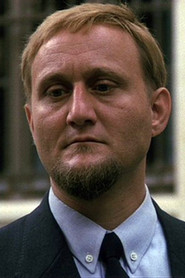 | Raymond Lemorne as played by Bernard-Pierre Donnadieu
Movie Review The Vanishing (1988) d. George Sluizer Spine #133 There is nothing as sweet as a one hit wonder. To think that an Artist could labor lifetime in their chosen field or fields and have their memory reduced to a single work in the collective consciousness of posterity. And yet, most Artists never even have that one "hit," so cruel is the marketplace for art products and so short is the memory of critics and scholars. The Vanishing is the one hit for director George Sluzier. He had an entire career, with films made in Europe and America, but this is his legacy. The Vanishing is maybe not the scariest movie in the world, but it is among the creepiest. The description typically is "Obsessed man searches for wife who disappears from French rest stop." But the film itself depicts the viewpoint of the distraught husbands AND the kidnapper. Thus, it is quite clear almost from the jump who the kidnapper is. Instead, the focus of the film turns towards the inevitable meet up between kidnapper and husband. The kidnapper is memorably played as a straight bourgeois sociopath by Bernard-Pierre Donnadieu- his sly mannerisms and quiet self confidence inspired a chill in me as I recalled clients who had shared similar characteristics. It's hard to understand how I could have missed this film before now. So glad I got to see it, and you should to. DO NOT watch the American remake because it fucking sucks- they change the ending from sad to happy which is just monstrous.
Boy (1969) d. Nagisa Oshima (9/6/13)
Movie Review Boy (1969) d. Nagisa Oshima Streaming on Hulu Plus in Criterion Collection section, not Criterion Collection or Eclipse title. ( Not Available on Amazon) Boy directed by Japanese maverick Nagisa Oshima, went up on Hulu Plus streaming last week in the Criterion Collection section. It's not actually a Criterion Collection release, nor is it part of an Eclipse DVD set. But it is a classic Japanese film by the most interesting Japanese director I've seen beside Seijun Suzuki. It's akin to a 60s Gus Van Sant film, focusing on a nuclear family of con artists who work there way from city to city pulling fake car accident scams. The Ellis History of Film has high praise for Oshima which I would echo, "Using narrative structures and techniques reminiscent of the French Jean-Luc Godard, Oshima is yet profoundly Japanese in his sensibility." Boy was the most watchable Japanese film I've yet seen- it was like seeing a parallel universe of indie film making. Oshima uses all the Godardian tricks, but he tells a compelling, tragic story rooted in human emotion and ideas about family. It was previously unavailable on streaming or DVD I believe (based on its absence on Amazon.com) so this is a big score for Criterion Collection on Hulu Plus, and hopefully it signifies a proper Criterion Collection release. Oshima has some legitimate Criterion Collection/Hulu Plus hits. In the Realm of the Senses is the number one popular streaming title within the collection (because it has sex in it?) and Double Suicide has a really low Spine number. And there are six others- but Boy is new.
The Ruling Class (1972) d. Peter Medak (9/6/13)
Movie Review The Ruling Class (1972) d. Peter Medak Criterion Collection #132 The Ruling Class is so strange that it is hard to even describe properly. It's clearly "from the 70s," it's British... Peter O'Toole plays the main character, there are elements of both musicals and horror films but the objective of The Ruling Class is clearly satirizing the landed aristocracy of England circa the late 1960s early 1970s. So.... if you go in for 70s era class conscious satire with elements of music and horror The Ruling Class will almost certainly appeal to you. On the other hand, if you are a normal American who doesn't give a f*** about the UK let alone the UK in the 1970s, The Ruling Class will leave you scratching your head. The strange mix of elements reminds me of little else besides the Rocky Horror Picture Show. The accompanying Criterion Collection write up is correct in calling Peter O'Toole's performance a :"tour de force." I gather from Ian Christie's article on The Ruling Class found on the Criterion Collection website that there is a whole bunch of stuff going on inside of The Ruling Class that I just don't have the background to appreciate. My knowledge of 70s British culture is limited to the "rise of punk," "Monty Python," and sociologists of the Birmingham school and their pioneering studies of youth sub-cultures. (1) The Christie article references the "theatricality" of The Ruling Class and I can see that. You could also call it "campy." Either way it is a particular stylistic chracteristic of The Ruling Class that is kind of make or break in terms of a subjective appreciation of the film. In other words, you either love it or hate it. NOTES (1) I don't think I've ever referenced the Birmingham School but when I was in college I did a thesis on punk/straight edge culture and I think a lot of that stuff really seeped into my brain: Birmingham School refers to the work of the Centre for Contemporary Cultural Studies (CCCS), which operated as a research center at the University of Birmingham (UK) between 1964 and 1988. The Birmingham School represents a decisive moment in the creation of the intellectual and institutional project of cultural studies, as well as a “cultural turn” in sociology. The substantive focus of the Birmingham School was popular culture as explored through the concepts of ideology and hegemony. Indeed, the work of CCCS contributed to the legitimization of popular culture as a field of academic inquiry. Among the substantive topics of research undertaken by CCCS were the mass media, youth subcultures, education, gender, race, and the authoritarian state. The media were of special significance insofar as the texts of popular culture in the contemporary world are forged within their framework. CCCS was founded in 1964 as a postgraduate center by Richard Hoggart and developed further under the leadership of Stuart Hall. It is during the period of Hall's directorship (1968–79) that one can first speak of the formation of an identifiable and distinct domain called cultural studies.
A Man Escaped (1956) d. Robert Bresson (9/7/13)
Movie Review A Man Escaped (1956) d. Robert Bresson Criterion Collection #650Criterion Collection edition released March 26th, 2013 Man it has been a boundary blurring few days in terms of this Criterion Collection project, what with the Criterion Collection uploading all these non-Collection titles to the Hulu Plus channel. I even found one film, the recently released Hitler comedy To Be Or Not To Be, that is uploaded to Hulu Plus but not listed as such on the website, a kind of hidden new release. The labyrinth gets deeper and deeper. I don't want to even talk about the fact that they seem to have uploaded all 26 "Zatochi the Blind Swordsman" films at once. I get anxious just thinking about the prospect of watching those Zatochi films. I also think it is the proper time to abandon the conceit that I'm only watching three films a week. Who am I kidding with that? Summer is over anyways, so it's not like I have some need to pretend that I'm out on vacation enjoying myself somewhere, as was the case for the last eight August's in a row. Let's get real. Robert Bresson is interesting because he is the French filmmaker that Truffaut first cited in support of his theory of Auteur cinema. A Man Escaped (1956) was based on a real incident involving the imprisonment of a member of the resistance and his escape from a Gestapo prison in the France of 1943. the film is only indirectly about the war and occupation, however; directly, as with so many of Bresson's films, it is about a human being in isolation, physical as well as spiritual in this case. The inner experience of the protagonist is refined to a pure, concentrated, intense expression. (1) A Man Escaped is actually the first of the six Bresson films within the Criterion Collection. I enjoyed the solid rigor of the prison escape plot. Throughout the entire film you do not see a single thing that the characters do not, giving A Man Escaped a near theatrical feel. This is good for developing narrative tension, but bad in terms of mise en scene and just general watchability. Notes (1) This paragraph is a paraphrase/citation from Ellis History of Film, page 297.
High and Low (1963) d. Akira Kurosawa (9/9/13)
 | | Toshiro Mifune as wealthy women's shoe manufacturer Kingo Gondo in Akira Kurosawa's High and Low (1963) |
Movie Review High and Low (1963) d. Akira Kurosawa Criterion Collection #24 High and Low is Kurosawa's take on the police procedural, with source material from Ed McBain's King's Ransom novel from his "19th Precinct" series. You can tell the difference between a police procedural and a film noir often because the police procedural deals with actual police doing actual police work to solve an actual crime, and film noir typically features private detectives sorta kinda trying to figure out a situation where a crime may or not have actually been committed OR accused of committing a crime themselves. But of course, like everything Kurosawa did from the early 1950s to mid 1960s it was a fucking classic of the genre. It's the first non-Samurai Kurosawa picture I've seen. Based on his imdb filmography it looks like he did a bunch of non Samurai titles before he really started churning out the hits. There are many features that make High and Low a compulsively watchable title: 1. Directed by Akira Kurosawa 2. Starring Toshiro Mifune as wealthy Industrialist and women's shoe manufacturer(!) Kingo Gordo (that's Mr. Gordo to you, friend.) 3. Set in contemporary Yokohama- exotic locale for a Japanese film. 4. Adorably police work by 50s Japanese Cops, who apparently have so little to do that they can muster the entire police force to work on a single kidnapping case. As a bonus, the Hulu Plus version includes an actual extra from the DVD- an interview with Actor Tsutomu Yamazaki (plays the kidnapper/villain). I know I've said this before, but I'm very hesitant to take the current heaven-sent situation with Crtierion Collection/Hulu Plus for granted. As I write this Hulu is taking offers on being SOLD. This New York Times article from last month clearly suggests that the current way of Hulu is at risk, and Criterion Collection already left one streaming provider (Netflix) because it was unhappy with the direction of the service. My feeling is that the Criterion Collection could disappear from Hulu overnight, essentially, if certain events occur, like if Hulu is sold to a major media conglomerate, for example. So while these review may seem a trifle obsessive, they are completed with the thought that nothing lasts forever. Subtracting the films out of the first 25 Criterion Collection titles that I've seen before beginning this project, there are only two unseen titles left- A Night To Remember- which I'm going to have to pay for, and Salo/120 Days of Sodom, which I'm going to have to purchase or borrow. I'm not recommending it, but if you were going to sample one twenty minute portion of High and Low I would check out the last 20 minutes- particularly the scenes set in the 60s heroin underworld of Yokohama- priceless/amazing stuff.
To Be or Not to Be (1942) d. Ernest Lubitsch (9/9/13)
 | | Carole Lombard- To be or Not to Be was her last film. |
Movie Review To Be Or Not To Be (1942) d. Ernest Lubitsch Criterion Collection #670Criterion Collection edition released on August 27th, 2013 Here is another strange title- not listed as being available on Hulu Plus on the Criterion Collection product page, but none the less available for viewing the same day (if not before?) the new release. To Be Or Not To Be is not listed in the recently added tab when you navigate the Criterion Collection on Hulu Plus, so I don't know if it has been up for a long time or if it just hasn't been featured as a recent addition yet. It's actually a been a couple days since they've uploaded a new title, perhaps because this marks of the end of their 101 Days of Summer promotion where they uploaded a new title every day for 101 days. To Boe Or Not To Be is what you call a "Hitler comedy" a group of perhaps four or five films (maybe six if you count Downfall as a comedy;) that deal with Hitler as a comic figure. You've got the Great Dictator, of course. The Producers. And, To Be Or Not To Be, which falls under the category of "too soon." Directed by the long tenured German filmmaker Ernest Lubitsch, To Be Or Not To Be starred Jack Benny and Carole Lombard as actors who are also members of the Polish resistance. They get involved in a "screw ball comedy" style plot that features much innuendo, costume changes and displays of verbal wit by Jack Benny. Like many Criterion Collection titles, To Be Or Not To Be is both better and worse then it sounds. To Be Or Not To Be is better then it sounds because the direction and performances are first rate. To Be or Not to Be is worse then it sounds because Hitler does not really go well with the screwball comedy genre- he's more of a subject for satire (see The Great Dictator.)
Rashomon (1950) d. Akira Kurosawa (9/11/22)
Movie Review Rashomon (1950) d. Akira Kurosawa Criterion Collection #138 With 26 films included, Akira Kurosawa, by himself, makes up close to 5% of the entire Criterion Collection (3.8 percent.) So what I want to know is that when the Criterion Collection writes that Kurosawa is "arguably the most celebrated Japanese film maker of all time." Who are the competitors that they are thinking about? Suzuki? Ozu? Inagaki? I would say that any "argument" on the subject of "Who is the most celebrated Japanese film maker of all time?" would last about as long as it would take all the participants to say "Kurosawa!" at the exact same time. Unfortunately I'm not a huge fan so watching all these Kurosawa movies is a bit of an endurance test. At least Rashomon clocks in at less then two hours. Criterion Collection saw fit to upload the Robert Altman interview that serves as the introduction on the DVD, and I found his opinion most useful. Altman notes that in Rashomon, Kurosawa was the first director to shoot the sun/sky- a technique Altman himself immediately utilized in his own work after seeing Rashomon for the first time. Rashomon is most well known for the unusual narrative technique: telling the same story from the perspective of four different witnesses. The only thing they agree on is the central fact of the film: the death of "the man" Masayuki Mori after the bandit (Toshiro Mifune in not one of his greatest performances) rapes his wife Machiko Kyo. Each witness, including the dead man via a medium, tells a different version of the same events. This narrative form was impressive in 1950, and it continues to impress today. After watching Rashomon I went to a movie theater and watched the new Wolverine film, and it was like going from a museum where you see a master piece to a Thomas Keller, painter of light, kiosk at the mall. They are both paintings, but one is art and the other mere commerce. I mention Wolverine because that film is set entirely in Japan, so one might at least expect some referencing to the Japanese film tradition. If they did- I didn't catch it- Wolverine might as well have been set in the Japanese Tea Garden in San Francisco for all the location mattered.
The Last Wave (1977) d. Peter Weir (9/13/13) Movie Review The Last Wave (1977) d. Peter Weir Criterion Collection #142 Boasting both a killer 80s synth sound track and an engaging plot concerning the efforts by an Australian lawyer (Richard Chamberlin) to defend a group of urban Aborigines accused of manslaughtering one of their own, The Last Wave shouldn't require much a pitch to watch in that it is a) not a silent film b) not a black and white film c) is in English and d) has a conventional criminal trial plot crossed with a supernatural/aboriginal hook to keep things interesting. This is the second Australian Criterion Collection title I've encountered- the other is Walkabout- and I've previously seen though not written about Picnic At Hanging Rock- which is also by Peter Weir, the director of the Last Wave. Walkabout is directed by Nicholas Roeg. Picnic at Hanging Rock was released in 1975 and catapulted Weir to international prominence, and so The Last Wave has the feel of a film that was meant to reach the widest possible audience for a film with Australian themes. The sound track is particularly notable for the synth heavy vibe. The Last Wave is no chore to watch and it makes an enjoyable evening view.
Grand Illusion (1937) d. Jean Renoir (9/14/13)
 | | Erich von Stroheim as Captain von Stroheim faces off with his friend/nemesis Captain de Boldieu (played by Pierre Fresnay.) |
Movie Review Grand Illusion (1937) d. Jean Renoir Criterion Collection #1 In Los Angeles for the weekend, as I often am these days, plotting my escape from the disaster of my San Diego based social life, I have access to my friends Criterion DVD collection, which includes Criterion Collection #1, Jean Renoir's masterpiece Grand Illusion. I've seen Grand Illusion at least twice, but never had access to the Criterion Collection edition, so I wanted to give it a spin. Because I've seen Grand Illusion multiple times, I had no compunction about watching it with the audio commentary track turned on. Here, the excellent commentary is provided by film historian Peter Cowie. Perhaps it is because the film itself is so interesting, but I found Cowie's commentary particularly illuminating, especially his comments about famous Director/Actor/Enfant Terrible Erich von Stroheim, who plays the indelible Captain von Rauffenstein. It is impossible to forget Stroheim's performance, and his performance is even more remarkable that it happened almost two decades after he was cast out of Hollywood for turning in seven and a half hour epic films (the original cut of Greed was seven hours plus) in complete opposition to what was becoming the Hollywood recipe for a feature film. Grand Illusion is a prison escape movie, set during World War I, but released on the eve of World War II. Renoir's vision has a warmth that put him out of favor in the era of the Nouvelle Vague/New Wave, but his mastery of the art form, which Cowie points out in intimate detail, eliminates any kind of serious crticism about the "softness" of Grand Illusion. Renoir was a master craftsman but his artistic vision sought to unify, not divide. It was this trait which put him out of favor with the literati in the 60s and 70s, but when Criterion Collection picks your movie as their number one title, it means you are all the way back and watching Grand Illusion for the first or tenth time it is easy to see why he is regarded as a master by
The Ballad of Narayama (1952) d. Keisuke Kinoshita (9/14/13)
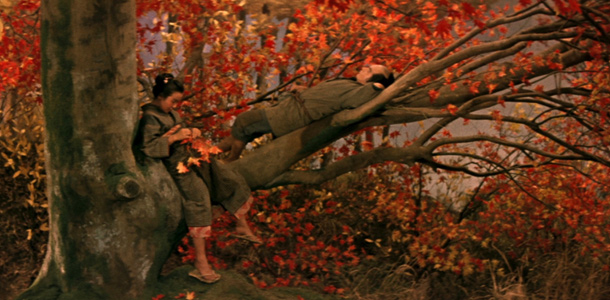 | | The Ballad of Narayama: Fun little movie about abandoning your Mom to be eaten by crows on a mountain top. |
Movie Review The Ballad of Narayama (1958) d. Keisuke KinoshitaCriterion Collection #645 Fun little picture about the ancient Japanese practice of abandoning one's elderly parents to die in the wilderness, The Ballad of Narayama is known equally for its distinctive visual presentation, influenced directly by the conventions of Japanese theater, and its utterly depressing subject matter. When you combine the subject matter with the pan-Japanese cinema tradition of holding shots for minutes at a time, you get a movie that feels much, much, much longer then the 90 minute run time would leave you to believe. The Ballad of Narayama is shot entirely on sound stages, with a breathtaking use of lighting and color to create a visual atmosphere that would feel contemporary today. On the other hand, nothing could be LESS contemporary then the subject matter. I don't shy away from dark films, but watching a 90 minute picture about a family making a conscious decision to abandon their elderly mother to be eaten by birds takes you to a really, really, really dark place, and I'm not sure why anyone would really want to watch this movie. Salò or The 120 Days of Sodom (1975) d. Pier Paolo Pasolini (9/15/13)Salò or The 120 Days of Sodom (1975) d. Pier Paolo Pasolini Criterion Collection #17 Movies don't get edgier then this. Pier Paolo Pasolini's version of Marquis de Sade 120 Days of Sodom is a tough watch, though if you are familiar with the book you can imagine myriad ways it could have been worse. The "plot" of 120 Days of Sodom is minimal in the book: A group of four decadent/depraved Libertines kidnaps a host of young boys and girls and wall themselves up with four elderly courtesans, some large dicked enforcers, and their own daughters who they marry as "wives."  | | "Nothing's more contagious than evil." -a still from Salo or the 120 Days of Sodom by Pier Paolo Pasolini |
During the day the courtesans tell erotic stories from their lives, and the libertines inflict all manner of humiliation and degradation on their captives, giving birth in the book to what we today call "Sado Masochism," or the infliction of physical and mental anguish in the service of sexual gratification. As the book makes perfectly clear, time and time again, 120 Days of Sodom is a critique of the totality of the enlightenment/rational world view, and it firmly makes the case that enlightenment itself is a sham and has terrible, anarchic implications. Over three centuries later, De Sade couldn't have been more right, and the evidence of the validity of his critique is supported by a hundred years of Continental philosophers (Foucault, Nietzsche, Adorno, etc.) Pasolini similarly made the movie version as a protest against the consumer-fascist culture that he hated and it is his disgust for consumerist society that permeates Salo. Pasolini set his version in 1944, in the Northern Italian Fascist puppet state centered on the city of Salo. During the film you can hear the Allied bombers putting a slow but decisive end to their world, but that is the only intrusion of the outside world into the narrative. Although the subject matter is "pornographic" Pasolini uses theatrically inspired distancing techniques to drain any kind of eroticism from the film. As Catherine Breilliat argues in one of the three accompanying documentaries, Salo is actually an anti-pornographic film in that it employs the opposite visual technique of most pornography: Rather then excluding context to focus on sex organs and sexual pleasure, Pasolini always shoots sexually themed material with long shots and a steady camera, forcing the context onto the viewer. Salo is one of several Italian films of the 70s- another is The Night Porter, that sought to re-contextualize the asethetics and themes of Nazism/Fascism. I believe the point of this critique was to emphasis that Naszism/Fascism was not some kind of aberrant behavior but rather a culmination of intellectual themes that were developed in the so-called Enlightenment, and that the mid 20th century success of Fascism/Nazi ideology points to the failure of that Enlightenment, and is evidence in support of the claim that modernity is a failed project. The Cranes Are Flying (1957) d. Mikhail Kalatozov (9/16/13)
Movie Review The Cranes Are Flying (1957) d. Mikhail Kalatozov Criterion Collection #146 Is there some alternate universe where a substantial number of people give a fuck about Russian film from the 1950s? I've never met a single person who could kick knowledge about Russian cinema outside of Eisenstein, and that knowledge is typically limited to his silent work. I don't ever remember seeing a vintage Russian film screening at repertory theater in any of the cities I've lived in. The Cranes Are Flying is the first classic of the post-Stalinist era, when the Soviet Union briefly relaxed for just a god damn second and let Artists experiment with themes that would have been samzidat under the prior regime. The Cranes Are Flying was instantly recognized as having classic status and being the start of a new era in Soviet film. It won the Palme d'Or at the 1958 Cannes Film Festival, for one. It's also very watchable- clocking in at just over an hour and a half, with a war time setting that gives you some action with the melodramatic plot concerning separated lovers Veronika and Boris. Spoiler alert: It ends tragically. The most stand out qualitiy of The Cranes Are Flying is the cinematography by Sergei Urusevsky. Urusevsky creates drama and rhythm by his progressive use of hand held cameras- this in the early 1950s that he's doing this. There are several moments of genuine emotional impact that are profoundly heightened by the editing. Second to the cinematography is the performance of Tatyana Samojlova as Veronika. Her unconventional (by Hollywood standards) beauty really draws the eye of the viewer. The plot is conventional melodrama: couple separated by war; will they find their way back together? I'm not spoiling anything by saying they do not- you find less then halfway through the film that he is dead and after that it's just basically an exercise in torturing his unfaithful girlfriend- Veronika- who has hooked up with Boris' cousin, the rascally Mark. The Cranes Are Flying is another legit Criterion Collection win- A movie you've probably never heard of before, which holds the eye and isn't overlong.
Chronicle of a Summer (1961) d. Jean Rouch and Edgar Morin (9/16/13)
 | | Chronicle of a Summer |
Movie Review Chronicle of a Summer (1961) d. Jean Rouch and Edgar Morin Criterion Collection #648 OK so this is a "cinema verite" film that features interviews with a variety of people in Paris and I think St. Tropez as well. The handheld camera was introduced to the market while this film was being made, and the use of hand held cameras in Chronicle of a Summer would prove to be a turning point in the development of the film documentary. I wasn't expecting Chronicle of a Summer to be particularly watchable, but I was pleasantly surprised at how interesting the slice-of-life conversations were. In particular there are conversations about race and the holocaust held between a young, Jewish French concentration survivor, two African-French immigrants and some young French men and women that I found particularly compelling. More then just a museum piece, Chronicle of a Summer is a must for anyone interested in the documentary as a separate art form from the narrative film, for people interested in the French new wave and a "pass" for everyone else. For anyone interested, the essay featured on the Criterion Collection product page is a must: One of the more thorough and in depth accompanying essays I've read and that is really saying something because all the essays on the Criterion Collection site are superb.
House (1977) d. Nobuhiko Obayashi (9/19/13)
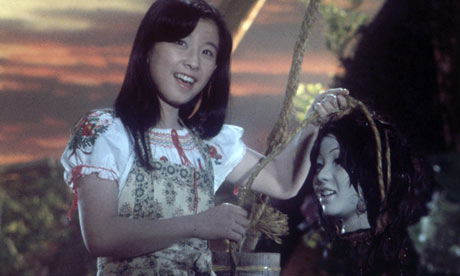 | | Just one of about of a million WTF moments in House (1977) d. Nobuhiko Obayashi |
House (1977) d. Nobuhiko Obayashi Criterion Collection #539 | | Obayashi creates visual effects by actually including art onto the frame to give it a real DIY/cut out feel. |
I've been reflecting that watching Criterion Collection titles is a good way to seek inspiration. There is a hugely liberating, soul-freeing feeling that stems from having the entire history of world cinema at your finger tips for 7.99 a month. I can't help but wonder about the viewer statistics per movie- what I wouldn't give to know how many watchers a day the most popular title garners.  | | Auntie eating an EYEBALL- NBD. |
House is, as the Criterion Collection itself says, a landmark in the Cinema du WTF?, a totally left-field blend of Japanese B Movie budget, school girls in distress, Japanese folk horror, 70s Italian Horror and American grindhouse, with psychedelic visual effects, a demonic cat and cannibalism all thrown into the mix. And if that description doesn't make you immediately want to watch House I will conclude this write-up with a serious of still photographs from the film. House is a Criterion Collection MUST-watch. 100% Watch-ability score.  | This is actually a gif derived from the film itself- her face does look like that in the movie.
Juliet of the Spirits (1965) d. Federico Fellini (9/20/13)
Movie Review Juliet of the Spirits (1965) d. Federico Fellini Criterion Collection #149 Been reading other blogs that serially review Criterion Collection titles and trying to understand why they are all so boring. Something I've noticed is that they tend to be lengthy over all, contain lengthy plot summations and lots of film studies type observations. If there is one thing I've learned about trying to blog about serious/academic subjects is that people do not a give a fuck and even devoted readers will give you about half a page before they move on. Unless you are like the New York Times, but I bet even they see incredible drop off for lengthy magazine features in terms of page views. If you write it up in a way that duplicates what is already out there, it's stupid, because if people want to know the plot or themes of Juliet of the Spirits they can Google it and read the Wikipedia page. I think the answer is to make it personal- I think the most successful writers on the web are people who can bring people in to their inner life- and to never assume that people have a background in what you are talking about. In fact, the opposite. Never considered myself a fan of Fellini. He's got nine titles in the Criterion Collection, but at least three of them aren't available for streaming. I'm sure I suffered through Nights of Cabiria at some point. I've never actually met anyone who said they've watched and enjoyed Fellini's films- but if I did I would look at them at sceptically and say, "Really- have you actually watched a Fellini film, or are you just saying that because you've heard him described as "surreal" and you think liking him is cool?" Because I really have not enjoyed Amarcord or Julie of the Spirits. I mean, I get it- I guess- and I can understand why he was such a revelation in the 60s, but I feel like the movies have aged badly. I probably need to just talk to a fan for fifteen minutes at a party. Juliet of the Spirits is yet another movie about a failed marriage. Here, it's the powerless wife and the flagrantly philandering husband. Forgive me, but I thought that behavior was entirely acceptable in Italy, particularly when the husband was the bread winner and the wife had no children and didn't work. Juliet is played by Fellini's actual wife, and the story is that this is a movie about their actual marriage, and when Gulieta Masina would ask how to play a certain part or line he would just shout out "Just play yourself." Oh Fellini! I guess the real story is that Fellini had a ton of gay lovers, which of course does not make it into the Fellini resembling husband, who is here a fashion show promoter of some sort. The usual cast of freaks and characters that gave rise to the phrase "Fellini-esque" are on hand, of course, and Juliet of the Spirits is the first picture where Fellini used color film, so it has that going for it. But it's hard not to kind of feel sorry for the wife. There is some insight here I suppose, but mostly she just seems confused and bewildered for the entire run time. I guess that's kind of the point, but it makes her look kind of of bad.
Stromboli (1950) d. Roberto Rossellini (9/23/13)
Movie Review Stromboli (1950) d. Roberto Rossellini Criterion Collection #673Criterion Collection Release Date: September 24th, 2013 Part of 3 Films By Roberto Rossellini Starring Ingrid Bergman Roberto Rossellini is probably the third most famous Italian film director behind Federico Fellini and Michelangelo Antonioni, but he is the number one representative of Italy in terms of films in the Criterion Collection: he has 12, vs. Fellini with 9 and Antonioni with 6. Rossellini is typically credited with being the originator of "Italian Neo-Realism," a style of cinema which preceded the French New Wave but shares aspects of that movement in terms of being a post-World War II reaction to pre World War II trends in Cinema. Stromboli was his first film with then Hollywood star Ingrid Bergman. Of course, Bergman had cemented her role as a Hollywood icon/A lister with her performance opposite Humphrey Bogart in Casablanca (1942). The story goes that Bergman wrote Rossellini suggesting that they make a movie or two together, Rossellini, presumably not a moron said, "OK." They subsequently had an affair and that affair produced twins (Isabella Rossellini is one). Bergman was ostracized from Hollywood for a decade afterward- like she gave a fuck- although maybe it was hard for her to abandon her husband and child(!) which she did. Considering the existential/bleak tone of Stromboli, the story of a Lithuanian national stranded in a Post War Italian Refugee camp (Bergman) who agrees to marry an Italian fisherman out of desperation, only to find herself marooned on his desolate, volcanic, hell-hole of a home island, the viewer has plenty of time to reflect on the ample back story between Rossellini and Bergman. Indeed, it is not so hard to actually search for the back story on the web while the movie is playing because there is so little happening on screen. Basically, Bergman is sad that she is on the island, for 90 minutes. It's hard to compare Stromboli to Antonioni's L'Avventura. L'Avventura has a different story, but the similarities between the volcanic type island that figure prominently in both films is hard to ignore.
Idi Amin Dada: A Self Portrait (1974) d. Barbet Schroeder (9/25/13)
Movie Review Idi Amin Dada: A Self Portrait (1974) d. Barbet Schroeder Criterion Collection #153 Idi Amin Dada: A Self Portrait plays better as a farce then an expose. The story of the making of Idi Amin is probably better known then the content of the film itself. French director Schroeder (who would become well known in the US a decade plus later for Reversal of Fortune) was invited by Amin himself to come to Uganda and shoot a documentary. One imagines that he had something like The Triumph of the Will in mind.but that is not what he got. Instead, Schroeder created a fairly straight forward documentary that largely consists of Amin talking at the camera. In terms of impact Amin comes off more like a parody of a genocidal tyrant then and actual tyrant, although the comic element is undercut by Schroeder's off screen commentary. In one particularly intriguing seen, Amin lectures his assembled cabinet and singles out the foreign minister for criticism. While you are listening it's hard to take Amin seriously- he sounds like a pompous high school teacher, but then Schroeder tells you that said foreign minister was found shot to death in the Nile river a month later and suddenly Amin looks terrifying. Idi Amin Dada is filled with such queasy/funny moments. It is hard to really find comedy in someone so obviously psychotic and when you add in his penchant for extra judicial murder it can be at times hard to watch. But it is, I think, the definitive film on the phenomenon of the 20th century African Strong Man dictator, and will be watched forever for that reason.
Journey to Italy/Voyage to Italy (1954) d. Roberto Rossellini (9/25/13)
Journey to Italy/Voyage to Italy (1954) d. Roberto Rossellini Criterion Collection #675Part of 3 Films by Roberto Rossellini Starring Ingrid Bergman Criterion Collection edition released September 24th 2013. Yet another fun Italian movie about a disintegrating marriage. Here, Ingrid Bergman plays Katherine, married to Alex (George Sanders). They are an English couple visiting the Naples area to sell a villa left to them by an eccentric uncle. While there, their marriage frays to the breaking point, only to be resolved in the last 60 seconds of the film in what feels like a cheap, tacked on happy ending. Both Stomboli! and Journey to Italy/Voyage to Italy have endings that put a happy spin on two 90 minute journeys of personal anguish. Ingrid Bergman cracks exactly two smiles within both films. Both times, the smiles are for men other then her husband and lead to further arguments and disagreements between her character and her husband. The real star of Journey to Italy/Voyage to Italy is Naples. The husband and wife spend most of the movie apart, she going to museums and various archaeological sites, he running off to Naples and consorting (but not consummating) with the prostituti. The tone of Journey to Italy/Voyage to Italy is set when Bergman announces to her husband that after nine years of marriage, she feels like they are perfect strangers. Growing up, you always heard about the seven year itch, but as someone whose own marriage broke up after nine years I have to say that seems to be more accurate. Anna Karenina's marriage lasted nine years, this one- there are others. Something about the nine year mark. I guess that's enough time to know that you are fooling yourself. While Journey to Italy/Voyage to Italy is interesting enough, I would be hard pressed to recommend it to anyone besides Italian Neo-Realist die hards and fans of films about failing marriages. I'm one but not the other. The Italian neo-realists are my second least favorite Criterion Collection genre behind "every movie from Japan." Luckily the third film in this Rossellini collection is NOT available on Hulu Plus so I'm all done for now.
Summer Interlude (1951) d. Ingmar Bergman (9/25/13)
 | | Maj-Britt Nilsson plays Marie in Summer Interlude (1951) d. Ingmar Bergman |
Movie Review Summer Interlude (1951) d. Ingmar Bergman Criterion Collection #613 Part of the point of this endeavor (watching all of the Criterion Collection titles) is to learn more about my own taste for films. One of the early discoveries thus far is that I really like Ingmar Bergman. The film text book I bought, itself from the 60s, derides Bergman claiming that his fans are typically people who view film as a form of literature, but if viewing film as a form of literature is wrong then baby I don't want to be right. I love the heroines of Bergman- dark, steeped in regret and repressed longing, I feel like I identify with them and their experiences. Bergman's films are steeped in fatalism/existentialism/ Protestantism, gloomy and severe they represent a body of work that comes close to approximating the real emotional experience of many people who love and lose, people who are isolated from their surroundings, people who live in the past. His culture is so far from what we call "contemporary pop culture" that he might as well be a 19th century novelist, and yet all of his films maintain a relevance simply by virtue of their emotional acuity. Summer Interlude is about a summer affair between two young people that ends with the death of the boy, Henrik. Marie, the female half of the pair (played by a winning Maj-Britt Nilsson) is a ballerina who tells the story from the present in flashback forms. The happiness of the past is contrasted with the gloominess of the present, where Marie is "always tired" and wonders what the point is of all of it. Bergman successfully counterpoints the beauty of the Nordic summer with the reality of a present where Marie is trapped inside the ballet theater for days on end, rehearsing for a big performance but realizing she is nearing the end of her professional career as a ballerina. I agree with the Criterion Collection synopsis entirely: Touching on many of the themes that would define the rest of his legendary career—isolation, performance, the inescapability of the past—Ingmar Bergman’s tenth film was a gentle drift toward true mastery. Everyone should watch Bergman movies, particularly those struggling with isolation and/or the inescapability of the past. Don't we all do that?
The Gold Rush (1942) d. Charlie Chaplin (9/27/13)
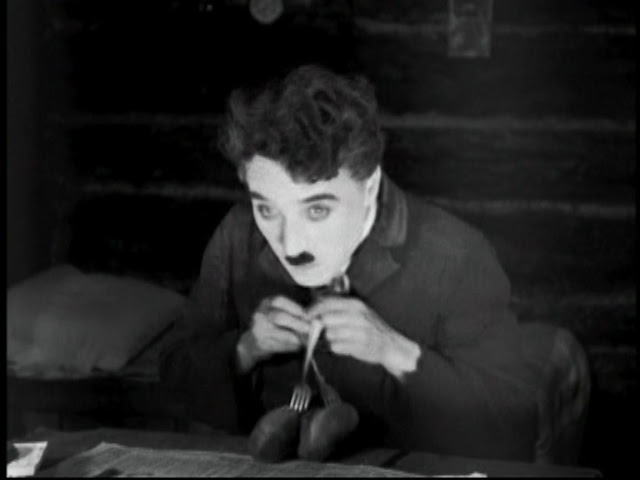 | | Charlie Chaplin performs the "dance of the rolls" scene from The Gold Rush, among the most iconic single scenes in cinema history. |
Movie Review The Gold Rush (1942) d. Charlie Chaplin Originally shown as a silent film upon release in 1925, Chaplin himself added narration (spoken by Chaplin) and music to a 1942 re-issue that the Criterion Collection bills as the "definitive" edition. To me, that is a little like calling the CGI enhanced versions of Star Wars that George Lucas put out last decade as being the "definitive" version of those titles. Or like calling the colorized version of a black and white film the "definitive" version of that title. I guess at a certain level the Criterion Collection is about marketing, and considering that it is Chaplin himself who wrote AND spoke the narration AND picked the music AND he wrote AND directed the 1925 version, he can do whatever the eff he wants to The Gold Rush. The Gold Rush was an international hit for Chaplin and the so-called "Dance of Rolls" scene, which younger people might have only seen reenacted by Johnny Depp in the trailer for "Benny and Joon" is among the most famous single scenes ever shot on film. Chaplin only has five titles in the Criterion Collection, so The Gold Rush, even in the narrated/music enhanced format- and by the way when I say "Music enhanced" I mean " flight of the bumblebee" used over and over and over again. The Gold Rush is a true classic of film: A work of art that has both maintained an Audience and critical esteem for over a century. Surely that is a fair measure of a classic work of Art? Audience and critical esteem fro 100+ years? Using that standard, you don't really know until a 100 years have passed, but for The Gold Rush we are 12 years off from that point.
The Great Dictator (1940) d. Charlie Chaplin (9/28/13)
 | | Charlie Chaplin does his Hitler. |
The Great Dictator (1940) d. Charlie Chaplin Criterion Collection #565 Really digging Charlie Chaplin right now, but unable to slip him into casual conversation. Compare the contemporary relevance of Chaplin to another recent emphasis of mine, Russian movies. I've used Russian movies in two different conversations in the last week and gotten good responses both times. So Chaplin isn't very cool, but he is a genius. Like any artistic genius who controls his/her own means of production AND obtains positive critical, popular and financial response to his/her early work, Chaplin became obsessed with a passion project. As the accompanying featurette by Chaplin archivist Cecilia Cenciarelli documents, Chaplin wanted to make a movie about Napoleon. He spent close to a decade working on this proposed film of Napoleon in exile. He had people doing research, he bought rights to a book on the subject, he paid to have a screenplay created. The featurette uses excerpts from letters between Chaplin and his close associates that show he didn't really abandon the Napoleon in exile project until the mid to late 1930s. The Great Dictator was released in 1940, and it incorporates many of the characteristics of the unamde Napoleon movie. Specifically, the central plot point of The Great Dictator: Chaplin playing both the Hitler character and a Jewish barber who looks exactly like the Hitler character. Watching The Great Dictator for the first time, it was hard not to be shocked at Chaplin's aggressively political film. Even with the funny included, The Great Dictator is a serious fucking movie. The Chaplin Dictator character talks about exterminating the Jews repeatedly, as well as casually discussing murdering 3000 striking factory workers because he "doesn't want any of his worker to be unhappy." Even more amazing is that The Great Dictator came out before the U.S.entered into World War II. As readers may or may not know, during the Jo McCarthy led Communist witch hunts after World War II, attacking Fascism BEFORE the US entered officially into World War II was called being a "premature anti-Fascist" and was grounds for being accused of being a closet Communist. The Great Dictator is the kind of bold film that could only have been produced and released by an Artist with complete control of his means of production. It is quite an accomplishment, and an astonishing film, but in terms of film art itself vs. historical significance, it is a flawed masterpiece with a clunky 2 hour run time and dozens of cringe inducing moments. Still worth seeing.
Solaris (1972) d. Andrei Tarkovsky (9/30/13)
 | | The sentient ocean of Solaris. |
Movie Review Solaris (1972) d. Andrei Tarkovsky Criterion Collection #164 Solaris (1972) was close to being next on the list by spine number, and then this week I read the Zola Jesus Top 10 feature at the Criterion Collection website, and she put Solaris at #2 and said: Solaris is not just a movie to me. It feels like an entire language. The more I watch it, the more I learn about the genius of Tarkovsky’s vision. I still have yet to read the original story by Stanislaw Lem, but it’s next on my list to understanding the puzzle that is this wonderful film. ( CRITERION COLLECTION TOP 10 FEATURE)
I knew going in that Solaris was slow, and that is "sci fi" and that there was a shitty American remake starring George Clooney, and that it was long. It is a long, slow sci fi film, which, as the Criterion Collection site itself points out makes it "vastly different from what most Americans consider to be sci fi." By which they presumably mean Star Wars and their ilk, but the obvious Western reference point is Stanley Kubrick's 2001- which was released in 1968. As I recall 2001 is slow and boring in similar fashion.
Solaris is also timely because of another upcoming film, Gravity:
Gravity seems to be a more straight forward action picture, but shares some of the same ambiance. And of course there is the NASA documentary For All Mankind- about the trips NASA took to the moon. It's all kind of a metaphor about alienation from one's surroundings.
|
|
Published 9/18/13
Weekend (1967)
d. Jean Luc Godard: 12 titles in the Criterion Collection
Criterion Collection #635 I want to be careful about talking shit about how unwatchable Jean Luc Godard's films are until I've actually watched a few. I've seen Breathless, Alphaville, this one. I also watched The Virgin Mary in college, although that is not a Criterion Collection title. You can't talk about Godard without discussing what Gary Indiana, in the essay that is featured on the Criterion Collection product page for Weekend, calls Godards penchant for "trying the patience of his audience." INDEED. How is one to discuss Godard-especially Godard after the mid 1960s, without discussing his disdain for the bourgeois conventions of film grammar, plot, strory-telling, emotional identification or really anything that makes people LIKE, as suppose, to despise, a specific work. As Indiana says, the key to understanding Godard's mindset in Weekend and subsequent films is to understand the influence of Brecht on Godard: The technique of Weekend, however, comes from Brecht. The film excludes any emotional identification with its protagonists. They have no inner lives. Corinne’s only emotional moment occurs when her Hermès pocketbook is incinerated in a head-on collision. Moreover, she and Roland are conscious of being characters in a movie. Weekend’s fistfights, shootings, stabbings, and highway carnage don’t simulate violence so much as transmit an idea of violence. The bloodshed is so deliberately fake that a scene where a real pig has its throat cut comes as a powerful shock. (Gary Indiana essay on Weekend) Brecthian distancing techniques seem key to understanding the Art House/Experimental cinema of Europe in the 1950s and 1960s. Call it experimental theater if you will, the theater of the absurd, the theater of cruelty, what you will. We're not so far removed from the academic post-modernism of the last few decades, and from that perspective Godard is like a patron saint, but personally, I think film that purposely eschews emotion in favor of lengthy Marxist diatribes (of which there are many in Weekend) are kind of missing the point of film. Maybe it's because I've never, ever met a single person in my whole life who could confidently look me in the eye and say, "Yes, I like watching the experimental films of Godard- Weekend, Virgin Mary, all of it- love how he refuses to abide by the conventions of film grammar and story telling." If someone said that to me I would be all, "Shyeaaahhh right." I mean no way. I can see where you'd watch Weekend for a class, or because it is in the Criterion Collection, or because you love the French New Wave, but I can't see anyone sitting down and watching this movie for fun- which is something I tried to do several years ago- and failed to do.  | | Alec Guinness plays Gully Jimson in The Horses Mouth (1958) d. Ronald Neame |
Published 9/27/13
The Horses Mouth (1958)
d. Ronald Neame
Criterion Collection #154 The Horses Mouth is a comedy about washed up painter Gilley Jimson, played by Alec Guinness, who has lived past his prime. In the first scene Jimson is being released from jail after serving a sentence for making harassing phone calls to the gentleman who owns all his early works. First thing he does is of course resume said threatening phone calls. The plot largely concerns Jimson figuring out a way to squat in a wealthy collector's apartment and create an indelible masterpiece on the wall of their flat., followed by a kind of coda where he creates an epic painting on the wall of a soon to-be-demolished Church.  | | One of the Gully Jimson paintings from the film. |
Jimson is obviously a character who was very close to Alec Guinness's' heart: Guinness wrote the screen play and it is hard to miss the obvious passion he brings to the role, raspy voice and all of it. The script is based on the on the novel of the same name by Joyce Cary- Criterion Collection calls the novel a classic but I'd never heard of the novel or the author. At times it seems like the Criterion Collection is just an endless exploratory journey, the artistic equivalent of having some kind of warp drive that would allow you to hop from planet to planet instantaneously. Almost every day I am humbled by just how little I know about the world of literature after 23 years of formal education and actually being interested in the subject both in and out of school for roughly the same amount of time. There is just so much out there it is easy to get overwhelmed on a day-to-day basis. I know I say this quite often but I could have easily lived my entire life without seeing or hearing about or discussing or being aware of the existence of The Horses Mouth, but it was a fine way to pass a couple hours, and it is worth checking out particular for the Anglophiles out there, and of course it is a much watch for those dedicated to British comedies from the 50s and 60s. Anyone? No? Ok.
Published 10/8/13
I Married a Witch (1942)
d.Rene Clair
Criterion Collection #676
Criterion Collection edition released October 8th, 2013 New release woop woop. I Married a Witch is obviously given Criterion Collection status because it was directed by Rene Clair and stars Veronica Lake and is a screwball comedy about a family of witches and isn't that enough, dammit? It is hardly the best film of Rene Clair's career. Veronica Lake is better known for a half dozen other roles, but still... the combination of the two with the supernatural theme; not to mention a 75 minute run time.... It's... easy to see why you would pick this film for Criterion Collection treatment.  | | Veronica Lake |
Still, I Married a Witch is not a canonical type picture, but it does have Veronica Lake in it, and it is directed by Rene Clair. Veronica Lake has a fairly spectacular Hollywood flame out story attached that makes her a kind of Hollywood Actresses' Hollywood Actress. Plus, she has the film noir roles with Alan Ladd. And she is a total babe. It's not a must buy, but you should probably at least watch it. Veronica Lake plays a witch. That should be enough.
Published 10/13/13
The Autobiography of Nicolae Ceausescu (2011)
d. Andrei Ujică
Streaming on Netflix Assembled entirely out of "official" state footage, The Autobiography of Nicolae Ceausescu is a totally unique approach towards its subject, Romanian dictator Nicolae Ceausescu. I keep waiting for 20th century Eastern European Communist Dictatorships to become "hot" but maybe I am putting too much on the trend-industrial complex to expect a real revival. The only moments in the film that are anything less then officially scripted Communist Part propaganda are the beginning and the end, both of which show parts of the hastily thrown together "trial" that immediately preceded Ceausescu and his wife being shot. In these scenes, Ceausescu and his wife look like they are being "tried" in a high school class room. Both look elderly, feeble and disheveled. This disconcerting scene segues into the funeral for Ceausescu's predecessor, Gheorghe Gheorghiu-Dej. Ceausescu met Gehorghiu-Dej in a Fascist prison camp during World War II, where they were roommates.
After he takes control it is a blur of two hours plus of world leaders visiting, Ceausescu visiting world leaders, speeches to his Congress andddd more meetings with world leaders. Some scenes have sound, other scenes are silent. Notable highlights include Ceausescu railing against the Warsaw pact invasion of fellow Warsaw Pact state Czechoslavkia, and visit to China and the U.S. (Jimmy Carter bay bayyyy)
Word of caution, The Autobiography of Nicolae Ceausescu is three hours long so make sure you have the time!
Published 10/16/13 The Law of the Border (1966)
d. Lüfti Ö. Akad
World Cinema Foundation
Available on Hulu Plus Criterion Collection Channel And sometimes I watch a Turkish cowboys and indians type movie from 1966 that aren't actually in the Criterion Collection because I'm like "How many Turkish films can be on the Criterion Collection channel but not actually in the Criterion Collection proper?" The answer is, "This movie." It is OK though because this is actually a really interesting movie about life on the Turkish....Iraqi? Syrian? It says "south east Turkey" on the World Cinema Foundation product page. I dunno it's cool. The World Cinema Foundation page says this film inaugurated the era of New Turkish Cinema and it is clear that there is some influence of, what else, French New Wave. It reminded me of a Pepe Le Moko. The story revolves around a group of rough neck smugglers who try to do good but are "pulled back into it" in familiar fashion. The performances are raw and edgy, and the actors are dirty. It's very real, until you get to the climatic gun battle, at which point The Law of the Border turns into a shoot em up western. The restoration back story for The Law of the Border is pretty interesting. Supposedly all copies of the film were "seized and destroyed" in the 1980 Turkish coup d'etat. I can see why they did it. The film is pretty sympathetic to the smuggler/anti-hero characters. I guess you would call it subversive if you were a Turkish General.
Published 10/25/13
The Life of Oharu (1952)
d. Kenzo Mizoguchi
Criterion Collection #664
Criterion Collection released July 9th, 2013 Another classic Japanese film from the 1950s, another total bummer night. The Life of Oharu is about the fall and fall of a 16th century Japanese courtesan/prostitute. The director is Kenzo Mizoguchi, a contemporary of Kurosawa in the great Japanese art house break out period of the early 1950s. Mizoguchi's next film, Ugetsu (1953) won at the Venice film festival. Unlike Kurosawa, Mizoguchi was in the twilight of his career in the post-war period. His filmography reveals dozens of films from the 20s all the way through and during World War II. During the 1920s, he was averaging over five titles a year. The Life of Oharu, in addition to being a player in the growth of the international audience for Japanese film, was also what the film maker considered his finest work. If Kurosawa rose to prominence by combining Japanese traits with insights garnered from Western films, Mizoguchi is an example of a more purely "Japanese" film sensibility. There are none of the quick cuts or innovative framing techniques of 50s Kurosawa. Instead there are tons of very long takes and a mastery of what is called ' mise en scene': the design elements of film production. Telling a story that takes place in the 16th century, Mizoguchi convincingly depicts that era down to the details on the human carried carriages that were used for elite travel during the period. Even knowing how well The Life of Oharu went over with the international film crowd, and taking into account its positive attribute; The Life of Oharu is what I would call a tough watch. Black and white, slow paced editing, two hours plus run time, and utterly depressing subject matter with little or no redemption at the end. Mizoguchi obviously sympathizes with poor Oharu, but his sympathy doesn't earn her much within the film. The Life of Oharu has no rise, just a steady fall from beginning to end.
Hopscotch (1980) d. Ronald Neame (10/12/13)  | | Walter Matthau as a dapper CIA agent in Hopsctoch (1980) d. Ronald Neame |
Movie Review
Hopscotch (1980)
d. Ronald Neame
Criterion Collection #163
There are two main categories of films in the Criterion Collection. The first category is are the "fun" movies and the second category are the "serious" movies. The first category includes many of the "cult classics" and then some of the foreign films, the second category contains most of the documentaries and many more of the foreign films. Hopscotch, a clever, witty spy thriller with overtones of the Edward Snowden affair, is firmly in the former category- as fun as the Criterion Collection can get.
Hopsctoch is yet another fine example of why watching the Criterion Collection is such a useful investment of time. A film I probably never would have even heard of, let alone watched, becomes a diverting way to pass a couple hours in the early evening, and provides plenty of food for thought about the way the world has changed in the generation since Hopscotch was released.
Walter Matthau, here at this best, plays Kendig, a top CIA operative who is put out to pasture by his Nixonian boss Myerson (Ned Beatty.) He decides to retaliate by writing a tell-all memoir, and then eludes capture in spectacular fashion. He is assisted in his escapade by the wealthy and beautiful divorce Isobel, played by Glenda Jackson and of course a young Sam Waterson would have to part of such a film.
Neame also directed the Criterion Collection title The Horses Mouth(1958), and both titles share winning actors in the title role. Matthau, so often cast as a nebbish, is a dapper sophisticated super spy in Hopsctoch and you can see that he enjoys every minute of the performance. Hopsctoch is, above all, fun to watch and there is no point during the run time where I was bored or scratching at the walls to get out. That is how I know that I'm watching a "fun" Criterion Collection title vs. a "serious" Criterion Collection title: During the serious films I'm often in sheer agony and need to take breaks or watch the film in half hour to hour blocks
Ratcatcher (1999) d. Lynne Ramsay (10/4/13)
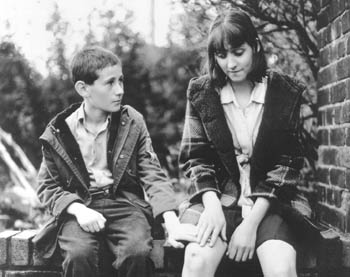 | | James with the neighborhood "slut" Maragret Anne in Lynne Ramsay's Ratcatcher (1999) |
Movie Review
Ratcatcher (1999)
d. Lynne Ramsay
Criterion Collection #162
When a film is "set during the national garbage strike in Scotland during the 1970s" you have a good idea of what you are in for. Like Scotland isn't filthy enough without a national garbage strike. Ratcatcher is a coming of age picture about a young Scottish lad- James (William Eadie) who accidentally kills one of his neighbors during the first five minutes in a muddy canal during the first five minutes of the film. It is, as they say, downhill from there, but Ramsay brings a strong narrative and visual approach to the utterly depressing material, making Ratcatcher a distinctive and memorable film about life in Scotland during the mid 1970s.
There are so many scenes of children playing in garbage that this image becomes the the signature of Ratcatcher. You've got a scene where a couple of ruffians extract an entire dog corpse from a trash bag and wave it around, you've got a little girl sitting in a pile of trash bags as one would sit on a thrown, and of course, you've got the handling of rats, dead and alive, as one would expect from the title.
Ramsay doesn't flinch from depicted the grim reality confronting young James. The simple fact that James kills another child in the first five minutes disorients the viewer, taking James out of the category of helpless observer of his unfortunate surroundings and more into the category of willing participant in the filth and degradation surrounding him.
There isn't much of a plot to speak of. The most plot-like story element is the "relationship" between James and Maragret Anne, a promiscuous older girl who takes a fancy to James even as she is relentlessly bullied into having sex(?) with a gang of neighborhood teens. Besides the heaps of uncollected rubbish (as they say in the UK) the fetid canal serves as a visual and narrative focus. Just looking at that canal was enough to make my skin crawl, and it is hard not to flinch when you see characters from the film immerse themselves in the filthy water.
The ending of Ratcatcher mixes a happy scene of James' family moving into a much sought after suburban home with James jumping into the canal in what looks to be a suicide attempt. Ramsay leaves it unclear as to which represents the "reality" but my money is on the suicide. Ratcatcher very much reminded me of Harmony Korine's Gummo. Gummo was released two years before Ratcatcher, but if you like one you will appreciate the other.
Double Suicide (1969) d. Masahiro Shinoda (10/7/13)
Movie Review
Double Suicide (1969)
d. Masahiro Shinoda
Criterion Collectin #104
Not sure what it is about Japanese cinema but it is rapidly becoming my least favorite sub part of the Criterion Collection. I like Seijun Suzuki and can obviously appreciate the majesty of Kurosawa, but other then the Suzuki films I don't actually like watching any of them. It's just a chore. Double Suicide is the worst of the bunch thus far. Double Suicide is a take on a classic Bunraku puppet play, where a man goes ga ga over a courtesan in feudal Japan. Unable to be together in life, they chose to be together.... in death. So yeah, it's another movie where you are waiting for the main characters to die at the end. Oh is this it? Do they die here? Oh maybe it's now? No. Now?
It's also not one of those films where afterwards you are like, "Oh I can't wait to till person X about this movie, I bet they will really like it." I don't know a single person in the entire universe who would make it through a half hour of Double Suicide. I can only surmise that it included in the Criterion Collection because it as free to acquire, or perhaps because the director uses "Brechtian distancing techniques" in the form of black garbed "puppeteers" who follow the (human) characters around and even intervene in the action at time. Me, I found it tedious. Not recommended!
Days of Wrath (1943) d. Carl Th. Dreyer (10/9/13) Movie Review
Days of Wrath (1943)
d. Carl Th. Dreyer
Criterion Collection #125
Boy, this movie has EVERYTHING if your definition of everything includes 17th century Danish fashion, witch burning and step mother/step son sex. From a movie shot in 1943 in Denmark, under Nazi occupation, no less. Truly a testament to what a skilled film maker can accomplish under strained circumstances, although I have to imagine the Danes were pretty mellow about being occupied by the Nazis. In fact, even though I knew this was a Danish film the language sounded so close to German and/or Dutch that I was unable to distinguish a difference, even though I was listening to one. I guess I was expecting something more along the lines of Swedish.
It turns out I actually dig Northern European/German cinema- I'm loving Ingmar Bergman, I love this guy Dreyer and I look forward to watching films from this part of the world. Days of Wrath is as emotionally intense as any movie I've seen, the fact that it came out of the 1940s makes it all the more remarkable. Also remarkable is the fact that anyone can now watch this movie streaming on Hulu Plus. I can't imagine there were more then a half dozen viewings of the old 16 MM pre DVD print in America in the last 50 years- if that many.
The accompanying essay on the Criterion Collection page for Days of Wrath makes some interesting points regarding the novel style of camera work that Dreyer employed- I must confess that my eye was not sophisticated to catch it but after reading the article and taking another look I see what author Jonathan Rosenbaum is pointing out about his use of tracks to create a disorienting effect.
Also Dreyer really nails the period part of this period piece- you get a sense of how witch burning was simply a fact of life in the day. Personally, my image of witch burning always involved tying a woman to a stake in he middle of a pile of wood and then setting fire to the wood, but here, in what I assume is a more historically accurate depiction of actual witch burning methodology, they start the bon fire, then tie the witch to a ladder, then hoist up the ladder and tip it into the fire, so that with falls face first into the flames. Also, they have a children's choir singing about burning the witch as they burn they witch, which- even if you are opposed to witch burning- is an undeniably classy touch.
The Hidden Fortress (1958) d. Akira Kurosawa (10/11/13) Movie Review
The Hidden Fortress (1958)
d. Akira Kurosawa
Criterion Collection #116
Man I don't know what it is about Kurosawa but I suffer through every single one of his films. It took me 4 days to get through The Hidden Fortress, which is an action film, mind you.
The highlight of the Hulu Plus streaming version of this film is that they include what can only be described as a priceless interview with George Lucas, who borrowed significantly from The Hidden Fortress when he was writing a little movie called Star Wars. To his credit, he cops to it...sort of. After first saying that The Hidden Fortress is his "fourth favorite" Kurosawa film, he admits that he was "inspired" by the two peasants who form the narrative focus of The Hidden Fortress (They were turned into Droids for Star Wars.) He's less forthcoming about the relationship between Kurosawa's Priness Yuki and his own Princesss Leia. At one point he says that Leia is a more active, adventurous character and that this represents a huge difference between Leia and Yuki but he must have been high when he said that because Yuki is like a spitting image of Princess Leia.
The story of The Hidden Fortress: A General must escort his Princess behind enemy lines to get her home after her army loses is a battle, has obvious similarities with the plot of Star Wars, even if Lucas is able to sanguinely state that there are really only 32 plots in existence, so of course movies resemble one another.
Keep telling yourself that George. It is cool that he did the interview though, I'm sure a lot of Artists would be reticient to praise a work that they directly lifted from to make their own breakthrough hit. Obviously though, he got away with it, because how many people actually saw The Hidden Fortress before the video/DVD era. Lucas flat out states that the only reason he saw it was because he was enrolled in film school. Ordet (1955) d. Carl Th. Dreyer (10/14/13) Movie Reviews
Ordet (1955)
d. Carl Th. Dreyer
Criterion Collection #126
It's funny, but because I'm a criminal defense lawyer I can't watch television shows about crime. I think I'm in much the same situation now with music, I don't actually relax by listening to music- don't even own a stereo actually. I listen to music when I drive and when I run, and occasionally at the office, but I'm not kicking back with a brewski and putting on the latest LP on my turntable. I think that's why I'm so into movies and novels right now, it helps me think about art without having to worry about the business issue that creep into any pure attempt to appreciate music as art. So I'll often think about music or art while watching movies or reading novels- I find it to be a really useful exercise to focus on good examples of the art form, rather then filling my mind with useless garbage- which I don't mind- or didn't mind.
Ordet is yet another good example of a movie I would never have seen without the COMBINATION of Criterion Collection and Hulu Plus but I'm telling you I am FEELING the Northern European cinema of Germany, Denmark and Sweden. I've liked every single one I've come across, and I feel like the Denmark/Sweden access is the opposite of the Japanese films: I shouldn't like them but I do. Maybe because they are so g-d somber, and death obsessed, and because a Danish filmmaker working in 1955 can drop a casual Soren Kierkegaard reference into a film set in rural Denmark in 1925. As one does.
There is no way to describe Ordet that makes it sound appealing- I think it's so funny when I read other Criterion Collection focused blogs and they have these lengthy plot descriptions or in depth analysis of the film makers- um HELLO- the Criterion Collection itself does that for every single film. If you're going to write about the Criterion Collection the focus needs to be on the COLLECTION not the individual films- they are just little pieces of this grand canonization of film that is truly unmatched- certainly in terms of the international scope of it.
But man I LOVED Ordet- and I really dig Dreyer- he makes me want to go to Denmark: between current bands like Iceage and The Ravonettes, the history of existentialism, the movies- all of it Ordet has a crazy ass ending that really gives the feature some oomph- which it needs because the plot elements are: A wealthy farmer, religious faith, a difficult child birth and a son who thinks he is Jesus Christ. Did I mention is set in rural Denmark in 1925? But it all comes together and the end left my jaw on the floor. And I watched the entire film in delight.
Samurai III: Duel at Ganryu Island (1956) d. Hiroshi Inagaki (10/16/13) 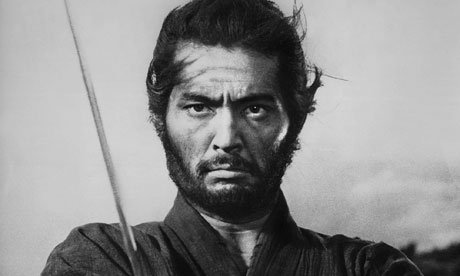 | | Toshiro Mifune |
Movie Review
Samurai III: Duel at Ganryu Island (1956)
d. Hiroshi Inagaki
Criterion Collection #16
I am relieved to have completed my viewing of Hiroshi Inagaki's Samurai trilogy because it was the biggest remaining gap in the first 20 Criterion Collection titles. Only two titles in the first 20 remain unseen: Salo, or the 120 Days of Sodom and A Night To Remember. I may end up buying Salo because let me tell you: you can not rent that shit on Amazon streaming video. A Night To Remember is available on streaming video so I'll probably knock that out. It's about... the Titanic and it was released in 1957? Looking forward to it. I've also decided to go back and rewatch some of the classics that I haven't seen in some time: 400 Blows (on cassette during college in the film library?), The Seventh Seal (Netflix on disc?), maybe Sid & Nancy. I'm not sure I'm going to watch Sid & Nancy again.
In the thundering conclusion to the Samurai trilogy, famed Samurai Musashi Miyamoto continues his wanderings, and eventually gets around to killing his main rival, Kojiro Sasaki, during a...you guessed it; island duel. In between he kinda saves a village from bandits, actually he fails to save the village but helps the villagers drive off the bandits. He finally agrees to marry Otsu and Otsu's rival Akemi betrays him and then dies. It is, as they say, a rollicking good time, and I have to admit that for this episode I was emotionally invested in Miyamoto, even though the title gave me a pretty good idea about where the plot was headed.
 | | Koji Tsurata as Kojiro Sasaki |
Toshiro Mifune is again iconic as Musashi Miyamoto, and the third film really shows off Koji Tsurata as the rival samurai Kojiro Sasaki. I wouldn't say that the Samurai trilogy whetted my appetite for more Samurai movies, and oh by the way Hulu Plus has a shit ton, and not all of them are Criterion Collection titles either; but I do feel like I have a deeper appreciation for this chapter in cinema history.
There aren't really any contemporary Samurai films (The last Samurai?) so it's not the same situation as with Kung Fu films. Why did the Samurai movie go extinct? A question for another day I suppose.
Ballad of A Soldier (1959) d.Grigori Chukhrai (10/21/13)
Movie Review
Ballad of A Soldier (1959)
d.Grigori Chukhrai
Criterion Collection #148
Can we talk for a second about the other blogs that are also watching the Criterion Collection in a comprehensive fashion? Criterion Reflections is doing it chronologically. He's been at it since 2009 and he writes ridiculously comprehensive reviews that I can barely get through myself. Here's his intro for this movie, Ballad of A Soldier- a 1959 Russian film about a soldier coming home for a brief leave during World War II to see his beloved Mother:
Ok so this is just the first paragraph:
Ballad of a Soldier is a pleasantly accessible and emotionally powerful meditation on the effects of war on a society's common folk that probably earns its status as an "important classic and contemporary film" (i.e. part of the Criterion Collection) as much for the circumstances of its original release and historic significance as for it's cinematic achievements. It's a handsome production, skillfully rendered and performed with impeccable sincerity by a very photogenic cast - even the rough-hewn peasants, tragic victims and a small number of unsympathetic characters, presented to us as examples of weakness and faltering integrity, have a noble glow to them. A few scenes show technical prowess, most memorably an early overhead shot of tanks pursuing a running soldier that flips upside down as the action passes directly underneath the camera, and a dreamy montage reverie later in the film in which two would-be lovers, now parted by circumstance and ever-increasing miles, speak tenderly to each other in their own thoughts words of affection that they never dared speak to each other. But these effects, as moving and genteel as they unquestionably are, might not in themselves have won the enduring respect and admiration that they have if the film itself hadn't emerged at a particularly critical time - the late 1950s "thaw" in Soviet media censorship and US-USSR relations that took place after the passing of Stalin but before the Cold War ramped up again in the early 1960s with the construction of the Berlin Wall, the Cuban Missile Crisis and the entry of the USA into the Vietnamese conflict. (Criterion Reflections)
Holeee shit- he goes on like that for the equivalent of another four or five paragraphs, leaving one with the existential question of what there is left to say. I'm just come out and say it- it's an enjoyable movie, but there can't be more then 500 people in the whole world who would actually sit down and watch this bad boy. Maybe I'm wrong, but the Criterion Collection page for Ballad of a Soldier has 67 "Likes". 67. Out of everyone on Facebook.
Here's another example of a serial Criterion Collection blogger, reviewing this same film:
Russia, historically speaking, has cemented themselves as a stark contradiction to the American film style. Whether it be the prolific Man With A Movie camera, or the entirety of Eisenstein's ouevre, narrative dissonance and non-linear editing are their thing, so when I approached Ballad of a Solider, I assumed these would be traits of the film, however, within only moments of viewing the clearly melodramatic film, I was baffled to find its clearly American composition. Between long reaction shots, use of music to emphasize emotion and the focus of redemption within the narrative, Ballad of A Soldier is not entirely Russian in its composition. Now that by no means makes this a terrible piece of cinema, in fact, it is quite great and clocking it at just under ninety minutes, the film is accessible and earnest. Furthermore, the films is neither a clear condemnation of war efforts, nor is it set out in praising the validity of warfare. The narrative of Grigoriy Chukhray's film, which he both wrote and directed, is as the title suggests about a soldier and is certainly a ballad at that, considering its lyrical nature. It focuses on one character and his vision of a slowly eroding nation, one that evolves from foolish youthful ignorance to adult disillusionment. If it were not for films like Forbidden Games and Ivan's Childhood, I would define this as one of the greatest coming of age tales ever composed, but mind you if I ever were to make a list of the top ten, it would certainly make the list. (Cinemalacrum)
Seriously though, again that's a single paragraph. In my experience, people reading on the web are comfortable with paragraphs that are maybe four, five six sentences long, and they want a picture on top. I also disagree with the actual opinion ventured by the second guy. If you watch When Cranes Fly- which is like two number removed in sequence from Ballad of A Soldier, it's obvious that Russian Cinema isn't simply the silent films of Eisenstein. For that matter, if you watch Ivan the Terrible it is clear that one of the main influences on his work is Walt Disney and you can't get more American then that.
It's also worth mentioning that Chukhrai is a one hit wonder- there is a huge difference in the Criterion Collection directors who have upwards of ten or more titles, vs. the one hit wonders of world cinema who make a single appearance and vanish.
Purple Noon (1960) d René Clément (10/28/13)
 | | Alain Delon |
Movie Review Purple Noon (1960) d René Clément Criterion Collection #637 Presently drifting through the Criterion Collection, like a leaf in the wind, without plan or scheme. Front to back, back to front, by year, country or director- I have a vague inkling that I'm going to tackle every Ingmar Bergman film but I find the prospect exhausting. Purple Noon is at this point best known as a prior adaption of the Matt Damon starring The Talented Mr. Ripley, which is the actual title to the Patricia Highsmith novel that both films are based upon. If you've seen The Talented Mr. Ripley, you know what is up with Purple Noon. With the recent American version so widely known, Purple Noon is mostly notable for the luscious mise en scene of Southern Italy and Rome, and the performance of Alain Delon as Ripley. Even as a straight man it is hard not to be impressed with the physical attractiveness of a young Alain Delon (or an old Alain Delon for that matter.) I believe I've seen Purple Noon at least three times by now. I'll probably watch it again a couple times before I die. True crime classic.
Les visiteurs du soir (1942) d. Marcel Carné (10/30/13)
 | | French actress Arletty plays Dominque, minion of the Devil, in Les visiteurs du soir d. Marcel Carne |
Les visiteure du soir (1942) d. Marcel Carné Criterion Collection #626 It must be a bittersweet moment when you get a New York Times obituary but said obituary says that you "outlived your time." Such is the case for french director Marcel Carné, the top director in pre and post World War II France. Carné was public enemy number one for the critics of the French New Wave, and he suffered a reversal in artistic fortune that has essentially lasted until today. Perhaps that is only because the precepts of the French New Wave became so popular with serious film fans that they also imbued the sort of temporal prejudice that led those critics to trash the poetic realism of Carné. Les visiteurs du soir was filmed during World War II, in occupied France. The Tarantino film Inglorious Basterds gives a fairly accurate representation of the level of control and interest that the Nazi's had in the French Movie business. They had their own studio, they censored content, and of course all Jewish film makers were taken away to the gas chambers and murdered. Carné continued to work but financed Les visiteurs du soir himself, perhaps an important distinction separating him from outright Nazi collaborators. Les visiteurs du soir is about two minions of the Devil, disguised as minstrels, who arrive at a castle in the Middle Ages during the preliminaries prior to a noble wedding. The mission of these minstrels is roughly explained as "seduce and destroy;" and that is what they do, seducing the bride, the groom and the groom's father. AND THEN the Devil shows up. Les visiteurs du soir most reminded me of the medieval-set films of Ingmar Bergman (The Virgin Spring for one.) Although the setting is unabashedly historical, the morality and story is anything but, with sly nods to what would come to be known as "existentialism" and a frolicsome Devil who seems to caper with delight in every scene.
Touki bouki (1973) d. Djibril Diop Mambéty (11/13/13)
Movie Review Touki bouki (1973) d. Djibril Diop Mambéty Criterion Collection #685From Martin Scorcese's World Cinema Foundation Criterion Collection edition released December 10th, 2013 Criterion Collection is partnering with Martin Scorcese's World Cinema Foundation to release a bunch of restored films from all over the world. It seems to me like a vital project, and I'm excited that Criterion/WCF have chosen to make many of these releases available on the Criterion Collection Hulu Plus channel. Touki bouki is billed on the original release art as "An African Road Movie" though it's kinda Bonnie n Clyde type situation, depicting Mory (guy) and Anta (girl) as they commit a series of petty crimes in order to pay for passage to Paris. It's obvious from jump street as to why this film would be picked for restoration/rerelease. Filmmaker Djibril Diop Mambéty had obviously seen his share of French New Wave, and these techniques, including non narrative documentary footage, surrealism and fantasy shot as reality, coupled with the African locations, combine to give Touki bouki the feel of revelation. Even these New Wave influenced techniques pale in comparison to Mambety's decision to open the film with the slaughter of a bull- and then to continue that motif, showing also the slaughter of a goat. Thus, if you are the squeamish sort who frowns at the thought of a film opening with a five minute shot of a bull having it's neck cut wide open and the blood draining out onto the killing room floor, you will not make it past the first five minutes of Touki bouki.
Young Törless (1966) d. Volker Schlöndorff (11/14/13)
Movie Review Young Törless (1966) d. Volker Schlöndorff Criterion Collection #279 I gave this movie review a book review "time slot" (Thursday 5:30 AM) for two reasons. First, I'm not done with the Forsyte Saga by John Galsworthy. Second, The Confusions of Young Torless is ALSO a title from the 1001 Books collection of Novels, and I've previously reviewed the book, on May 22nd of 2012. Young Törless is an enduring classic for reasons beyond the execution of the film itself. Volker Schlöndorff is a lesser known (compared to Werner Herzog and Fassbinder) figure in the world of New German Cinema, but I believe an argument can be made (and is made by the film maker himself in the 20 minute feature that accompanies the streaming version on Hulu Plus.) Schlöndorff actually went to school in France and worked in the French film industry as a second director/assistant director. According to his own words, he was motivated to return to Germany and introduce some of the energy created by the French New Wave to German Cinema. The result of this was New German Cinema, though Schlondorff admits that upon his arrival/return to the German film industry Werner Herzog was already there, though only a director of "short documentaries." Besides the seminal role Young Torless plays in New German Film, there is Schlondorff's awareness of the horrors of Nazi Germany, and his attempt to make a German language film which addresses that horror. Although the book was written well in advance of World War I, let alone World War II, it clearly shares some foreshadowing of certain aesthetic aspects of Nazi rule, particularly the gleeful, sadistic perpetration of violence on the bodies of the excluded. In Törless, the young thief Basini is subjected to all sorts of physical, mental and sexual abuse at the hands of Beineburg and Reitling, while Torless passively watches from the sidelines. Schlondorff draws a clear line between the passivity of European intellectuals during the rise of Nazism and the passivity of Törless in the face of such gross, deplorable abuse. The relationship of the main characters of Torless to sex and sexuality is a topic for another blog post, but clearly tracks with the repressed homosexual overtones familiar to anyone with a passing knowledge of English "Public" (private) school life in the same time period. Musil's frank depiction of this abuse is simply without peer in contemporary English literary culture. Finally, there is the increased importance of the author of the source material, Robert Musil. His "big novel" the uncompleted the Man Without Qualities, has experienced a revival within this decade. This revival was no doubt spurred by the 1996 reissue of the novel with a new translation by Sophie Wilkins and a "textual overall" of the uncompleted work. If you look at a Google Ngram of "Robert Musil" in English language books, you can see a steep ascent, but not until 1960. Musil suffered through a half century of English language obscurity, but when Scholodorff made his version of Young Torless Musil was in the midst of his first dramatic uptake in the English language. Other then a brief decline in the first part of the 70s, Musil has been gaining in popularity ever since his initial cultural break out at the beginning of the 60s. Highly recommend this one.
The Market Makes Whores of Us All: The Prostitute in Japanese Cinema (11/14/13)
The Market Makes Whores of Us All: The Prostitute in Japanese Cinema Double Suicide (1969) d. Masahiro Shinoda The Life of Oharu (1952) d. Kenzo Mizoguchi Gate of Flesh (1964) d. Seijun Suzuki You can't work with Artists and ignore the metaphor of Artist as prostitute in terms of their relationship with the larger cultural-industrial complex. It is a well trodden Artistic theme since before culture WAS an industry, via the Romantic movement. In Western Art frank depictions of the economic causes of prostitution are few and far between. Instead, the emphasis up until today tends to be a religious/moral analysis often explicitly made in reference to Christian literature. However Japanese cinema, while often dealing with the feelings of personal shame experienced by prostitutes, lacks the Christian reference point that permeates Western Art, and allows Japanese films to more explicitly deal with the economic roots that lay behind most acts of prostitution. This in turn allows the viewer to think about the larger idea of prostitution as a metaphor for the relationship that most have with economic necessity. In other words, we all trade valuable part of ourselves in exchange for the economic necessities of existence, and compromising a personal code of values is often unavoidable. The economics of prostitution are in full display in Double Suicide, where the plot revolves around the attempt by the star-crossed male love to "free" the Prostitute by buying her. In this film, his rivals are economically favored men who also want to buy the Prostitute in an effort to buy her love. The title and ending of the film suggests a deeply fatalistic philosophy and the story itself clearly takes the stand that "resistance is futile." The Life of Oharu is closer to a Western style morality play, with a main character who declines and declines in a way that would be intimately familiar to any semi-literate Englishman of the 18th century via the widely disseminated prints of William Hogarth. Oharu is, again, a tragic figure, but stripped of the prissy moral judgment of Christianity her plight takes on a more universal feel. Removing moral judgment from the equation allows the Viewer a closer level of sympathy with the prostitute, and again helps to draw out the ways in which we all compromise ourselves to survive: The prostitute as universal symbol of humanity. Gate of Flesh differs from The Life of Oharu and Double Suicide because it is a contemporary tale set in the aftermath of World War II, but the economic imperative behind the main group of prostitutes is made impossible to ignore. They even have their own "code of conduct" which requires ALWAYS getting paid for sex, much in the same way we have the Pimp code of conduct in contemporary Western culture. These prostitutes are moral agents, which is somewhat unexpected since Gate of Flesh in most other ways is what we call an "exploitation film" in terms of using brutality and sensationalism to excite the (limited) Audience. I feel like this frank depiction of the economic/universal qualities of prositution- and as a mirroring artistic theme- is still limited in the West, and the non-Western sources are a fertile place to find inspiration for fresh ways with developing "The Market Makes Whores of Us All" as a viable artistic theme.
Redes (1936) d. Emilio Gómez Muriel and Fred Zinnemann (11/15/13)
Movie Review Redes (1936) d. Emilio Gómez Muriel and Fred Zinnemann World Cinema Foundation Criterion Collection #686Criterion Collection/World Cinema Foundation edition available December 10th, 2013 I'm sure I've mentioned the two main categories of Criterion Collection titles: movies that are actually watchable/fun and movies that are boring and "important." Different people may break movies down among those categories different ways. For example, I would the work of Carl Th. Dreyer in the for former category, and I'm sure many people would put them in the later. I can barely make it through Japanese films from the 50s and 60s, and Italian Neorealism give me a desperate feeling in my soul, like I'm trapped in a boring film class and can't out, and I'm sure there are people who love both those types of films. Redes, however, is incontestably a film of historical significance, rather then a fun romp. Shot by a multi-national crew and released in 1936, Redes is a very early attempt at documentary style realism, shot with non-professional actors and with a very distinctive (for 1936) visual attitude. The press release for the Criterion Collection edition calls it a "precursor to Italian Neo Realism" but it seems more likely that Italian Neo Realism was created under similar conditions and with similar influence. The good news is that Redes clocks in at barely an hour, so if you are in the mood for 30s Mexican film about the plight of fisherman in Baja California... check it out. One release note that is worth considering: None of these World Cinema Foundations come with extras- just the (restored) film.
Gate of Flesh (1964) d. Seijun Suzuki (11/19/13)
Movie Review Gate of Flesh (1964) d. Seijun Suzuki Criterion Collection #298 OK I'm out of book reviews- damn you The Forsyte Saga by John Galsworthy- no one told me it was really 3 books! So I'm going to fill the gaps with more Criterion Collection reviews because those are easy to churn out. At times it feels like half of the Criterion Collection is Bergman films and the other half are Japanese films. At least Gate of Flesh is by Seijun Suzuki, the left field bizarro b movie Auteur of legend. Suzuki has 7 Criterion Collection titles under his belt. Gate of Flesh is set in deolate, post apocalyptic World War II Tokyo, where a gang of scrappy, color coded prostitutes shacks up with a scummy ex-Japanese soldier. The soldier is played by Suzuki stalwart/Chipmunk cheeked champion, Joe Shishido. Everything about Suzuki's film making feels fresh a half century later. Although Gate of Flesh is clearly what Americans of the same time would call an "exploitation picture" the quality is unmistakable. As is... the weirdness, endemic to all Suzuki films, and the brutality, which also appears to be common in Suzuki pictures. Dry Summer (1964) d. Metsin Erksan (11/20/13)Movie Review Dry Summer (1964) d. Metsin Erksan Criterion Collection #688Criterion Collection/World Cinema Foundation DVD released December 10th, 2013. This movie has 17 likes on Facebook via the Criterion Collection? According to the listing, Dry Summer won the "Golden Berar" award at something called the "Berlin Film Festival" which strikes me as being the rough equivalent of the Toronto Film Festival in terms of market making impact. I frankly question the Audience for this picture, and that is speaking as someone who watched it himself. That being said, I can see why the Criterion Collection/World Cinema Foundation calls Dry Summer a "benchmark" of Turkish cinema even though I have only seen one other Turkish film, also released by the World Cinema Foundation (and streamed on Hulu Plus on the Criterion Collection channel though NOT an official Criterion Collection release.) That other film, The Law of the Border was more or less a Cowboys and Indians story. This film is more like a Turkish version of a Balzac or Hugo novel- 19th century French realism. The story revolves around two brothers and the wife of one of the brothers (the younger.) The older brother is the villain of the piece. The older brother hatches a plan to dam up the spring on their property which angers the local villagers at the bottom of the hill. Litigation ensues, and then murder. The younger brother goes to prison after being convicted of the equivalent of manslaughter and then the older brother convinces the wife that the younger brother was killed in prison. Younger brother shows up, murders older brother. I am summarizing the plot because I'm sure nobody reading this gives a shit or will watch Dry Summer. The theme of scarce resources and changes among traditional cultures appears to run consistently through the first batch of World Cinema Foundation films being released by the Criterion Collection: Redes: Mexican film about the plight of fishermen in Mexico.
A River Called Titas: Bangladeshi film about the plight of fishermen in Bangladesh.
Dry Summer: Turkish film about the conflict over water in Turkey.
The Law of The Border: Turkish film about plight of tribesmen in south east Turkey. That is what you call an artistic theme. The World Cinema Foundation is clearly concerned with realistic portrayals of traditional cultures in flux. The two remaining films, The Housemaid from Korea and Trances from Morocco break the theme but there you have it.
Trances (1981) d. Ahmed El Maânouni (11/22/13)
Movie Review Trances (1981) d. Ahmed El Maânouni Criterion Collection #689Criterion Collection/World Cinema Foundation edition released December 10th, 2013 With two films from Turkey and this film from Morocco, the wider Islamic world is well represented in the batch of World Cinema films being released by Criterion Collection in a collected set on December 10th, 2013. Trances is about popular Moroccan musicians Nass El Ghiwane. What is amazing about this film is that it's a documentary about popular music in an Islamic/Arabic country- the only other film of that sort I can remember seeing is a Vice documentary about Heavy Metal in Iraq and Syria, but this is obviously several classes up from that. You can be forgiven if you have never heard of Nass El Ghiwane. They don't have a rerelease going, there is no Pitchfork coverage of them. That may actually change after this movie comes out, but maybe not, since it has been streaming on Hulu Plus for a minute and only 4 people like it on Facebook. Trances has a ton of performance footage, some random shots of Morocco, discussions between band members about stuff and like a love story or something between the main guy and this hot Moroccan chick. It's pretty uh.... non-Muslim. I'm sorry but the Muslim world has such a bad rap when it comes to art and modern artistic culture that it's almost stunning to learn a band like Nass El Ghiwane actually exists.
Through A Glass Darkly (1961) d. Ingmar Bergman (11/27/13)
Movie Review Through A Glass Darkly (1961) d. Ingmar Bergman Criterion Collection #209Part of A Film Trilogy by Ingmar Bergman (four discs) Criterion Collection #208 There is A LOT of Bergman to work through within the Criterion Collection. The three of the four films I've watched thus far, The Seventh Seal(1957), Cries and Whispers (1972)& Persona (1966)are big hits, but I dig all of his movies. I haven't really dug into the non-hits but I am most eager. I believe that you can divide Bergman into three main periods: His films of the 50s are what you might call his "expressionistic" period, with ponderous medieval settings and heavy use of allegory. In the 60s he made a transition to more "realistic" film making, with heavy use of natural lighting and plots that were typically contemporary. And then in the 70s there was a late shift into more "modern" looks- using color and more graphic sexual material. So through A Glass Darkly is from the beginning of that second period, and it has a theme that resonates with other Bergman sixties films like Persona. Through A Glass Darkly was part of a trilogy of films Bergman made between 1961 and 1963. Through A Glass Darkly was the first film, followed by Winter Light (1962) and The Silence(1963). Although none of Bergman is what you would call "light" all three films from this period are very "heavy" and did poorly at the box office, according to the interview with Bergman biographer/film scholar Peter Matthews, because they broke with audience expectations. Personally, I found Through A Glass Darkly, with it's theme of Artists cannibalizing their loved ones for material particularly appetizing because I actually spend a good amount of time thinking about the relationship of the Artist to his/her environment and how that impacts the resulting art. In Through A Glass Darkly, Bergman seems to be copping to the fact that such a process is inevitable, and to a certain extent, simply unforgivable. There is no redemption at the end of Through A Glass Darkly, only sadness.
The Magician (1958) d. Ingmar Bergman (11/29/13)
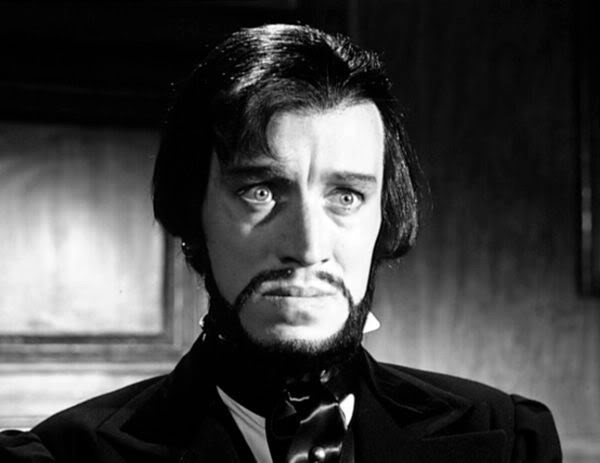 | | Max Von Sydow as Vogler the magician |
Movie Review The Magician (1958) d. Ingmar Bergman Criterion Collection #537 I was intrigued by The Magician because the included visual essay by Bergman scholar Peter Cowie identified the relationship between Artist and Audience, specifically the hatred of Bergman for his critics, as a primary theme motivating the film. Bergman's relationship with critics/Audience was formed during his decade long turn at the helm of the Malmo Civic Theater, where he directed plays. Apparently, he wasn't appreciated quite enough and he took the lack of appreciation to heart. It's common to think of great Artists as having a quality that places them above such concerns, but that is a disingenuous fraud, and I'm always interested when Artists confront that relationship in their art. That being said, The Magician is a bit of what I would call a "parlor drama" filled with characters in old timey costumes standing around inside and talking. This isn't Bergman's best look, and all of his top line classics have a substantial outdoor component that is missing from The Magician. The Magician is also an unusual Bergman film because it has a bona fide happy ending, with The Magician be summoned to perform for the King of Sweden to the shock of all.
The Atomic Submarine (1959) d. Spencer G. Bennet (12/9/13)
.jpg) | | Literally a one eyed monster, The Atomic Submarine creature couldn't be a bigger phallic symbol |
Movie Review The Atomic Submarine (1959) d. Spencer G. Bennet Criterion Collection #366Part of Monsters & Madmen Boxed Set Criterion Collection #364 There are some Criterion Collection titles where you kind of scratch your head and think, "OK, I guess you know what you're doing, Criterion Collection. Then you read the critical essay and your like, "Ummmm...ok, not so sure about this title, but I trust you." Then you watch the film and your like, "Ummmmmm... maybe you guys are wrong about this one?" I'm not saying The Atomic Submarine doesn't deserve Criterion Collections status. One of the primary goals of the Criterion Collection seems to be to bring obscure movies wider recognition, and a host of these films are found within the B-Movie genre pictures of the 1950s and 1960s. Generally speaking, Criterion Collection picks weirder, lesser known films. So I can see where The Atomic Submarine fits in but it isn't that weird, and it isn't that fun. It's no Carnival of Souls, to name a similar type of film with the Criterion Collection universe. I will admit that the creepy one eyed alien that lives at the center of an alien ship the military insists on calling "the cyclops" did give me the phallic symbol giggles, and the acting is classic b movie bad acting, which is itself an art form at this point, independent of "good" acting (see 80s indie films by John Waters and the Eating Raoul guy.) Knife in the Water (1962) d. Roman Polanski (12/11/13)
 | | Roman Polanski and Sharon Tate. Tate was murdered by the Manson Family. |
Movie Review Knife in the Water (1962) d. Roman Polanski Criterion Collection #215 Another movie review getting run on a book review day because the Forsyte Saga by John Galsworthy is actually a hellacious monster. I am done with one out of three volumes after a week of dogged, determined reading- including multiple e reading devices (computer, two phones, kindle) and reading in Court instead of playing Candy Crush, but it is just a terrible slog. Knife in the Water is Polanski's first feature film, made while he was still in Poland (Knife in the Water is actually in Polish.) His talent, ambition and technical are all fully on display. I'm not familiar with his career path to know how quickly he moved West, but even a casual viewer can tell that they are in the presence of an Auteur level talent. Considering that the movie features only three actors and is almost entirely set on a small boat, Polanski runs through a cavalcade of differently framed shots that often feature multiple focii points in a manner that would have been considered sophisticated at a Hollywood level. The story of Knife in the Water, about a couple that randomly decides to take a hitchhiker for an over night trip out on... the Baltic Sea? Is packed with tension and humor. His portrait of the troubled marriage of the two lead characters is concise and insightful. At 93 minutes, the film clips along with Hollywood level pacing and editing and you barely have a moment to be distracted. I'm a huge fan of Polanski- child sex abuse or no child sex abuse- and at the same time I understand why American doesn't want him here. I think it's a loss, and that what he did was forgivable, especially at the time and place when/where it happened. Polanski's Chinatown is probably my favorite movie of all time. The fact that a Polish filmmaker made the greatest California Noir and did it in the 70s is quite an accomplishment, and his other films aren't bad either.
Summer with Monika (1953) d. Ingmar Bergman (12/13/13)
 | | Harriet Andersson stares frankly at the camera in Bergman's Summer with Monika (1953) This film pre-figured French New Wave and anticipated many of the techniques used by those film makers. |
Movie Review Summer with Monika (1953) d. Ingmar Bergman Criterion Collection #614 Bergman didn't really have an international hit before The Seventh Seal in 1957. Distribution for the films prior to that The Seventh Seal was uneven. For example, in the New York Times article that I'm not linking to because of the NYT pay wall, the writer notes that in 1953, Summer with Monika was purchased for an American run by a distributor who emphasized the film in terms of its sexual explicitness. It was shown in the pre-art house grindhouse circuit, and largely ignored by the American critical Audience. However the reception in France was different, and Summer with Monika would later be cited by the Auteurs of the French New Wave as a primary influence in terms of the kind of filmed intimacy they sought in their early films. The same New York Times article points out that Summer with Monika is a more well developed version of his 1951 film, Summer Interlude. I would second that observation, especially since I watched Summer Interlude two months ago and still have it in mind. It is hard not to fall in love with a young Harriet Andersson playing Monika. Summer with Monika about a young, working class couple who fall into and out of love within the hour and a half run time of the film. The calm, steady camera work emphasizes Andersson's natural beauty at the same time her character displays personality traits that are anything but beautiful. The contrast is a quintessentially Bergman-esque theme. The last third of Summer with Monika is the familiar "hell is other (married) people" thesis that Bergman explores so successfully in his more mature work.
Sawdust and Tinsel (1953) d. Ingmar Bergman (12/16/13) Movie Review Sawdust and Tinsel (1953) d. Ingmar Bergman Criterion Collection #412 Understanding the career of Ingmar Bergman requires understanding his initial "break out" from the European film scene into the American/UK markets. Ingmar Bergman started directing films in the 1940s. By the time The Seventh Seal was released, February 16th, 1957, he had been making films for a decade. As this Google Ngram showing the popularity of Bergman in the English language clearly demonstrates, 1957-1958 was a break out year for him in terms of audience size: You can see that between 1950 and 1960, Berman experience a 500% rise in popularity. The release of back-to-back masterpieces: The Seventh Seal in February AND Wild Strawberries at Christmas in the same year, clearly led to a dramatic uptake among English language movie fans. This rise in popularity continued until 1975, when Bergman reached his peak, likely as a result of Bergman influenced American film makers (Woody Allen, most notably) reaching their peak. Thus, whatever one may think of Bergman's pre 1957 out put, it's important to recognize that any appreciation is essentially in the nature of a revival. Films like Summer with Monika and Sawdust and Tinsel were, at best, novelties, and did not have the break out quality of The Seventh Seal and Wild Strawberries. What you see in these earlier filims is a working-out of what was to become the Bergman signature style of combining dry humor with trenchant meditations on subjects like death and loneliness. In Sawdust and Tinsel, the story is a more conventional melodrama, though with obvious Bergman signature like an explicit acknolwedgement of human sexuality as well as actress Harriet Andersson playing her lusty peasant girl character to the hilt.
Wise Blood (1979) d. John Houston (12/20/13)
Movie Review Wise Blood (1979) d. John Houston Criterion Collection #470 Yeah I mean I've lived my whole life and I just found out that "Southern Gothic" is a literary genre, that Flannery O'Connor is emblematic of the Southern Gothic literary genre, that Wise Blood was Flannery O'Connor's first novel and that it was published in 1956, and that this film version- WHICH IS AMAZING- was made by John Houston in 1979, and set in the 1970s. I watched Wise Blood simply because it is on my Hulu Plus quesue and close to the bottom- and is an actual Criterion Collection title vs. those Eclipse titles they try to pawn off as legit Criterion Collection titles. Wise Blood is like a constituent element of what we would today call "Lynchian" though it also dove-tails with contemporary film makers like Harmony Korine, as well as the American independent films of the 60s and 70s. That Lynchian aspect is emphasized by the sepulchral presence of Harry Dean Stanton as a "blind" preacher. All of the performances are creepy and distinctly "southern" in tone. Presumably, Houston made a conscious choice to transport the late 50s time of the book to a late 70s reality. If you are a fan of the Jarmusch/Lynch/Van Sant wing of the Indie Film Museum- don't miss Wise Blood- it is a MUST.
Ashes and Diamonds (1958) d. Andrzej Wajda (12/25/13)
Movie Review Ashes and Diamonds (1958) d. Andrzej Wajda Criterion Collection #285 Why not post a movie review on Christmas? It's not like I'm actually writing this post the night before Christmas. Ashes and Diamonds is a pretty cool Polish picture about the aftermath of World War II in Poland, when the Polish resistance continued to resist against the new Soviet backed Communist regime by assassinating officials and so forth. Bear in mind that this movie came out in 1958, while Poland was (obviously) a Communist state. The main character, Maciek Chelmicki, played by Zbigniew Cybulski is a disillusioned veteran of the resistance, called upon to do "one last job" by assassinating sympathetic government official who has recently returned from war time exile in Russia. The job goes wrong initially, leading to two unnecessary deaths, and Chelmicki is forced to skulk around the Hotel where the target is staying for a local banquet honoring the local Mayor, who is on the verge of becoming a minister. While he waits for his moment, he woos the comely barmaid Krystyna, who shows him enough for him to decide that he is tired of the fighting life.... but first... he must finish this one last job. Other than Cybulski's iconic turn as Chelmicki: A cool anti-hero with all the charm of a James Dean or Steven McQueen, Ashes and Diamonds is fairly unremarkable save for the fact that it is a Polish film from 1958 operating at a high level of "Hollywood" style professionalism. Ashes and Diamonds is not particularly riveting, particularly during the courtship sequences, but it is overall a work of high caliber and certainly an unexpected surprise. The films from Eastern Europe/Soviet Union may be the biggest delight for me out of the entire collection.he likes "sad monsters" and uses the example from this film of the vampire from Cronos, Jesus Gris (played by Argentinian actor Federico Luppi) licking up blood for the bathroom floor. It's true, you can't get sadder then that. The jury is still out on del Toro as an Auteur. Methinks he needs a little less Pacific Rim and a little more Pan's Labyrinth, but it is still too soon to judge. I'm sure there will be more personal films like Cronos, The Devil's Backbone and Pan's Labyrinth in the future, intermixed with his more predictable genre exercises. Personally, I liked Pacific Rim.
|
|
|


.JPG)


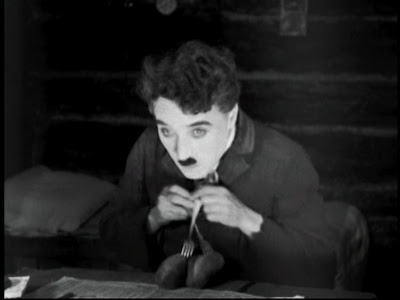


.jpg)


 Instagram
No comments:
Post a Comment