 |
| Still from the 1977 movie version of The Left-Handed Woman , also written by Handke. |
Published 11/9/16
The Left-Handed Woman (1975)
by Peter Handke
The Left-Handed Woman is hardly a novella, let alone a novel. At 70 pages, with large spaced between lines and equally ample margins, The Left-Handed Woman reads like a New Yorker short story, which, according to the jacket copy, it actually is. Confusingly, Handke himself made the movie version, which is "better known" as far as the English language audience for German literature is concerned. Like The Goalkeepers Anxiety of the Penalty Kick, The Left-Handed Woman is a 70's German take on the 1950's era French exisentialist novel. Who are we? Why are we here? What are we doing with our lives?
In The Left-Handed Woman, this classic plight is acted out by the narrator, a youngish haus frau named Marianne, who abruptly orders the husband and father of her children out of their apartment after she experiences a revelation that her husband, Bruno, will leave her "some day." Having been through my own personal experience with a woman whose behavior closely mirrored Marianne in this novel, I can say that Handke accurately describes the sudden change of mind that suddenly descends upon utterly normal type people. One minute you are in a happy marriage, the next you desperately need to escape. That is a way that people behave in our world.
Published 11/11/16
Ratner's Star (1976)
by Don Delillo
The 1001 Books project is well into the present of literature. Most of the authors on the list after this point in time are still publishing. Don Delillo occupies a rank just below the rank of Nobel Prize for Literature: He's well regarded by both audiences and critics, he's won national level book awards, at least one of his books is a staple of 20th century lit classes in colleges nationwide (White Noise). The only thing Delillo is missing besides a major international award is a successful movie adaptation of one of his works.
Delillo's place within the 1001 Books project is far from clear. He had eight titles in the first edition of the 1001 Books list. He lost four of those in the 2008 revision but gained a new listing, then he lost that new listing not two years later, leaving him with three remaining titles. I would observe that Delillo hasn't had a hit since Underworld in 1997- he's published five other novels since then, so it's not from lack of effort.
Ratner's Star is a famously difficult book, and it most closely resembles Grimus by Salman Rushdie- which was published in 1975. Both novels take the framework of genre fiction- science fiction and fantasy, and then ornament that structure with similar accroutements: A firm grasp on the "linguistic" turn in 20th century thought a la Wittgenstein and Beckett, a separate debt to Beckett for his exploration of language in the form of the novel and a playful idea that serious fiction can also be "fun" and/or "funny.'
I say this because both Grimus and Ratner's Star are described as "comic" despite being wholly unfunny. That is a characteristic of Beckett himself, but very much in evidence in the work of his followers as the "post-modern" period of the novel begins to arrive in the mid 1970's. Ratner's Star revolves around a teenage mathematical prodigy who is whisked away to work on a mysterious radio transmission from a distant star. His job is to decipher the meaning of the message.
Like the work of his contemporary Thomas Pynchon, Delillo studs Ratner's Star with numerous, elaborate discussions of higher mathematical theory, astronomy and geometry. These bodies of technical knowledge, analogous to the way Pynchon uses rocket technology in Gravity's Rainbow, are a distinctive characteristic of "serious" American fiction in the mid to late 20th century, and it is a development unique to American writers. These is nothing of such a technical obsession in the work of the modernists. If anything, they are anti-technology.
Now I'm not actually recommending Ratner's Star to anyone as a fun read. It literally is a combination of Beckett style linguistic dueling and complicated higher math and geometry. The characters all have funny names. It is, in a word, interesting but tedious, and at 420 pages, it is not a short book.
Published 11/22/16
The Autumn of the Patriarch (1975)
by Gabriel Garcia Marquez The Autumn of the Patriarch is probably Marquez's third most famous title behind
One Hundred Years of Solitude and
Love in the Time of Cholera.
The Autumn of the Patriarch is more challenging than either of the two other books. It is more of a "prose-poem" then a novel. The sentences are long and opaque, the plot thin to non-existent. What it does contain is atmosphere, loads of it. The atmosphere oozes from the walls of the decreipt Presidential palace, the location of the even-more decrepit Patriarch in question who is, "in reality" a dictator of an unnamed Latin American backwater, but who bears a marked resemblance of several of the uniformed"
Caudillo's" (strong-men) of Latin American politics in the post World War II 20th century.
In that sense,
The Autumn of the Patriarch is a minor-key in the ballad of literature about 20th century dictatorships, ranging from the experience of German's under Hitler, the victims of Hitler, the experience of Russians under totalitarian Communism, the experience of the Chinese under Mao and assorted other victims of power-mad single-person state governments. What makes it worth while is the attempt, with however much poetic license, to get inside the head of the perpetrator, rather than his victims. Nothing is pointed enough to constitute a specific criticism of a specific person, rather
The Autumn of the Patriarch is an attempt to make the reader feel the stench of corruption engendered by a totalitarian regime
It is an irony of 20th century history that regimes that are imposed with the specific idea of instilling discipline, purity and respect for authority so frequently obtain the opposite result, as citizens passively resist edicts they've had no part in formulating. I was surprised at times by the gross-ness of the imagery. It seems like few people have actually made it all the way through to the end, because there are scenes of De Sadian depravity towards the middle-end that really blow your hair back.
Published 11/30/16
W or The Memory of Childhood (1975)
by George Perec The Oulipo movement, a loose association of (mostly) French writers and academics who were the vanguard for experimental French fiction in the mid 20th century, is largely unknown outside of the academic specialty audience in English. The major formal innovation of the Oulipo writers was to impose constraints on their fiction writing. That is an approach which has found disciples outside of fiction, you can think of the Dogme movement spear headed by Lars Von Trier (mid career Harmony Korine was an adherent) and the career of American artist Matthew Barney, who literally built his career on a performance art series called "Drawing Restraint" where he physically restrained himself in different ways and then struggled for the Audience.
It's natural to think that experimental fiction written in French would lose "something in the translation," since it is written to be difficult to understand in the original French. From this perspective, W or The Memory of Childhood is an accesible entry point for readers exploring the works of Perec and the Oulipo school. It is both a straight forward narrative written from the perspective of the author, who is a Jewish child in Nazi occupied France, and an equally easy to understand parable about a fictional island nation off the coast of Chile, where everyone is engaged in an endless athletic struggle.
The details of the fictional athletics obsessed society are part Thomas More's Utopia, part Gulliver's Travels and part 1984/Brave New World, and of course, directly inspired by Nazi Germany and would I presume are the Author's dim memories of the so-called Nazi Olympics. I'm not sure if, by 1975, Perec was still operating under the voluntary restraints of the Oulipo movement.
By comparison,
Things: A Story of the 60's,
is obvious the product of conscious restraint, with first-name only protagonists who lack any sort of inner life. Although the stylistic restrictions are absent, there is still an obsession with rule in order, manifesting in the detailed descriptions of the horrific rituals of the fictional athletics-obsessed society of the parable half of the book.
There's also an interesting overlap with another 1001 Books title,
V by Thomas Pynchon. In
V, Pynchon writes a plot that hops back and forth, combining at a point, the V of the title (who is also a mysterious character in the book.) In the version of
W or The Memory of Childhood that I read, the author includes a foreward where he explains that the proper English translation of the title is, "Double V" not the English letter W, and this is because the inclusion of two parallel but related stories. 2 V's, in other words.
This approach is also echoed by the common film grammar of creating narrative tension in action sequences by moving between two separate locations without making clear the temporal relationship of the two sequences.
Published 12/13/16
The Dead Father (1975)
by Donald Barthelme
The Dead Father is the only one of the three novels by Donald Barthelme to survive the initial cull and replacement of titles between versions of the book. Frequently described as "surreal" and "post-modern," I would describe The Dead Father as turgid academic post-modernism, the same words used by a French critic who is quoted on the author's Wikipedia page. I didn't invent that description, but I subscribe to it. The front cover says it was one of the five best books of the year according to the New York Times, and the back cover compares Barthelme favorably to other early post-modernists like Thomas Pynchon and John Barth, both of whom are far superior to Barthelme.
To call The Dead Father a "novel" is more a tribute to it's length, over 200 pages in the pocket paperback edition I read, then any novel-like characteristics. Critics call his style "digressive" but you could also, just as easily, say that the book makes no damn sense. The Dead Father is supposedly a parody of high modernist writers like Joyce and T.S. Eliot, and I suppose I get that, but it's not a parody in the sense that is any way, shape, or form comic, let alone funny. I mean, it might be comic in the sense of the Greek theater sense of the word comedy as being the only type of drama besides drama or history, but it's not funny.
In fact, if I met someone and they claimed that The Dead Father was funny, I would pull up a copy of it on line and make them show me what is funny about The Dead Father. It is undeniable that there were some very "Emperor's New Clothes" in post-modern criticism and literature. The Dead Father may represent the earliest work where this turn into turgid academic post-modernism is crystallized, and therefore, it is also understandable why someone who happened to fashion a career in the academy during this time period might argue that The Dead Father is a classic work of literature. That, apparently, is the position of the editors of 1001 Books, but personally, I don't get it.
Published 12/14/16
Amateurs (1976)
by Donald Barthelme
Amateurs is maybe one of five books I've read as part of the 1001 Books project that doesn't have it's own Wikipedia page. I'd wager there aren't more than 10 books on the entire list that don't have their own page. I get it though, I have no idea what to say about Amateurs besides:
1. It is a book of short stories by Donald Barthelme, many of which were published in prestigious mass-market literary magazines.
2. The pocket paper back edition I read has a quote from Time magazine calling him a genius.
3. Not a single one of the stories made any sense.
Barthelme is closer to surrealism and dadism then he is to post-modernism. It just so happens that he was writing at the dawn of the post modern era in literature, so the tack stuck. But really he is just updating the cultural reference points for a set of narrative strategies (or anti-strategies) that were close to half a century old by 1976. Really, what we call post-modern in literature is a simply reaction to the realist novel, and realism as a literary ideology. That attack against realism in literature, which we call post-modernism, is part of a larger cultural attack against reason and the enlightenment which was spear headed by French and German philosophers before and after World War II.
At the same time, many writers on the experimental fringes of fiction were deeply influenced by the heavy logic of other philosophers like Wittgenstein and Alfred Whitehead, a movement separate from the critique of the enlightenment sponsored by the left leaning theorists in Europe. In his fiction, Barthelme seems to embrace both the process oriented, Wittgenstein/Whitehead influenced practice of spinning out every logical iteration of a sentence or phrase- something clearly visible in the earliest prose fiction of Beckett as well as the surrealist/dadaist practices of the Europeans.
So, I suppose, if you were reading this book in 1976, and you were aware of various nascent philosophical post-modernism in France, you would find Barthelme novel, but that is no excuse for hailing the man as a genius, let alone including three of his books in the first edition of the 1001 Books list.
Published 7/22/17
Gravity's Rainbow
by Thomas Pynchon
I would argue that Gravity's Rainbow is the second best novel of the 20th century (Ulysses by James Joyce). No author has more directly influenced by cultural development than Pynchon, from roughly college, when I read Gravity's Rainbow for the first time, to today. The reading I did for this post was, I think, the third time I've read Gravity's Rainbow, but it was the first time I bought a "reading copy" and sat there with a pen in hand, making notes page-by-page, so that I could delve deeper into the mysteries presented.
What I was discovered was more linkages between Pynchon's books, details of the intricacies of the plotting that had previously escaped my notice, and observations about Pynchon's influences. Starting with the last first, I was very much struck by the similarities between large swathes of Gravity's Rainbow and the writing of William Burroughs circa Naked Lunch. A critical character in Gravity's Rainbow is Doctor Weissman/Captain Blicero, a German army officer with a fondness for BDSM and gay sex. The chapters involving Blicero and his proclivities seem like they were almost imported from the Burroughsian fantasies of Naked Lunch. These heavy s&m sequences, which I basically didn't even remember reading about the first two times through, are likely the reason that Pynchon hasn't won the Nobel Prize for Literature- too dirty for the Nobel committee!
Blicero, as it turns out, spent his formative years in the German Southwest, where he served in the aftermath of the Herrero massacre- itself a reoccurring theme in the work of Thomas Pynchon. It is in the character of Blicero-Weissman that Pynchon really connects the idea of the exercise of power upon the body to his shaggy-dog rocket man plot. One aspect that becomes very clear is that for Thomas Pynchon, the idea of "plot" has a double meaning- the first is the typically literary meaning, the plot of the novel. It is the second aspect- that Gravity' Rainbow works out if you look at it in the sense of an x/y axis, where one plots points of data onto a map or graph.
This theme is woven throughout many of the sub-plots of Gravity's Rainbow, and embodied by the closest thing this book has to a central character, Tyrone Slothrop, who has an uncanny ability to predict an imminent rocket attack via an erection. The unraveling of this atttribute- with Slothrop seeking his own answers and a variety of world power trailing in his wake, is the main plot point, and the easiest way to describe the plot of Gravity's Rainbow. The title itself actually refers to the geometric space under the parabola of a rocket's trajectory, if I have that right- Gravity's Rainbow literally refers to the space one would describe under the arc of a rainbow. Thus, geometry, and geometric space, the plotting of points on an x and y axis, and the sciences they have been inspired seem to be THE central theme of this book.
The linkages between books are obvious, with reoccurring, tailismanic characters and shared narratives- the German extinction of the Herrero people in German Southwest Africa in the early 20th century being central to any attempt at a pan-Pynchon narrative of 20th century history.
I could go on.
Published 7/17/18
A Question of Power (1973)
Bessie Head
Bessie Head is the most well known novelist from the southern African country of Botswana. Her back story is incredible, born in 1938, the result of what they then call a "union" between a wealthy white South African woman and a black African. Head's mother was quickly and decisively sent to a mental institution and she may or may not have been insane as well. It's unclear what actually happened to Head's mother. Head came of age in South Africa where she briefly married an African political activist and got on the bad side of the South African government. She left, permanently, for Botswana and A Question of Power is a work of biographical fiction about a mixed-race woman living in super-African Botswana, while struggling with the burden of mental illness.
The description of Elizabeth, the protagonist/Head character's repeated descent into the throes of mental illness is astonishing. It's hard to make an accurate diagnosis- Botswana, at the time of A Question of Power has one western trained psychiatrist, who sees the institutionalized Elizabeth early on in the book, once, and dismisses her as "difficult." Elizabeth is outsider in multiple senses: She's half white, which is essentially unheard of in Botswana. She is educated, though Botswana in the 1960's and 70's was not the place for rarified discourse, especially for women. Head's Elizabeth is a woman without family, without anyone, living, essentially at the end of the Earth. A Question of Power is an extraordinary achievement in that regard- almost impossible to imagine it being written, let alone published, though I suppose simply receiving something by a Botswanan author writing in English would be enough to get a review for publication.
The fact that Head wrote this book while she herself struggled with similar mental health issues is enough to make the most cynical reader just stop and consider. I think the way the literature from the post-colonial global south has developed, the conflict between western-intellectual psychology and non-western cultures either already has taken or will take center stage. A Question of Power, written in 1973 in a trail-blazer.
Published 5/15/18
Interview with the Vampire (1976)
by Anne Rice
Largely credited with spurring the most recent revival of interest in vampire culture, Interview with the Vampire is going on a half-century of being the single most read book about vampires that isn't Dracula by Bram Stoker. The 1897 publication date of obscures an even older lineage for the vampire in western literature: In 1819 Lord Byron wrote a so-called "fragment" of a novel featuring the first Vampire in western literature. Thus, by the time Dracula was published, people had been talking Vampires for close to a century.
Tracing a literary pedigree for the vampire in western literature beyond Byron is a fools errand, surely the origination of the vampire character by the pre-eminent English poet and literary celebrity of his era is enough. Rice certainly deserves credit for pulling the Vampire into the age of tape recorders, gay love and locales like New Orleans. Her "new world" vampire, epitomized by the conflicted young planter cum vampire, Louis, is urbane and sophisticated, and most importantly, torn about the morally dubious prospect of constantly needing to murder innocent children in order to survive.
This represents an innovation on the Count Dracula/Nosferatu motif of the vampire as aged Eastern European nobility, brought to the west by boat for reasons which often remain unexplored. The conflicted vampire is a vampire who retains the moral sensibility of an ethical human being. If you've read the entire "Vampire Chronicles" you are aware that the first volume is a tame jumping off point for a mythology that rapidly grew to include Egyptian Gods and all manner of supernatural competitors. In Interview, you've only got the vampire Lestat, Louis, the girl child vampire, Claudia (memorably played by Kirsten Dunst opposite Brad Pitt's Louis.
I'm certain I read Interview before the 1994 film, meaning I read it in high school. I was never a goth, but I was goth adjacent and spent a year or so chasing various goth type girls in college before I found a long term girlfriend (who herself was goth adjacent.) Revisiting the audiobook version today, I was struck by just how bad Rice can be as a writer, making the incredible world-wide success of Interview a tribute to her grasp of the appeal of a vampire to a popular audience circa 1975.
Interview with a Vampire has been so overwhelmingly influential that it now can almost seem derivative if you aren't mindful of it's progenitor status. For example, True Blood, the recently popular HBO TV show, is so influenced by the aesthetic of Interview that it almost seems like a riff, in retrospect.
Published 5/31/18
Cutter and Bone(1976)
by Newton Thornburg
The editor who wrote the caption for this book for the 1001 Books to Read Before You Die called it a "lost classic," and considering how long it took me to track down a copy to read- an LA library ebook of a belated 2015 reprint- I'd be inclined to agree that is both lost and a classic of crime fiction. Amazingly, there is an equally obscure movie version called Cutter's Way, which stars- wait for it- Jeff Bridges as "Bone" who is, if I'm not mistaken, a major reference point for his character "the Dude" in the Big Lebowski. I have to watch the movie, which is available to stream on Amazon.com
Like all late 20th century noir/detective genre stories which rise to the level of literature, the plot is secondary to the scene and character development. Here, the Cutter and Bone duo are a corporate rat race drop out(Cutter, John Heard in the movie), currently making his way as a sometime gigolo among the casual vacation goers of Santa Barbara, and Bone(Bridges), a paraplegic amputee and Vietnam war veteran, living off his disability check. They are both living in a one room shack with Mo, who has a baby, and is herself on the run from life in a wealthy suburb and a college education. The three of them spend their time drinking, smoking and taking pills, and none of them seem particularly inclined to deal with anything.
Coming home from a bar one night, Cutter sees someone awkwardly dumping a large package into a trashcan. He wakes up the next morning to read that a local 17 year old is murdered. Despite his avowals to authorities that he didn't see anything, Cutter blurts out "it's him" the following day reading a story about a Midwestern millionaire in town for a business conference. Bone then launches a dubious extortion scheme, which eventually leads the duo and the victim's older sister, and a virginal UCSB student named "Monk," on a cross county adventure ending in Arkansas, the home of said suspect and Midwestern millionaire.
Published 12/2/18
Gravity's Rainbow (unabridged audiobook)(2014)
by Thomas Pynchon
Read by George Guidall
Penguin AudioBook Review: Gravity's Rainbow (1973)by Thomas Pynchon (
Reviewed 2017)
Audiobooks have been overshadowed in the past five years by the Podcast, but there is no reason to think that the Audiobook shouldn't see a kind of explosion in audience size as more and more people migrate to the world of unlimited online data. At a very basic level, an Audiobook is much smaller than a real book, less expensive (or should be) and just as available, if not more available, from your local library for free. Not every book gets the Audiobook treatment, and the industry essentially developed after 1970, in an iteration known as "books on tape." This evolved to books on CD, and what was originally limited to genre books and award winners has extended down to debut works of literary fiction, non fiction, current affairs and of course, genre fiction.
Like many new art-forms, the declasse nature of it's origins have led to a delay in acceptance and acknowledgment that an Audiobook is anything other then cheating on a regular book, but if you've actually spent any time listening to Audiobooks, you know this is untrue. The fact is, and this particularly true for longer books, you can get a lot more out of the Audiobook equivalent of a 500 page or more title. Trying to read a 5, 6, 7 hundred page book is a chore, requiring the reader to set aside blocks of time in a place where it is convenient to bust out an enormous book.
Thus, for a long work of literary fiction, the existence of an Audiobook version expands to potential audience dramatically, even among people, like me, for example, who actually do read long works of literary fiction. Many people do not, and it seems to me that
Gravity's Rainbow as a 40 hour Audiobook is a much easier pitch than the 800 page paperback. The Audiobook of
Gravity's Rainbow is the third time that I've made my way into what Robert Newman, in his 1987 book,
Understanding Thomas Pynchon called, "the epitome of the male labyrinth novel."
Newman also compares
Gravity's Rainbow to
Ulysses- a reference I made in my 2017 reading for the 1001 Books project. As I said in 2017, and Newman said in 1987, if Ulysses is the greatest novel of the twentieth century, then
Gravity's Rainbow is a strong number two. Newman identifies 11 major themes:
(1) the heroic quest for knowledge for self-growth and for the salvation of the quester's society
(2) the ambiguity of such knowledge in an uncertain world
(3) the meaning of freedom
(4) the paradox of mutability being the only stable concept in life
(5) the betrayals that occur between generations
(6) the consequences of repression
(7) the uses and misues of language
(8) the dangers of solipsism
(9) the perversions generated by man's misuse of nature
(10) the connections between the natural and supernatural worlds
and (11) the consequences of ignoring those lessons. - Newman 95-96
I would add a 12th theme, which is the duplicitous nature of international capitalism.
Pynchon develops these themes through close to 450 characters. I found the Audiobook preferable to the text in many different ways, and while the text, for a book like this is indispensable, the Audiobook stands on it's own as an important achievement. For example, Pynchon frequently makes use of songs, rhymes (he loves a good limerick), slang and argot, and reader George Guidall is able to give voice to these moments without the reader needing to puzzle it out.
40 hours appears to be an absolute limit for Audiobook length-
Cryptomonicon by Neal Stephenson is 40 hours.
War and Peace by Tolstoy is 40 hours. If you've ever read a long book, you can listen to a long Audiobook. As described as above, it is simply a more manageable commitment, never more now then one can listen to it on an App on a smartphone.
Published 3/24/19
Child of God (1973)
by Cormac McCarthy
Critically reviled when it was published in 1973, Child of God is an excellent example of a failure that presages later artistic success. Lester Ballard is the serial-killer protagonist of Child of God, living alone in Sevier County (pronounced severe county) in the 1960's. He is very similar to the Gene Harrogate character in Suttree (1979). The theme of a monstrously isolated outsider clashing with society is repeated in many of his books, but Lester Ballard is the most extreme example, and all of Child of God is about him. In other books- Suttree for example, the Ballard-like character only plays a supporting role.
I checked out the Audiobook version from the library- I think I mentioned before that McCarthy makes good material for an Audiobook, one of those authors where being able to hear the voices of the character really helps. I can't do an Appalachian accent in my head for a four hundred page book, let alone keep track of different variations on the theme. For readers who love McCarthy's later, more succesful books, Child of God is a must because you can really see how he developed between then and his more recent now.
It is also incredibly violent and depraved, and there is frequent unapologetic use of the n word- though not as much as in Suttree, almost putting him beyond the pale of current literary fiction conventions.
Published 10/26/19
Woman at Point Zero (1975)
by Nawal El Saadawi
Replaces: The Newton Letter by John Banville
Any thorough reader of the Western literary canon will notice a paucity of works translated from Arabic, let alone works published in English where the writers are the children of immigrants to the West. Only one writer in Arabic has won the Nobel Prize in Literature (Naguib Mahfouz- 1988). Mahfouz is absent from the 1001 Books list- I found some Audiobooks in the Libby Library app but just can't generate the energy to tackle him.
Woman at Point Zero is a feminist era book that blends fiction and non-fiction- with the text purportedly based on a real interview El Saadawi conducted with a female prisoner awaiting execution for murder. Nawal El Saadawi is interesting in her own right, a female doctor and public intellectual who clashed with the- also secular- dictatorship of Anwar Sadat, eventually being stripped of her public status and even sent to prison. Obviously, prostitution is an issue in Egyptian society but it isn't really out there, Egypt being a pretty conservative, repressive place, even during the secular 70's.
It's an easy choice to replace The Newton Letter by the excellent but overrepresented Irish author John Banville. The diversity bonus from a book written in Arabic, by a secular, Egyptian author, about a member of the urban underclass- that's like quadruble diversity bonus points- the mere fact that it has been translated into English is enough to warrant a canonical inclusion.
Published 11/4/19
Kiss of the Spider Woman (1976)
by Manuel Puig
Replaces: Fools of Fortune by William Trevor
This book is better known in the English speaking world for it's Academy Award winning movie version (1985) and the subsequent musical (1993), but the book stands out as a pathbreaker in Argentina, both for its frank depiction of the life of prisoners under the Peronist dictatorship and for its treatment of LGBTQA themes, a rarity for that time and place. Such was the controversy that Kiss of the Spider Woman was actually published in English translation before the Spanish language version came out, and it was several years before the Argentinian authorities allowed it to be officially published inside the country.
The story is straight forward, but the execution is not. Two people are in prison in Argentina, one, Valentin, is a political prisoner of great interest to the authorities, the other, Molina is a transgender woman (biologically a man) imprisoned for "corruption of a minor." The prison authorities want to use Molina to get information out of Valentin. Molina is eager to take advantage of the benefits of such a arrangement but becomes predictably conflicted when it comes to actually divulging any information and betraying Valentin.
The plot is interrupted or supplemented by several lengthy recapitulations of "films" told by Molina to Valentin, some based on real films, others invented, in an attempt to while away the endless hours. The style of the book is stream of consciousness, and it is left to the reader to deduce who is speaking, and indeed, what is actually happening.
Puig's gain as an add to the 2008 edition of the 1001 Books list is another loss for Ireland, since Puig's book replaces Fools of Fortune by William Trevor. Of course, Puig is another win for Spanish language literature.
Published 11/13/19
Blaming (1976)
by Elizabeth Taylor
Replaces: The Diary of Jane Somers by Doris Lessing
No, it's not that Elizabeth Taylor, rather it is English author. Blaming was published after her death. Like Barbara Pym, another overlooked English author who was omitted from the original 1001 Books but added to the first edition, Taylor writes what you might call "domestic fiction": fiction about ordinary people living ordinary lives, with no meta-fictional fuckery, unusual viewpoints or exotic locations. In Blaming, Amy, a 60's empty nest housewife is suddenly widowed when her painter husband dies unexpectedly during a Mediterranean cruise. Amy is befriended by Martha, an awkward American novelist, and they continue a halting friendship upon Amy's return to London, where she tries to figure out what to do with her life.
The characters are unlikeable in a manner that reminded me of the Larry David school of interpersonal relationships: Friends are a bother, people are terrible. Despite being the wife of a succesful painter, Amy is about as unartistic as you can get, she doesn't seem to read or have any unusual opinions. She doesn't like caring for her grandkids, and cringes at almost any social interaction. I can see why Taylor might be the type of author to see her career rescuitatted in the decades after her death, a woman writer, writing quiet, domestic, fiction, it is the precisely the type of literature overlooked in the literary critical/popular marketplace of the mid to late 20th century.
The book(s) it replaces on the 1001 Books list is the collection, The Diary of Jane Somers, originally published by Lessing under that pseudonym Jane Somers. Lessing was decades away from her 2007 Nobel Prize, but still, it is a strange, if not uncommon stunt for an established author to pull. Lessing was incredibly prolific, with forays into science fiction (the Canopus in Argus series, five books) and her wild quasi-fictional biography the Children of Violence series, which has its own dystopian science fiction entry, five books. She's also got close to twenty separate volumes of short stories and even four books grouped as "Cat Tales" about Cats, I presume.
So, it's hard to mourn the loss of The Diary of Jane Somers from any canonical list of 20th century literature. I think it's probably not even her third of fourth best book, all told. Taylor doesn't do anything to increase diversity except in the introduction of a petit bourgeois/non family based "office worker" milieu, basically unrepresented in the serious precincts of literary fiction.
Published 11/19/19
Year of the Hare (1975)
by Arto Paasilinna
Replaces: Concrete by Thomas Bernhard
This extremely popular (in Finland) picaresque novel didn't get an English translation until 1995- also an Audiobook- but it was a welcome departure from the parade of woeful existentialist protagonists who have featured prominently in most of the additions to the first revision of the 1001 Books list. I get it, if you include diverse viewpoints you are going to end up getting voices that sound similar to the voices that already exist inside the canon- with a different viewpoint but similar structure.
Kaarlo Vatanen is a ennui stricken Finnish journalist, who, after injuring a hair while driving to a small Finnish town on assignment, spontaneously decides to abandon his life and embarks on a series of adventures with said hare. He gets drunk, gets into fights, works as a firefighter, sells salvaged German armaments from World War II, gets engaged even though he is married, goes on two separate bear hunts and ends up getting arrested inside the Soviet Union. Year of the Hare was a fun Audiobook- seemingly the first addition to the 1001 Books list that has an Audiobook version available. Year of the Hare replaces yet another title by Austrian author Thomas Bernhard- I feel like three of the last four books I've read from the revised 1001 Books list replaced Bernhard books.
Published 12/3/19
Cataract (1976)
by Mykhaylo Osadchy
Replaces: Yes by Thomas Bernhard
This Soviet era prisoner memoir by Mykhaylo Osadchy, a Ukrainian poet is hard to figure as an addition to the 2008 edition of the 1001 Books list except as a diversity pick- Ukraine and all the other ex-Soviet Republics being sorely absent from the original 1001 Books list. Of all the nations subject to the 20th century Soviet embrace, only Czechoslovakia and Poland had any success getting the attention of Western readers of literary fiction. In recent years, that's changed- Svetlana Alexievch, the Belarussian Nobel Prize winner in 2015, and Olga Tokarczuk, the co-winner this year, have introduced two potential representatives that are Ukraine adjacent.
Honestly, with those two writers in mind, it is hard to make a case for Cataract, which is pretty much your standard Soviet era prison memoir. The minor twist is that Osadchy is from a post-World War II generation that was actually raised to believe the promises of the Soviet Union, and much of Cataract has the tenor of late 20th century American teen who goes off to an elite college and learns that capitalism is bad, man. Only here, Osadchy gets a two year prison sentence. If you know anything about the Soviet prison memoir you know that two years is basically a slap on the wrist.
Cataract replaces yet another Thomas Bernhard title- I feel like that is maybe four of the last five 2008 additions to the 1001 Books list- that they've replaced Bernhard titles.
Published 12/3/19
Cataract (1976)
by Mykhaylo Osadchy
Replaces: Yes by Thomas Bernhard
This Soviet era prisoner memoir by Mykhaylo Osadchy, a Ukrainian poet is hard to figure as an addition to the 2008 edition of the 1001 Books list except as a diversity pick- Ukraine and all the other ex-Soviet Republics being sorely absent from the original 1001 Books list. Of all the nations subject to the 20th century Soviet embrace, only Czechoslovakia and Poland had any success getting the attention of Western readers of literary fiction. In recent years, that's changed- Svetlana Alexievch, the Belarussian Nobel Prize winner in 2015, and Olga Tokarczuk, the co-winner this year, have introduced two potential representatives that are Ukraine adjacent.
Honestly, with those two writers in mind, it is hard to make a case for Cataract, which is pretty much your standard Soviet era prison memoir. The minor twist is that Osadchy is from a post-World War II generation that was actually raised to believe the promises of the Soviet Union, and much of Cataract has the tenor of late 20th century American teen who goes off to an elite college and learns that capitalism is bad, man. Only here, Osadchy gets a two year prison sentence. If you know anything about the Soviet prison memoir you know that two years is basically a slap on the wrist.
Cataract replaces yet another Thomas Bernhard title- I feel like that is maybe four of the last five 2008 additions to the 1001 Books list- that they've replaced Bernhard titles.
Published 1/8/20
The Dispossessed (1974)
by Ursula Le Guin
Replaces: City Primeval by Elmore Leonard
I can think of three series of literary/science fiction involving authors who projected an anarchist/socialist/communist society into an intergalactic milieu- I heard of all three of them via the 1001 Books project, probably reflecting the fact that American readers of genre fiction aren't huge on left leaning works of literary/science fiction. The Dispossessed is part of American author Le Guin's Hainish Cycle, which takes places in a galaxy where a small number of planets- including a future earth (called "Terra") were colonized by the original humans- the Hainish- who then promptly disappeared for several hundred thousand years before popping back into the picture and reaching out to their various progeny.
The cycle doesn't take place in chronological order- The Dispossessed was published sixth in sequence, but its events are the first in chronological sequence. The protagonist- not the narrator- The Dispossessed is written in the third person- is a physicist names Shevek living on a planet that embraces a dispersed anarcho-communism. This planet is a moon of another planet, Urras, which resembles a conventional, better managed Earth, with capitalists and state-communists, and an upper and lower class. Half the chapters are flashbacks showing Shevek's life before he leaves his planet and travels to Urras- the first person from his planet to do so.
Because it is first chronologically, The Dispossessed is a good entry point for readers looking to delve into the nine volume Hainish cycle. I've always associated Le Guin with her very popular young reader titles- A Wrinkle in Time is a canon-level classic, I would expect that the editors of the 1001 Book project would have picked that book, not something from the Hainish Cycle, but there you go.
Published 1/22/20
The Alteration (1976)
by Kingsley Amis
The Alteration is a fun alternate-history tale with a genuine literary pedigree, set in a world where the Reformation was avoided after Martin Luther accepted the Papacy. In alternate 1976, the whole Christian world is Catholic, with the exception of a rumpish independent New England under its own religion affiliated government. The enemy is "the Caliph" or "the Turk," a full strength plus Ottoman Empire that maintains a modern military.
Alternate 1976 is a variation on the steam-punk motif, in the world of The Alteration, science remains suspect, electricity is banned, and fast transportation relies on (non-electrical) diesel power. There is, for example, a train that runs between London and Rome in six hours. The mode of government in this world is totalitarian-lite and there are echoes of Nazism (Jews are in hiding, have to wear yellow stars) and a straight forward projection of an Inquisition era church projected onto the modern era.
The story is about a 10 year old boy who has the sweetest voice in all of England. Visitors from Rome arrive to suggest that he be "altered" i.e. castrated, so that his pre-pubescent voice is kept pristine. Mind you, it is 1976 in this book. Hubert Anvil, the angelic singer, is too young to know what he will be missing, but he's old enough to know that there are pluses and minuses and that he should be concerned.
He goes on the run, enlisting the help of some would-be kidnappers and the embassy of the New Englanders, before everything resolves in an ambiguous fashion. Seems like a good basis for a prestige tv version!!!
Published 5/29/20
Guerrillas (1975)
by V.S. Naipaul
V.S. Naipaul is one of those 1001 Books discoveries who have made it to the next round- making my way through the non canonical novels and 100% skipping the non fiction. Most Nobel Prize in Literature winners have different dimensions ranging the gamut from novels to short stories to poetry, and then usually you've got some essays around, a memoir or two. Guerillas was his follow up to his Booker Prize winner, In A Free State (1971) Guerrillas finds Naipaul at his nastiest, the kind of book that Naipaul haters would hate especially, and I can see how Guerrillas would be especially "problematic" if you were reading it from a feminist perspective.
The characters in Guerrillas are sketches- we are never told where, exactly we are, though Trinidad or a similar island seems like a good bet. The histories of the major characters: Roche, a white South African revolutionary who has taken a PR job with a colonial mining company, Jane, his diffident wife and Jimmy Ahmed a recently returned from the UK island intellectual with a penchant for sexual misadventures. Jimmy may or may not be fomenting revolution under the guise of an agricultural collective that Roche is supporting. Jane may or may not fancy a fling with Ahmed. The action lazes along for much of the book only to explode in the final act, though given the emphasis on political revolution the ending is likely to surprise.
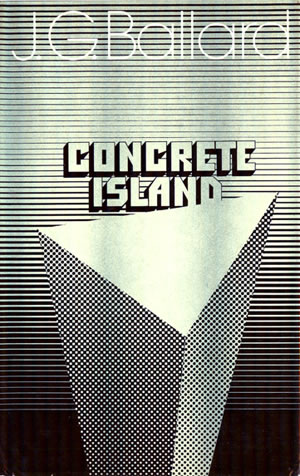 |
| Original hard back cover for Concrete Island (1974) by J.G. Ballard |
Published 8/17/20
Concrete Island (1974)
by J.G. Ballard
J.G. Ballard novels don't get any more high concept than this: London architect finds himself stranded on a between-freeways island, where he becomes involved with a homeless sociopath and hooker-with-a-heart-of-gold in his attempts to escape. The Ballardian website describes Concrete Island as the third volume of his "Urban Disaster" trilogy, alongside Crash and High-Rise. To me, it seems to be his most Robinson Crusoe-ish book, attaching Concrete Island to the main-stream canon of great literature in a way that many of his other books do not. With his emergence from the genre world, Ballard never seemed to be particularly concerned with the boundaries of genre and literature, and it makes sense that the resemblance to Crusoe was just another example of genre-allowed borrowing rather than an explicit attempt to ascend from fiction to literature.
It seems like by the mid 1970's, Ballard concerned considered himself a capital A artist, no matter what critics or audiences might have thought. This decision seems crucial to understanding Ballard the man as well as understanding his work. I was genuinely enthused to get to it, but ultimately Concrete Island, like many other of Ballard's non-canon works, seems more exciting when you hear it described that it is when you actually read it.
 |
Cover of the New York Review of Books Classics edition of The Glory of the Empire by Jean d'Ormesson
|
Published 9/22/20
The Glory of the Empire (1974)
by Jean d'Ormesson
The Glory of the Empire sounds like a Borgesian short story brought to life: A French author writes an entire history of an Empire that never existed. The Onessa Empire exists somewhere around the Black Sea- the nearest historical analogue seems to be the Byzantine Empire or an Empire founded by one of the Greek colonies on the coast of present-day Turkey. The lead characters include Alexis, an Alexander the Great type of polymath who founds the the original Empire and Basil the Great, the canny political operator who extends Onessa's domain from Europe to the coast of Korea via an unexpected alliance with a Genghis Khan type barbarian ruler.
In truth though, The Glory of the Empire sounds like more fun that it actually is, probably because the history that d'Ormesson is aping is the 19th century style "great man" kind of history. It's possible that this is the exact point he is making: Our practice of elevating so-called "great men" is fiction whether the men in question existed or not.
Published 5/11/21
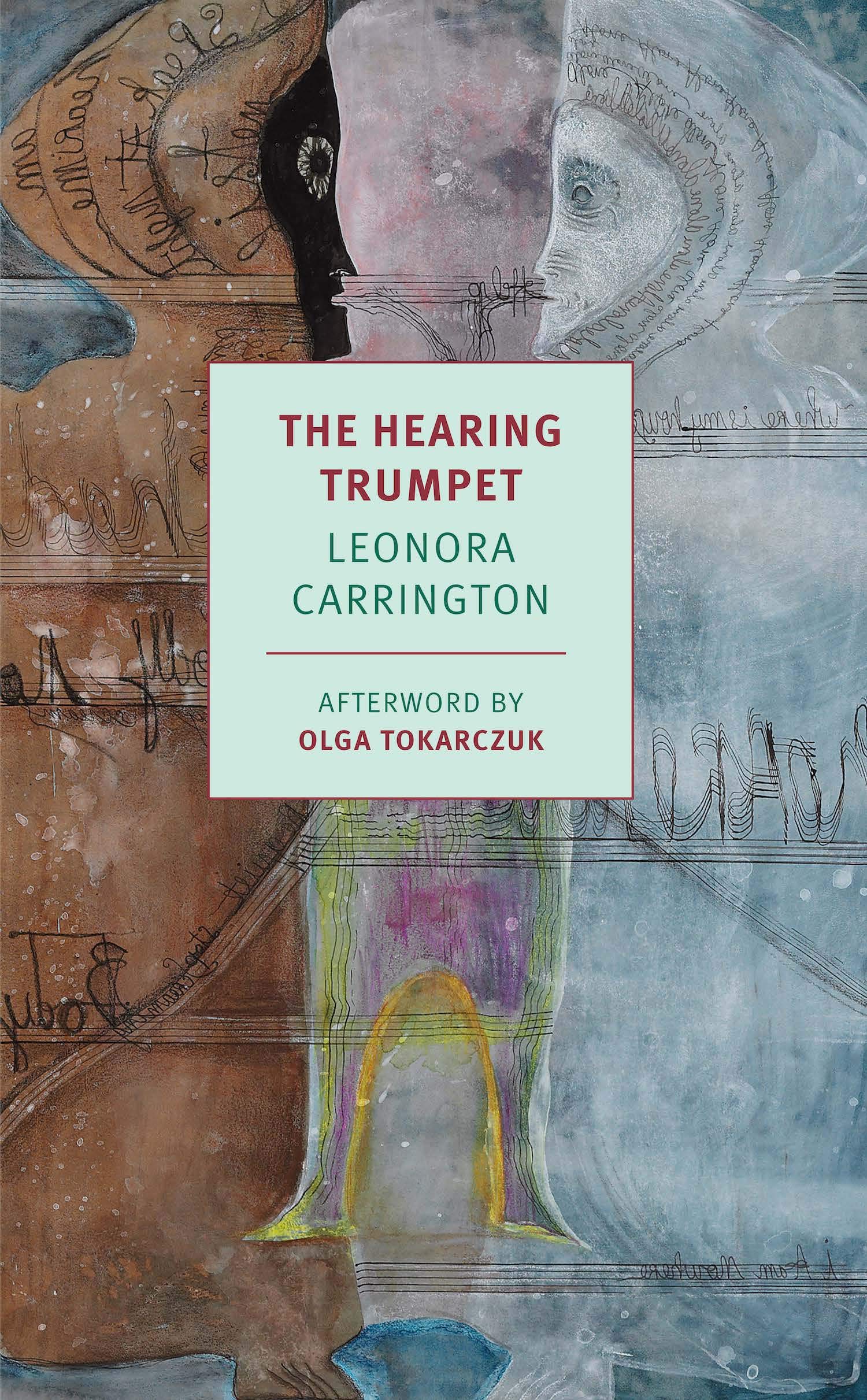
The Hearing Trumpet (1974)
by Lenora Carrington
I read the new edition of The Hearing Trumpet by Lenora Carrington for two reasons. First, it was published by New York Review of Books Classics. Second, the afterword was written by last year's Nobel Prize winner Olga Tokarczuk. Carrington is known as one of the last surrealists (she died in 2011.) Although I'd never heard of her either department, she is also well known for her (also surrealist) paintings.
It's hard to say what The Hearing Trumpet is about, like most truly surrealist works of literary art, The Hearing Trumpet makes little or no sense. But it was published in 1975- 1975! That is DECADES after the surrealists passed from the scene, and there she is, churning out surrealism in the 70's.
The cover of the New York Review of Books Classics edition of
The Continuous Katherine Mortonhoe
Published 6/3/20
The Continuous Katherine Mortonhoe (1973)
by D.G. Compton
I went through the science fiction/fantasy category of the New York Review of Books Classics selections on the Libby library app and simply tagged most of them. The Continuous Katherine Mortonhoe is the first book from that group, originally published in the UK as The Unsleeping Eye in 1973. The 2016 New York Review of Books edition kept the American title, and added an introduction from dean of the "new weird" writers of American speculative fiction, Jeff VanderMeer. In the case of Katherine Mortonhoe, his introduction to the plot is useful, since Compton's switching between two different first person narrators leaves the reader guessing at the "reality" of Compton's world:
SOMETIMES a novel is so complex it’s simple. Take D. G. Compton’s The Continuous Katherine Mortenhoe. The novel chronicles the dystopian adventures of a woman told she has four weeks to live, and builds an intricately imagined and believable near future not so different from our own, complete with wildly popular reality shows that feed the appetite of a “pain-starved public,” even as death from anything other than old age has been virtually eliminated. The story is told in chapters that alternate between narration from Katherine’s point of view and the first-person account of Roddie, the host of one such Human Destiny program. At its heart, however, Compton’s book is about two essential predicaments of the human condition: mortality and love. Harkening back to social realist novels by the likes of Theodore Dreiser, Compton’s structure methodically but brilliantly exposes Katherine to different strata of society as she reckons with her diagnosis and Roddie reckons with the man his job has made him.
Honestly, I had trouble following The Continuous Katherine Mortonhoe, and I'm sure readers of early 1970's British science fiction were equally vexed. A true first person narration is difficult enough to follow when the universe depicted is based on a "reality" of the past, when you introduce speculative elements, the absence of an "all knowing" narrator to explain things to the reader makes understanding doubly complicated. It also makes such a book more "literary," and I'm beginning to see that as a trend in the speculative fiction category of New York Review of Books Classics titles.
For example there is Moderan (2018) by David R. Bunch, which is similarly difficult to piece together because of the use of a first person narrator in a post-apocalyptic world. It's a cautionary tale for authors seeking to blend speculative fiction with literary fiction, too simple, you lose one audience, too complicated and you lose both.








 Instagram