Dedicated to classics and hits.

Showing posts with label 2021. Show all posts

Wednesday, June 26, 2024

Criterion Collection Reviews 2014-2021

 
Criterion Collection Reviews 2014-2021

   The idea that I would watch all of the titles of the Criterion Collection was first made possible by the emergence of streaming platforms.  I remember watching Criterion Collection titles on both Netflix and then a dedicated Hulu channel back in 2013, 2014.  The second enabling circumstance was the end of my marriage which gave me several months of solitude where I could actually sit around in my house and watch long, boring, foreign movies without anyone wanting me to do anything else.  After I started dating my current partner, about a year later, I simply didn't have the time or inclination to sit down and watch these titles.  There was a brief revival of interest in my part in 2021 when the Criterion Channel emerged as a stand alone streaming service, but again, there simply wasn't the time for me to be sitting, alone, watching these films, which is the only practical way to do it, because they are long, often boring and often complicated.

  Mostly what I remember from the Criterion Collection escapade are the films of the 1950's from Japan, Sweden and Italy.  Even though it is a subject that never comes up, I feel well-grounded in the world of those films.  If Ingmar Bergman or Frederic Fellini ever comes up in conversation I've got five to ten minutes of plausible material. 
\
  It's also worth mentioning here that the Criterion Collection subculture is one of the saddest I've encountered in the world of culture.  I continue to be a member of the Facebook group of Criterion diehards and they are a sad bunch.  It's ironic that even though this blog has the vibe of a collector-completist and I actually make vinyl records and sell them I basically despise the culture of collectible artistic artifacts, i.e. book collectors, vinyl record collectors, dvd collectors. 

   Nowhere is that attitude more apparent than in my utter abandonment of writing about movies in the past few years. 


Published 2014
The Lost Honor of Katharina Blum (1975)
d. Volker Schlöndorff and Margarethe von Trotta
Criterion Collection #177


  I guess I haven't mentioned many of the German Criterion Collection films by Wim Wenders and Werner Herzog because I've seen them all.  Werner Herzog especially-  Many of the recent films in the theaters.  Soooo.... Scholndorff, who has seven films in the Criterion Collection, is like the most famous German director who's films I've seen or heard mentioned by anyone at any time in my entire life.
        Both Katharina Blum and Young Torless, the other Schlondorff film I've seen, are versions of literary novels. Schlondorff is pretty on the record about not wanting to write movies, and his choices of source material within the German world certainly limited his appeal in the English speaking film markets.
         Katharina Blum is a young divorcee in 70s Germany who has the misfortune of falling in love with a terrorist/army deserter.  She is hounded by the press after her arrest on suspicion of aiding a terrorist. The "shocking" ending involves her murdering the reporter responsible for tarnishing her name AND the fact that she is, actually, a communist sympathizer.  At least that is how I read The Lost Honor of Katharina Blum.  The psycho sexual nature of the abuse she suffers at the hands of the "system" is a point of emphasis in the film: the obscene phone calls and greeting cards she received are harped upon, repeatedly.
          That sexual element is a kind of thematic link to the subject of "internet fame"- the tabloid culture that is the primary target of this movie.  Like then, is now, unwanted attention from the media can have a very rapey element, and Katharina Blum is a kind of rape at the hands of strangers parable, compete with a revenge fantasy tacked on at the end.


Published 2014
The Spirit of the Beehive (1973)
d. Victor Erce
Criterion Collection #351


   I know my quest to watch every Criterion Collection film AND read all 1001 Books listed in the 2006 edition of 1001 Books to Read Before You Die, but I am making progress.  As I write this I am accumulating the harder to obtain titles in the period between 1900 and 1920 in 1001 Books to Read Before You Die.  Criterion Collection just re-upped with Hulu- making it more likely that additional titles will join those already available.

  Initially released in 1973, the Criterion Collection of The Spirit of the Beehive released in 2006 was hailed at the time as an excellent version of an all-time classic film.  The Spirit of the Beehive has a perfect 100% on Rotten Tomatoes from the important 2006 Criterion Collection edition release- with 19 favorable critical reviews- most from the 2006 DVD release.

  The Spirit of the Beehive is a film set in the 1940s in the immediate aftermath of the Spanish Civil War, made during the 1970s, while Franco was still in power, so it's a movie that is elipitically "about" Spain under Frcianco while actually telling the very non-political story of a little girl, played by the immortal Ana Torrent, who becomes obsessed with Frankenstein after seeing the movie in her rural village.

  The tale unfolds in a pace reminiscent of Japanese cinema: A LOT of static composition and lingering images of interiors.  Specifically, director Erce seems inspired by Ozu.  This point is made by film scholar Linda Ehrlich in a featurette that is basically a 15 minute film professor lecture on the film.  Based on her material, it seems like The Spirit of the Beehive was subjected to a good deal of 90s style academic film criticism. I'm not sure any of that would really add to a movie that is classic and enduring because it is delicate and vague.

  There is a lot you could say about The Spirit of the Beehive, but that seems like its besides the point.


Published 2014
Shadows (1959)
d. John Cassavetes
Criterion Collection #251
Part of John Cassavetes: Five Films
Criterion Collection #250


  Ever since I discovered John Cassavetes via a Le Tigre song reference, he's been presented as a take it or leave it proposition.  The lyric in the Le Tigre song is, "What's your take on, Cassavetes? Genius?  Alcoholic!"  This trope is mirrored in much of the critical literature discussing his films within the Criterion Collection.  The Criterion Collection John Cassavetes: Five Films includes Shadows- which is his first feature, Faces (1968),  A Woman Under the Influence (1974), The Killing of a Chinese Bookie (1976) & Opening Night (1977) are all amazing films, each and every one.  Additionally, he was the first figure in the American Independent Film Movement.  Saying you dislike Cassavetes is tantamount to saying you hate independent film.  I mean even if you have some kind of problem with Cassavetes as a human being, I just don't see how that in any way compromises the importance of his art AND his status as an independent producer of art and artist simultaneously.

 Shadows, shot over a period of 2-3 years and compiled largely from two separate versions of the same story shot more than a year part- cost 40,000.  Released in 1959, the same year as Godard's Breathless, its impossible to watch Shadows and not consider/compare it to Breathless and other films of the French New Wave.  However even a cursory consideration of the two films leads the viewer to the inevitable conclusion that Shadows was just raw as fuck.  Precisely how raw is brought into focus by the accompanying feature-ette about the restoration process that preceded the re-release of the restored version of the film that is available for viewing on the Criterion Collection Hulu plus channel.

 Shadows is transparently a revolutionary film by virtue of its subject matter, technique, style, sensibility and mode of production.  It is loosely "about" an interracial brother/brother/sister combo and their circle of musical/literary friends.  Hugh, the older brother, is a dark skinned African American.  Lelia, the younger sister, is (thought played by a white lady) light skinned African American who effortlessly "passes" for white in the desegregated world of books and music in late 1950s New York City.  The depiction of the intellectual milieu of late 1950s New York- filled with be bop jazz, party talk about existentialism, and self conscious Beats who are anxious to avoid any discussion of Beats, will ring a bell both with those familiar with the era in question or hipsters in any generation.

  The technique: using non-actors, shooting in a variety of lighting conditions and scenery gives Shadows (and all of Cassavetes films) a pulsing energy which has come to define the style of Independent film, as well as becoming highly influential within Hollywood itself.   I could go on.  I guess I just don't see the argument AGAINST Cassavetes AT ALL and I think if you don''t like Cassavetes you are ignorant or haven't watched his hits.  Go watch his hits.


Movie Review
The Devil and Daniel Webster (1941)
 d. William Dieterle
Criterion Collection #214

  I guess this is what you would call a "lost classic."  Based on a now forgotten short story by Stephen Vincent Benet, The Devil and Daniel Webster is about a small New England farmer who hits a run of bad luck and sells his soul to the devil in exchange for seven years of fortune.  The Devil or "Mr. Scratch" is memorably depicted by Walter Huston in a "worth it just to see him" kind of way. His Mr. Scratch is more akin to a character our of a 90s independent film then one from an American film shot in the early 1940s.

  The Devil and Daniel Webster is really ABOUT Daniel Webster and America in a way that strikes a contemporary viewer as being, to say the least, overly sentimental.  That's more a flaw of the source material then the film itself, which uses expressionistic effects and surreal dream time sequences to elevate the film far above the short story which spawned it.

  Watching The Devil and Daniel Webster almost requires reading the two(!) accompanying essays at the Criterion Collection website.  The 2003 essay by Tom Piazza about the performance of Walter Huston as Mr. Scratch, and the 1990s essay about the troubled post release and restoration history of the film; both give the needed background to really get into the mode of the film.  Without context, a modern viewer is likely to want to take a pass after the first ten minutes.


Movie Review
Only Lovers Left Alive (2014)
 d. Jim Jarmusch

The release of a new Jim Jarmusch film is a rare and exciting event for anyone interested in Criterion Collection type films.   Jarmusch already has three features in the Criterion Collection proper: Stranger Than ParadiseDown By LawMystery Train and Night on Earth (??)  He also has multiple titles that probably worthy of the Criterion Collection treatment: Ghost Dog and Dead Man.  One Bill Murray starring certified indie hit, Broken Flowers (13 million dollar domestic box office.)  Jarmusch averages approximately one film every four years.  His last movie, The Limits of Control, released in 2009, was his biggest flop.

 Your average Jim Jarmusch joint clocks between 1 and 3 million in box office.  He has resolutely maintained his independence as a film maker, which I think means that he does not do work for hire.  It doesn't mean that he distributes his own films.   Only Lovers Left Alive is released by Sony Classics and his two films before that were Focus Features.

 It's a fair observation 20 plus years in that Jim Jarmusch is not for everyone. When you compare his box office results to similar film makers like David Lynch, the Coen Brothers or other well known indie film makers like Wes Anderson that share a similar "target audience" Jarmusch will inevitably have a smaller audience.

 This is perhaps understandable in terms of Jarmusch's use of a slow, contemplative style that links all of his films with the work of Italian proto-auteur Michelangelo Antonioni.  Jarmusch evokes comments from the Audience similar to critical responses to Antonioni, namely that his movies are slow and boring.  Saying that a specific Jarmusch film is "slow or boring" is not a particularly valid point because the films are supposed to be like that.  He's drawing on a half century of international cinematic language, and it is no surprise that his foreign box office is often double or triple that of the US box office.

 The Antonioni connection is particularly significant in the context of any discussion of the artistic merit of Only Lovers Left Alive because Tilda Swinton, the vampire Eve, is to Jarmusch what Monica Vitti in L'AventurraLa NotteL'eclisse,  and Red Desert, is to Antonioni's in his most enduring films.  To put it bluntly, if you want an Audience to sit and stare at the screen for an hour and a half while nothing much happens, put a woman (and/or man) in the frame who merits that much attention.  Tilda Swinton is that woman (or man depending on the role.)

 For a film maker to find such a muse so far into his career seems unusual, if I was to think of examples: Godard with Anna Karina, Antonioni with Vitti, Tarantino with Travolta, I would say the muse usually shows up earlier rather than later.  But Jarmusch has never been in much of a hurry has he?  His progression, from defiantly "art house" pictures, to genre experiments, to some kind of synthesis of the two is typical of that of the independent auteur trying to adhere both to a specific artistic vision AND continue to make films.

  In framing Only Lovers Left Alive as a "vampire movie" Jarmusch has pulled off the clever tactic of cloaking an art house wolf in genre sheeps clothing. It is a tried and true tradition more than a half century old at this point. Ghost Dog and Dead Man represent earlier, and in my opinion less
successful attempts to do much the same thing that he accomplishes in Only Lovers Left Alive.

  Most surprising about Only Lovers Left Alive is the humor, something awol from many of his reent efforts. I laughed aloud repeatedly in Only Lovers Left Alive- it was truly a funny movie, and cool, and thoughtful.  The vampires are the artists, the zombies are the audiences, and the facilitators.  Only Lovers Left Alive is a metaphor about the life of the Artist in the contemporary world. 

Published 2014
Il Posto (1961)
d. Ermanno Olmi
Criterion Collection #194

   Certain to be a hit with people who fetishize early 1960s Europe, Il Posto is an intimate look at a young boy from the suburbs who goes to work for a faceless corporation in post war Milan. Although the brief description might make Il Posto sound like a late 60s Godardian nightmare, the reality is that Il Posto is one of the warmer Italian films of that period, with a real sympathy and fondness for young Dominico, played by Sandro Panserio.  Loredanno Detto is alluring as his love interest, Antonietta.

  For me, the best scenes took place during their lunch break, as they wander the cityscape of late 50s/early 60s Milan and do memorable things like having espresso or looking in store windows.  It's enough to make me wish I was there, and that I could travel back in time.  There's a palpable sense of innocence and naivete that is a far cry from Antonioni's bleak-ass existentialism, and that sense does set Il Posto apart from contemporary Italian films


Published 2014
Dillinger Is Dead (1969)
 d. Marco Ferreri
Criterion Collection #506

  Ferreri is not one of the better known Italian directors of the 60s/70s, but he evidently has his fans among the lords of the Criterion Collection, who call Dillinger Is Dead a "magnificently inscrutable masterpiece."  Well it is inscrutable.  Near as I can tell, the whole movie is "Man" played by Michel Picolli, coming home from his job where he designs gas masks (satire alert!) to his "Wife"(Anita Pallenberg.)  He farts around in his house: feeding his wife pills, cooking a meal, and playing with a pistol.  He listens to music. Then, five minutes before the end of the film he puts a pillow over his sleeping wives face and shoots her in the head three times, before driving off and joining the crew of a Tahiti bound yacht as a chef.

  Not entirely sure why Dillinger is Dead would be hailed as a masterpiece, but there you go.

Movie Review
Elena and Her Men (1956)
 d. Jean Renoir
Criterion Collection #244

   Another popular category within the Criterion Collection is the lighter works of directors who are generally considered to be "serious" types. Elena and Her Men, a romantic comedy starring Ingrid Bergman as a Polish Princess, fits neatly into this category.  Set after the Franco-Prussian War of 1871, Bergman's Princess Elena Sorokowska is the object of affection for multiple men.  You've got Henri de Chevincourt, a quiet but influential aristocrat who prefers to stay out of the limelight, then you've got General Rollan, who is being pushed by his supporters to assume dictatorial powers in the aftermath of a border dispute over a "captured" French observation balloon.

 I don't think Elena and Her Men is supposed to be anything other than light comedy, but a movie about a potential dictator in the aftermath of World War II seems like a strange choice for a romantic comedy.  Throughout the film, Bergman is pushed to use her influence with the General to get him to become Dictator, but ultimately she tells him to follow his heart and helps him escape his fate by means of kissing his romantic revival (she makes out with the revival in front of the assembled masses while the General slips out the front door.)

 For me, 85% of the pleasure of watching this movie came from Bergman's performance and 15% from the post-Franco-Prussian War milieu.  Renoir does a stylish, professional job executing his task, but I can see why the New Wave critics might have found films like this wanting.

Movie Review
Secret Honor (1984)
d. Robert Altman
Criterion Collection #257

   Another delightful surprise from the interior of the Criterion Collection, this is a Robert Altman directed version of a one man play featuring Richard Nixon, drunk and alone in his house in New Jersey, dictating to a tape recorder and ruminating about his past, his presidency and a shadowy conspiracy of global capitalists who controlled his rise to power.

In this film/play, Watergate was a ruse devised by Nixon himself to "get out."  The reason to watch is Phillip Baker Hall playing Nixon.  Hall is familiar to most people for his roles in Paul Thomas Anderson films, starting with Hard Eight (Sydney) but when Secret Honor came out in 1984 he was a nobody.  Hall is nothing but extraordinary.

  I wasn't expecting to actually be engaged by 90 minutes of Nixon ranting, but I found myself googling his off hand references and learned a ton about Nixon era conspiracies involving the Bohemian Grove, the Bay of Pigs, and the Committee of 100. Murray Choitner- the shadowy campaign manager.  It was an interesting period in history. Richard Nixon was an interesting guy.  Surely any hard feelings of him must be mitigated in light


Movie Review
That Hamilton Woman (1941)
d.  Alexander Korda
Criterion Collection #487

  I'll watch the shit out of an Alexander Korda picture.  They are... delightful, like a series of films from an alternate universe where Hollywood came via London.  His movies are Hollywood type pictures.  The Thief of Baghdad is one of the first special effects spectaculars, The Four Feathers is a  War Picture.  That Hamilton Woman was shot during World War II on a very limited budget with the goal of making a film that would prop up morale in England during the early stages of the war. That Hamilton Woman stars Vivien Leigh as Lady Hamilton and Laurence Oliver as her adulterous lover and Naval hero, Lord Nelson.

  Lady Hamilton is a real life lady who had an adulterous (and child producing) affair with Lord Admiral Nelson during the time of his greatest military triumphs.  Her consort was co-Naval officer Admiral Hamilton.  The woman was, in real life, a former show girl (and maybe prositute?) who is traded by her young aristocratic lover to his uncle (Admiral Hamilton) who is much older.  Lady Hamilton meets Nelson in Italy and their passionate affair comes all the way back to London, where society is scandalized.

  The last thirty minutes of the two hour run-time is highlighted by a French/English Naval battle that recalls the action scenes of Four Feathers and the special effects sequences of The Thief of Baghdad.  Of course, Leigh and Olivier were in the midst of their own adulterous affair, mimicking the plot of the film. As a bonus you get an impassioned


Symbiopsychotaxiplasm (1968)
 by William Greaves
Criterion Collection #360

   The Criterion Collection calls Symbiopsychotaxiplasm a one of a kind film, and it is a pretty amazing piece of work: A movie about movie making, made by an African American film maker in 1968.  Greaves is best known as a documentarian, prior to making this film he worked in Canada on educational films (Boards of Canada are named after these films.)

  Although Symbiopsychotaxiplasm clearly echoes some of the stylistic contributions of the French New Wave, Greaves own status as a documentary filmmaker informs Symbiopsychotaxiplasm throughout.  Although it first appears to shambolic, the interplay between Greaves, "playing" himself as the director of the film, the crew, and the actors is intriguing and at times it's like watching a Robert Altman movie from the next decade.

  There's not much a plot, just the two characters endlessly repeating a single scene where they fight about the guy possibly being a homosexual.  The rest of the hour and fifteen minutes is either the actors complaining, Greaves counseling the actors, and the crew complaining about Greaves and debating his merit as a film maker.  The extent to which the director William Greaves is the "real" Greaves is unclear, certainly the characters in Symbiopsychotaxiplasm is at times brutally  negative about his capabilities as a film maker in the film-within-a-film.  Hard to believe this is Greaves only film in the Criterion Collection, and that I'd never heard of William Greaves before watching this film.


Movie Review
Sweetie (1989)
d. Jane Campion
Criterion Collection #356

   Adjusted for inflation Jane Campion's, The Piano grossed over 70 million USD.  However it's Sweetie, her first feature, that interests me, mostly because it's just so weird. The Piano was nominated for three Academy Awards and won two, for Best Actress and Best Supporting Actress, but Sweetie is no less of a revelation.  It's hard not to view Sweetie through the lense of its Australian-ness.  The "Australian Literature" label on this blog has two entries, both films (Walkabout and The Last Wave.)  Through 1929 there are exactly zero Australian books and one book written by a Kiwi (Katherine Mansfield was born in New Zealand but raised and lived in England.  I'm also totally unfamiliar with any Australian painters or studio artists of note.

 That makes film Australia's primary contribution to world culture.  Campion was a clear and distinct female voice at a time when there were few female auteurs operating anywhere in the world.   Part of the enduring quality of Sweetie is the visual style of the film, with off-kilter camera angles and frame composition.  Another part is the performance of the two central actresses Lemon as Sweetie and Karen Colston as her frigid sister Kay.  Sweetie is a mentally handicapped loud nightmare and the family dynamic is twisted indeed.  There may or may not be an incest theme- everyone who has seen or written the film mentions it, and the film appears to keep it open ended (whether the Father molested Sweetie and or Kay.)

 For sure, you can't forget the character of Sweetie. Truly immortal performance.


Movie Review
La strada (1954)
 d. Federico Fellini
Criterion Collection #219

  Federico Fellini is a core member of the Criterion Collection.  In the United States, his name is/was typically invoked in the same way that people call something "Lynchian"(David Lynch) today: Having a surreal and/or grotesque visual quality.  Criterion Collection is more concerned with showing the whole film maker than dwelling on Fellini's more extreme films.  Satyricon, the most "Fellini-esque" of his films, does not even have a Criterion Collection release, and his early films which show is development as a neo-realist are heavily featured.

 La strada is notable simply because it was Fellini's first international hit, and secured him an Audience (and funding) for his films for several decades.  It also made a star of his wife, Giulietta Masina, who plays the mildly retarded Gelsomina Di Constanzo.  At the start of the picture, Giuletta is essentially sold to Zampano (Anthony Quinn), a travelling strong man who was previously "married" to Giuletta's older sister.  Anthony Quinn, an American actor, is a brutal, terrifying thug and we watch the situation go from bad to worse between the two of them, with Zampano unable to do anything save bully and cajole, and Gelsomina foregoing several opportunities to ditch Zampano in favor of making pathetic ( and failed) attempts to "win him over."

  Considering the quality of the two lead performances, I'd say it's easy for a contemporary viewer to see what all the fuss was about, and La strada is certainly a good starting point for someone looking to "get" the work of Federico Fellini.


Movie Review
The Threepenny Opera (1931)
 d.Georg Wilhelm Pabst
Criterion Collection #405

  The addition of sound to film was actually a set back for the art of film, in that recording sound with a motion picture required using a huge, immobile apparatus that prevented the movie camera from moving around the set, making the resulting sound pictures very static and uninteresting in terms of the film art.  While The Threepenny Opera by Georg Wilhelm Pabst is an example of expressionist cinema, the film is based on Brecht's adaptation of a 1920s revival of the 18th century work "Beggars Opera."  Originally meant as an iteration of the "Penny Dreadful" genre in the late 18th century, a revival in London in the 1920s made it way to Germany via the English speaking mistress of Bertolt Brecht.

  Brecht used Kurt Weill to write the music for his version, and it would be these tunes that would end symbolizing the Weimar Republic for generations of Audiences.   The most famous song is of course, "Mack the Knife" a song which topped the US charts in the 1950s during the Rat Pack era.
So yeah, it's a German expressionist version of a Brecht version of a 1920s English revival of an 18th century English popular opera.  What else do you need to know?  Oh, and it is close to 2 hours long, and there is a fifty minute documentary that Hulu Plus has thoughtfully included.

  It is the musical numbers that stick with you, the impressive quality of the sound in 1931 and Pabsts' expressionist camera techniques- shadows and all that.


Movie Review
Before the Rain (1994)
d. Milcho Manchevski
Criterion Collection #436

  It is hard not to associate Before the Rain with Kieslowski's Colors trilogy.  Kieslowski was Polish, and Manchesvski is Macedonian what there is something memorably "European" about the visual look and storytelling feel of both Artists binds the four films together on an emotional level.  Before the Rain was an American hit, and remains the only Macedonian sponsored film to be nominated for Best Foreign Film for the Academy Awards.

   Manchesvski came from a background of helming music videos in the United States, and it is clear from the opening scenes that Manchevski has a visual style that summons to mind Enya and 90s U2.  Although Before the Rain is about the violence that wracked the Balkans in the early 1990s, it's not a specifically Macedonian milleu- Macedonia having been the only Balkan nation to escape widespread violence. Manchevski also provides a story line centered in London, and his directorial touch is smooth whether he's in the outback of.... Bosnia? Albania? or shooting in downtown London.

  It's easy to see why Before the Rain struck a court with international audiences, it seems almost perfect for the 1990s American Arthouse circuit that I experienced in the Bay Area and Washington DC growing up and going to school.  It's very much a situation where if you liked the Colors trilogy by Kieslowski, you'll like Before the Rain.

Movie Review
An Angel at My Table (1990)
by Jane Campion
Criterion Collection #301

  An Angel At My Table is Jane Campion's 1990 bio-pic on New Zealand author Janet Frame. Frame was notably confined to a mental institution for 8 years in her mid 20s, and given "over 200 rounds of electro-shock,"  as the story goes, she was rescued from a "fast-track lobotomy" at the last minute when her book of short-stories won an award.  She was hastily deemed "cured" (decades later a board of English psychiatrists would issue a ruling that she was never schizophrenic).   Her new found status as a prize winning author was sufficient to get her a grant to travel to Europe, England and Spain in particular, where she was able to "live life."

  With a biography that itself evokes many of the literary themes of the mid to late 20th century: mental illness, early death of a sibling, loneliness, etc. there is an obvious question about whether (to quote the accompanying Criterion Collection essay by Amy Taubin, "Frame's autobiography is fictional or her fiction autobiographical or both."  Under both formulations, it makes for a good movie, or miniseries for that matter.  An Angel at My Table was originally shot as a television series, and its origins are revealed both by the three part one hour episodes (which correspond to the three volumes of her auto biography) and the fairly static "workmanlike" visual style, which is in sharp contrast to the stylistic virtuosity of Sweetie.

   The themes of artistic development and being an "outsider" is central to both the 1001 Books project and the Criterion Collection.  A high volume of "break through" projects by artists are based on the most interesting aspects of their personal history.  "Write about what you know" is a truism of 20th century college education, but a more accurate statement might be "Write about what you are."

   Janet Frame is emblematic of an artist turning personal flax into artistic gold, and it is easy to see why Campion, or any other artist would be interested in giving her life story the feature film treatment.


Movie Review
Foreign Correspondent (1940)
d. Alfred Hitchcock
Criterion Collection #696
Criterion Collection edition released 2/18/14.

   Alfred Hitchcock arrived in Hollywood and released two films in 1940: Rebecca and Foreign Correspondent.  Both were nominated for a Best Picture Oscar, Rebecca won, but Foreign Correspondent is probably the more relevant film in 2014, with a topical "Europe at the cusp of war" background and international spy story plot.   John Jones (played by Joel McCrea) is a crime reporter working at a Daily paper somewhere in the United States.  The editor, frustrated by the low quality of the reportage coming from his European reporters, sends Jones to the United Kingdom with the explicit direction to interview Dutch minister Van Meer, who "holds the key to war and peace" for unnamed reasons.

  He chases Van Meer from London to Amsterdam, where Van Meer is (seemingly) shot in front of his very eyes- HITCHCOCKIAN HI JINKS ENSUE.  There is laughter, tears, action sequences, unexpected plot twists, all of the elements of classic Hitchcock, right there the first year he shows up in Hollywood.  Hitchcock is truly one of the paragons of artistic and commercial success in the area of film art.  He was an inspiration for the "Auteur" concept, with his rigid control of every element of production from casting to, of course, directing.


Published 6/18/15
8 1/2 (1963)
d. Federico Fellini
Criterion Collection #140


 One of the peculiarities of watching the Criterion Collection is that you are more likely to see the minor and/or early works of  particular canonical director.    Minor and early works are more often available and less often have a prior DVD edition, allowing Criterion to essentially introduce the film to their audience.   Minor and early works are also more likely to show up on the Criterion Collection Hulu Plus channel, which is why the sudden appearance of 8 1/2 in mid May of this year was such a surprise.

  Getting a handle on Fellini without 8 1/2 under your belt is nearly impossible.  It's also one of the quintessential "movies about making movies" that seem to substantially define the mindset behind the "art film" as a genre.   In it, Marcello Mastroanni plays Guido Anselmi AKA Federico Fellini. The plot concerns Anselmi/Mastroanni/Fellini's trials and tribulations immediately prior to the principle photography portion of a movie he is supposedly making.  The movie remains un named and undescribed, but it appears to be a grand, complicated affair.

  Anselmi's musings are nearly universal and concern the struggle about whether the creation of art is worth the effort.  The role of naysayer is tellingly played by Anouk Aimee as Luisa Anselmi, the wife of the director.  She inserts herself into a cozy weekend getaway for the director and his mistress, and it isn't long before she is talking about the lies he creates with his films, and how his art is ultimately self-serving, masturbatory and useless.  Ultimately, Anselmi abandons the film, though a cryptic/surreal ending hints that maybe his decision is subject to a later reversal.

  Through and through a masterpiece, 8 1/2 is a must if you have Hulu Plus- it was just uploaded, so don't delay in watching it lest they take it down before you get a chance to watch.
 

   Movie Review:
 Tess (1979)
d. Roman Polanski
Criterion Collection #697

  This my second go at the re-telling of Thomas Hardy's 1891 novel, Tess of the D'Ubervilles. I also took a look at the BBC miniseries from 2008, with Gemma Atherton playing Tess.  I gave Thomas Hardy a label on this blog because he represents a kind of dark perfection of the late Victorian novel, and the Victorian period really was the high point of pre-modernist fiction.  As a heroine, Tess is at the far side of the abyss which have the heroines of Jane Austen and the Bronte sisters on the other side.   Tess, a murderess, is an unabashedly tragic heroine in a way that both anticipates the future of tragic heroines, embodies his present in the Edwardian Period, and flawlessly harkens back to the prior period of late Victorian fiction represented by Anthony Trollope.

  Polanski's Tess is the definitive filmed version, with three 1980 Oscars to its name and a total of six nominations.  This three hour long movie also grossed 20 million at the box office, which would be close to sixty million dollars today. The Criterion Collection obviously does not have a problem with Polanski's flight from the United States to avoid facing charges of statutory rape/real rape of a child, but, hey it was the 1970s.  At any rate, disliking an artist because they are a monster is the equivalent of saying you don't like any artist, because many of them have issues with people and engage in bad behavior of all sorts. It's not necessary to create great art, but it seems to be a favorite aspect of artistic life.  The art they create is separate from their behavior, and exists independently of whatever they do as people.

  The box office success and Oscar wins reflect that Polanski really nailed the Victorian novel adaptation Hollywood film genre in 1979. His production is anchored in the landscape of the English countryside, a languid pace allowing him to exploit said countryside for maximum visual impact, and casting Natassja Kinski (who was 19 during filming) as Tess, and these elements were enough to win the movie multiple Oscars.

 I think a central fact to understand about the appeal of Hardy's original novel is that it was published in 1891, but covered time in the 1870s.  In other words, Hardy was writing about a time period over twenty years ago.  This is the same kind of nostalgia embodied by the film, American Graffiti or Grease, a romantic past, but of course with Hardy it turns out terribly badly.  The ability of an Artist to succesfully reach back in time and capture the attention of an Audience at the time of the initial reception increases the likelyhood that future Audiences will react similarly.  This is in comparison to works that reach the attention of an Audience because of their novelty or timeliness.  Those works which initially gain attention because of their novel characteristics are less likely to be appreciated by subsequent audiences.


Movie Review
Revanche (2008)
d. Götz Spielmann
Criterion Collection #502

  It's not everyday you watch an Austrian film. Götz Spielmann has a smooth, international style that reminded me of Krzysztof Kieslowski and Atom Egoyan.  Revanche splits its time between the seedier precincts of an unnamed German speaking city and the bucolic country side of either Austria or Germany, and Spielmann seems equally drawn to both locales.  There are many, many, many contemplative shots of the landscape, typically with a single character in frame, staring off into the distance.  Call it Euro cinema, but it seems to happen where you have good cameras and technical staff a need to conserve and limit camera movement and fast cut editing for cost purposes.
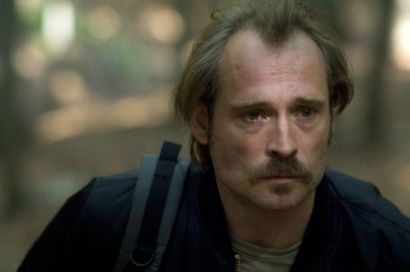
Johannes Krisch plays Alex in Revanche (2008) directed by Gotz Spielmann
     Despite breaking no new ground in terms of look or feel, Revanche is compelling for the combination of elements: German crook looking for revenge or redemption, Ukrainian prostitutes, Polish gangsters, strip clubs, farm life are compelling and together.  What starts out as a crime caper gone wrong transforms into a very different film once Alex (actor Johannes Krisch) leaves the urban underworld for his fathers farm.

  The happy ending comes as a welcome surprise, and Revanche ends more like a Hollywood movie than a dour European art form.  Only released in 2008, I have to wonder if and when Gotz Spielmann will make it to Hollywood, and what they will have him do.  He is a film maker to watch.


Movie Review
The Flowers of St. Francis (1950)
 d. Roberto Rossellini
Criterion Collection #293


   Merry Christmas!  I like to keep the blog dark on major holidays but writing about The Flowers of St. Francis on Christmas was irresistible.  While there are stylistic consistencies between Rossellini's better known Italian neo-realist trailblazers of the same period and this film, the thematic gap is likely to leave viewers double checking whether The Flowers of St. Francis is really a Rossellini picture.  There is no hint of world weary irony or cynicism in his portrayal of St. Francis, here simply Francis.  Rather the approach is classically hagiographical: a series of well known incidents from the works produced after his death by his followers.

   Franciscan monks famously take a vow of poverty, and The Flowers of St, Francis will certainly fill you in on the medieval back story as well as the various ways Francis proved himself to his followers, who are also the "Flowers" in the title (I think.)  Francis stands for peace, non-violence and kindness towards others.  In the accompanying Criterion Collection essay, the author mentions that in contemporaneous interviews Rossellini compared St. Francis to Gandhi as a way of making the case for the relevance of his film.

  Despite the ponderous and religious nature of the subject, the film possesses the quiet beauty of other Rossellini films, and by the end it becomes comparable to his other films and less the stylistic outlier that it at first appears to be.


Movie Review
In Vanda's Room (2000)
d.Pedro Costa
Criterion Collection #510

  I feel compelled to restate every so often that there is no higher/pretentious purpose to watching all the Criterion Collection movies and reading all 1001 Books to Read Before You Die. It's just something I do in my spare time. I don't spend much time on these posts either, thus the typos and general lack of attention, and I don't feel bad is only 15 people read a specific post.  Really, it just seems to me that in a world where we can get everything at any time it takes a little more than randomly casting about to see what tv series one is going to watch next on Netflix.  I will cop to being a fast reader- basically 100 pages an hour, so that is why it appears that I read "so much."

  It is not an exaggeration to say that my life prior to the streaming/free everything computer revolution was a constant search for new material to read, watch and listen to. If you didn't work, your choices were limited in terms of what books you could read, what films you could watch, and albums you could listen to. But people need to give examples of things to do beside binge watching all the tv shows of a sitcom in a weekend., or listening the Billboard 100 on free Spotify. So this blog is my idea about how to take advantage of being able to get anything anytime for free.  After all what does everyone do with their surfeit of leisure time?  Squander it, mostly.

  All that says, there were moments during In Vanda's Room, a 2 hour forty five minute movie shot on digital video about a bunch of Portuguese junkies, that triggered the above reflections about why I should even bother.  In Vanda's Room is an example of another recurring non-official category of the Criterion Collection, "Movies my 25 year old self would have been super excited about."  I'm not saying that my present day self might not also enjoy some of these films, but 25 year old would have been like, out in the street, at bars, telling people about In Vanda's Room.

  The two hour forty five minute length is all the more remarkable because Costa shot In Vanda's Room on digital video.  Most of the scenes are static shots of the interiors of the junkie squalor chic of the now demolished Lisbon/Lisboa slum, Fountainhas.  In Vanda's Room is actually the middle film in a trilogy which is set entirely in Fountainhas prior to demolition.  The apartment complex at the center of this film appears to be actually in the process of being demolished during the shooting of the film, multiplying the already strong Verite vibe lent by the simple scene set-ups and digital video contrast.   The Vanda of the title is a more-charming-than-most junkie and she is surrounded by a cast of characters who exist both inside and outside the titular room.

  According to the Criterion Collection cast list, all the characters play themselves, which makes me want to say that he actually made a movie using junkies.  Were they actors?  The ambiguity is what sets In Vanda's Room apart from other entries in the Junkie film oeuvre that use recognizable professional actors.  It's easy to see the choice to use non-actors in film as cutting across financial and artistic considerations.  It is obviously cheaper, particularly in a country with a small domestic film industry.  You can also argue that professional actors detract from other more artistically important aspects of the film, like the generation of mood and the mise en scene/composition.

Movie Review
Ikiru (1952)
d. Akira Kurosawa
Criterion Collection #221

  Ikiru, directed by Akira Kurosawa, must be one of the most "Criterion Collection" titles within the Criterion Collection, since it satisfies virtually every criterion used to select films for the Criterion Collection AND because it also exemplifies those criterion.  If you wanted to describe a generic film that would be included in the Criterion Collection, you would describe Ikiru.  As the Criterion Collection product description page puts it, Ikiru is "[c]onsidered by some to be Kurosawa's greatest achievement." By whom, exactly?  Ikiru is a work by an acknowledged master of a Foreign cinematic tradition, it is two and half hours long, it wasn't a hit in the United States upon initial release, it's about a guy with stomach cancer, it uses flashbacks and stylized mise en scene to tell a multi-faceted story about the protagonist.

    Ikiru has all the qualities that make the Criterion Collection the Criterion Collection, and it also has all the qualities that make the films of Akira Kurosawa the films of Akira Kurosawa, and they are essentially the same qualities. One of the questions I've begun to ponder as I move into double digits with Kurosawa films is where the Western influence stops and the Japanese contribution begins.  Of course, Western scholars have historically dwelled on the influence on Kurosawa by Western film, but he was very much a product of Japan and its film culture.

    It is easy to see the Japanese contribution in his selection of subjects, which adheres to the Japanese distinction between Jidaigeki and Gendaigeki.  The former of these are historical drama (including Samurai films) and the latter are drama's set in the present day.   Whereas Western watchers may interpret Kurosawa's Samurai pictures as his take on the Hollywood Western, Japanese watchers will see a typical Jidaigeki influence by American director John Ford.  Similarly, a movie like Stray Dogs, which will remind Western watchers of a police procedural/detective story, is a well executed Gendaigeki for Japanese audiences.

   Japanese Gendaigeki differ from Western melodrama in that they are less often centered around the traditional Anglo-Western marriage plot, and typically don't deal with the drama of wealthy elites.  Rather, the characters are typically  normally people, with normal concerns.  This day-to-day earthiness can perhaps be explained by Japanese filmmakers being less convinced of the merit of the Romance as a genre. I think it's almost impossible for Western audiences to conceive of a world where the Romance isn't the primary influence on domestic drama in filmed art.  With Kurosawa and Japanese filmmaking you have a whole artistic universe not subject to the limiting dictates of romantic artistic convention.

  This discussion is appropriate for a discussion of Ikiru because the story of a man dying of stomach cancer, with no wife and an estranged son, is the polar opposite of a romantic story.  Literally about death and bureaucracy, Ikiru could only exist outside the world of Western art. One of the major "character traits" of Japanese culture that I've picked up from Japanese film is the deep fatalism of its hero's, and Ikiru is remarkable in that it depicts someone struggling against his destiny, and doing something other than submitting meekly to his preordained fate (dying of stomach cancer.)

Masaki Kobayashi, director of J-Horror film Kwaidan and also Samurai Rebellioin, was an important Japanese film director in the 1960s.


Published 1/12/15
Samurai Rebellion (1967)
d. Masaki Kobayashi
Criterion Collection #310


  Masaki Kobayashi is better known for his early J-horror classic Kwaidan (also in the Criterion Collection), but Samurai Rebellion is impressive in its own way, with the inestimable Toshiro Mifune playing the lead role as Isaburo Sasashara, an initially faithful vassal in the late 18th century who is forced into rebellion when his liege lord first forces his son to marry a discarded mistress, then seeks her return after an untimely death makes her bastard son the next heir to the local feudal title.  Like many Samurai pictures, Samurai Rebellion keeps the potential for sword play close by but reserves actual action sequences until the final act.

 Instead, Samurai Rebellion is a rare-for-the-milieu classic "man against the system" tale.  Kobayashi focuses his eye on the injustic of the feudal system, and his feudal Japan is a critical perspective that delves deeper into the actual feudal relations between lord and liege in a way typically absent from Japanese Samurai pictures. 


Movie Review
Casque d’or  (1952)
d.  Jacques Becker
Criterion Collection #270

  Initially a failure upon release, Casque d'or, a period piece set in and amongst the Apache Dandy-Criminals of the Parisian Belle Epoque at the turn of the 20th century, was revived by the critics of the French New Wave, who saw something endearing in the low life characters and setting.  Casque d'or isn't exactly "gritty" or "raw" in the way we think of noir realism after the revolution in appreciation for film noir.  It is, after all, a period piece, which stand opposed to everything that the French New Wave stood FOR.  Becker worked as a cinematographer with Jean Renoir, and his style reflects the cool, professionalism internationalism of the major cinema markets prior to the earthquake of post-war European film innovation.

  Because of that influence, Casque d'Or is almost a "Hollywood" film in terms of the simple moral fairy tale of the plot and the physical attractiveness of the actors.  It is not a part of the French New Wave, and viewers looking for experimental camera and plot techniques are advised to stick to Godard.

Movie Review
Harakiri (1962)
 d. Masaki Kobayashi
Criterion Collection #309

  There are a good number of Criterion Collection titles I've already seen, but not written about.  If you add that amount to the 231 films I've covered here, I'm probably closing in on 400 films watched, and that is almost half the collection. Of the films remaining that I haven't written about here and haven't seen already, about half of them are available on Amazon streaming video and the other half... Maybe from the library?  I'd need a DVD player?  That's really the "end game" portion of the Criterion Collection project.

 The reason I bring up all the films I've already seen is that they are without a doubt the "easiest" films on the list- mostly Hollywood pictures- RobocopBrazil, etc.  That means that a disproportionate number of the films I've written about here- the ones I've actually watched as part of the Criterion Collection project, are the 'difficult' Criterion Collection titles.  It really gives a distorted view of what the Criterion Collection is about, because I'm leaving out all the "fun" movies.

  SO when I say that Harakiri, the 1962 movie by Masaki Kobayashi is about the practice of Japanese Ritual Suicide, I don't want people thinking that EVERY Criterion Collection title is about a Japanese dude falling in love with a ghost, or a 17th century historical drama centered around Seppuku (Japanese Ritual suicide.)  In case you are wondering: No, Kobayashi does not employ any techniques to lessen or otherwise mitigate the intensity of a man killing himself by disemboweling himself and in fact heightens it by having a character kill himself using a BAMBOO sword.

  The featurette of Japanese film scholar Donald Richie introducing Harakiri is most helpful, and its a reminder about how much those featurettes add to the viewing of a movie you might otherwise not "get."  For example, Richie implies that Kobayashi's use of the informal Harakiri instead of the more formal Seppuku is meant to indicate the critical nature of Kobayashi's attitude towards the Samurai conception of honor.

  Harakiri works as a criticism of government, and government bureaucracy and in this way it is very much a film of the 1960s, and stands out further from the mainstream of social thought (without being radical) in terms of questioning the idea of justice.

Movie Review
Richard III (1955)
d. Laurence Olivier
Criterion Collection #213

 First substantive mention of a work of Shakespeare comes eight years into the history of this blog.  Strange- I would think that at least one of Shakespeare's plays would be one of the "1001 Books to Read Before You Die" but I don't pick the titles for them. Shakespeare doesn't dominate the Criterion Collection either, there is Richard III and Henry V, both directed by Olivier.  Olivier also stars in Richard III as Richard III and so what you get is a A LOT of Richard III.

  It's a fairly timeless classic, and Olivier doesn't try to spin the material any which way.  I remember I saw a theater version of this play in San Francisco and Ian McKellen played him as a fascist dictator. This is a traditional, historically accurate version in the style of a 50s Hollywood costume drama, with an incredible performance at the center of the film. Two and a half hours of Shakespeare is actually a watchable title in the context of three hour Japanese films and two hour French and Italian films.

Book Review
Gimmie Shelter (1970)
 d. David Maysles, Albert Maysles and Charlotte Zwerin
Criterion Collection #99

  Widely known as "the death of the 60s, on film" Gimmie Shelter is also maybe the best music documentary ever made.  It was also made by Maysles brothers, who are perhaps the world's most well known documentarians.  Their Grey Gardens is another Criterion Collection stalwart and their shorter work Salesmen, about door-to-door Bible salesmen, is also included as a Criterion Collection.

  Other than their extraordinary subjects, the Maysles are best known for their low key filmmaking style, but at the same time they appear as characters in their own films, most often as questioners from behind the camera.  In Gimmie Shelters, David is largely on screen, since they use editing sessions as a framing device for "flashbacks" that recapture the magic at Altamount, which ended with the Hells Angels stabbing multiple fans.

  To recap, at the height of their fame and the 1960s themselves, The Rolling Stones decided they wanted to throw a free concert "for the people of San Francisco" in the spirit of the Summer of Love and Woodstock.  They first reached an agreement with the Sears Point speedway, but that deal fell apart on the eve of the concert itself, ironically at least partially over the question of rights to the anticipated concert film.

  For whatever reason, The Rolling Stones decided to ask the Hells Angels to help with security, and the Angels were stationed around the stage.  During the concert, there was an altercation between the Angels and Meredith Hunter, and 18 year old African American. Hunter was then stabbed to death by an Angel, Alan Passaro, who was charged with murder.  At trial, a critical piece of evidence was film shot by Maysles' which appeared to show Hunter with a gun immediately prior to the stabbing.  Passaro was acquitted on a theory of self defense after the film footage was produced as evidence.

   The movie stops before the criminal case- you can only wonder how amazing Gimmie Shelter would have been if it had followed through to the trial where itself was instrumental in acquitting a man facing a life sentence.  Still, Gimmie Shelter is still amazing without any follow up, and is certainly the best music documentary film ever made on a number of different levels, both in terms of the technique and the subject matter.  The concert footage of the Rolling Stones nearing the height of their fame is priceless.


The Umbrellas of Cherbourg (1964)
 d. Jacques Demy
Criterion Collection #716

The Essential Jacques Demy
Criterion Collection #713

   Criterion Collection released The Essential Jacques Demy boxed set last July.  Many, if not all of those films are now up on the Criterion Collection Hulu channel.  One thing I've noticed about the Criterion Collection Hulu channel is that it doesn't get new movies all that often, so when it happens, it is distinctly a cause for celebration.   Jacques Demy is terra incognita for me.  I have a vague memory of a revival of The Umbrellas of Cherbourg garnering limiting publicity when I was in college.

  "Delightful" is the word that you most often see used to described The Umbrellas of Cherbourg.  All of the dialogue is "sung" in the sing songy way that most Americans associate with the work of Steven Sondheim ("Anyone can sing in a Sondheim play you just have to goooo like thiiiissss.")  The story is a conventional drama about a virginal young woman (Denueve in her breakthrough role), living with her Mom, who runs an Umbrella shop in a town which is not Paris, but in France.  Dad is not around, but my guess would be he is dead

   Denueve falls in love with a handsome mechanic, and he is promptly shipped off to fight in Algeria, leaving Deneuve pregnant and alone.  Enter a wealthy jewelry merchant, who is willing to take on Denueve, other man's baby and all.  Mechanic returns from the war, is sad, and finds love with another.  Other than the sung lyrics, the visual, Technicolor style of Demy is what give The Umbrellas of Cherbourg its lasting appeal.  The mise en scene is nothing so much as a visual feast, and if you aren't staring at Deneuve, you are staring at whatever is behind her.

Movie Review
La Ciénaga (2001)
d.  Lucrecia Martel
Criterion Collection #743

   After going a couple weeks without watching a Criterion Collection title on their Hulu Plus channel, I find myself idly wondering during quiet moments about what is new.  Only 416 Criterion Collection titles are on the Hulu Channel, and I've made it through 237 of those, more or less.  I think maybe 25 plus of what's left are the Zatoichi samurai series and I'm not watching all of them, leaving about 150 movies available. Most of those remaining are Japanese films followed by Italian and French films.  Of the non Hulu plus available Criterion Collection films, many of them are the best known American releases- Wes Anderson's movies, Repo Man, movies like that.  I'd say I've watched maybe half of those films.  So honestly, the project of viewing all of the Criterion Collection films is not especially complicated, if only because you can knock out more than half as part of a 7.99 a month Hulu Plus subscription.

   What have I learned?  A LOT about European art films of the 1950s and 1960s.  Even more about Japanese film from that same time period.  Less about smaller national cinemas and underappreciated American independent and genre films.  Nothing about mainline Hollywood hits.  If you were to predict the trajectory of future additions to the Criterion Collection, I would say that "World Cinema," especially films from non-traditional film industries, is likely to be the biggest area for growth.

  For a good example of both the present and future of the Criterion Collection, you could do worse than La Ciénaga (2001) by Argentinian director Lucrecia Martel.  Portraits of dysfunctional upper middle class families are a subject near and dear to the heart of the Criterion Collection and "serious" film makers everywhere.  It has been that way from the beginning of European art film and it probably mirrors the larger cultural interest in Freud and family psychology that dates from the beginning of the 20th century.

   La Ciénaga sits firmly in the tradition of the disintegrating "European" bourgeois family, though here the family is Argentinian.   Although the accompanying essay on the Criterion Collections' website situates Martel among a tradition of 'new Argentinian' filmmaking informed by the economic turmoil of the 1990s, I saw this film as a fairly straight forward regional take on this larger genre.  To her credit, Martel employs a diffuse and elliptical film making style that lessens the familiarity of the milieu, but to me the pleasure was in an artist doing a nuanced take on an already popular number.

  Fans of dissolute bourgeois families and their drama will enjoy La Cienaga, for those not in that category, it will be the filmmaking technique that jumps out.  This technique is best expressed as "hazy" and "gauzy"... it reminded me of a less polished variation on the films of Sofia Coppola.  There isn't a main character at all, unless you count the decayed vacation home in which the action takes place.  This house is like the embodiment of the locations in novels like Under the Volcano, where the geographic landscape mirrors the decrepitude of the characters.  In particular, the unclean, murky green pool on the back patio of the house is like a psychic tumor hovering just off screen.

Movie Review
Donkey Skin (1970)
d. Jacques Demy
Criterion Collection #718
Part of The Essential Jacques Demy

   Donkey Skin, Demy's take on the classic Charles Perrault (the French "Grimm Brothers") fairy tale, is a mouth-watering concoction, and it is one of those movies where the restoration of the film to its original technicolor glory is particularly important.  The story is a dark version of the lost princess fairy tale.  The King of the realm loses his wife, promising her that he will only marry a woman more beautiful than her.  That turns out to be his daughter, played by Denueve, who is torn between her desire to please her doting father and well, the obvious fact that a marriage between a father and his birth daughter is monstrous.  The voice of reason is her fairy godmother, winningly played by Delphine Seyrig, who tells her to obtain a donkey skin and wear it as a disguise.  Denueve does, and she ends up working as the maid for a family of farmers.  There, she is discovered by her prince, and singing ensues.

  The sets are the star here- Demy's production is richly colored almost beyond comprehension, and you will be left gasping, even thought this fifty year old film wasn't shot in HD.  Donkey Skin is a real tribute to the possibilities of color in film, and that is why you should give it a watch.

Movie Review
Speedy (1928)
 d. Ted Wilde
Criterion Collection #788
DVD release 12/8/15

   This was the last silent Harold Lloyd film, and it is his love letter to New York City.  Speedy is a typical New Yorker, trying to make his way up the ladder of success through a series of low paying jobs that he can't keep for more than a day.  Lloyd's "glasses" character was as American as Charlie Chaplin's Little Tramp was global, and his presence in New York City makes engaging viewing.  Speedy is also helped by a digital 4k restoration and a newish soundtrack from 1992.

   If ever there was a service where I would pay for a stand alone source of entertainment, it would be for a subscription to the Criterion Collection.  It seems like the audience for that service would positively dwarf the audience for the DVD's.  It is very clear why Criterion chooses to withhold so many titles from the Hulu channel- either they don't have the streaming rights, or they don't want to compromise sales.  Personally, I'd like to see them leave the DVD's behind, and act as a subscription streaming channel.


Movie Review
Blind Chance (1981)
 d. Krzysztof Kieślowski
Criterion Collection #772
Released September 5th, 2015
 

     Chances are that if you've heard of Kielowski it's via his career capping Colors trilogy, RedBlue and White.  Those three films, released in 1993 and 1994 are synonymous with European Art House cinema of the 90s.  Blind Chance was his first feature film, produced and released in a firmly Communist Poland, and long censored and unseen in its original, non-censored form.  Kudos to the Criterion Collection for bringing this film to the American DVD market, and even more kudos for putting it on the Criterion Collection Hulu Plus channel.


    The take away from Blind Chance is that Kieslowski was already in firm grasp of the narrative and aesthetic principles that would manifest itself in the Colors trilogy in Blind Chance.  In Blind Chance, Witek is a young medical student who "loses his callng" after the death of his father.  At a pivotal point in his life, he runs to catch a train to Warsaw, and there Kiewslowski splits the story into three different "endings" (though these three endings constitute the bulk of the run time of the movie) where fate takes him in different directions based on whether he is able to catch the train or not.

 The three fates resemble one another and recombine around a trip that each Witek wants to make to Paris.  In Communist Poland, travel to the West was restricted.   Kieslowski keeps the pace up. Like other Polish directors he combines Hollywood level technical expertise with some of the concerns of the French New Wave and by the end ti is clear that the triumph of the Colors trilogy was presaged at the earliest stages of his career.
 

Movie Review:
News From Home
d. Chantal Akerman
Eclipse Series 19: Chantal Akerman in the 1970s


   I was sitting in a downtown Los Angeles cafe last month with Alex.  We try to touch base each month, if only for me to give him a royalty check and I always ask what he is up to, artistically speaking, dreaming of the day when he completes a project he deems sufficiently "commercial" to spend his own money promoting.


  So when he mentioned he was considering to a live score to a movie at Cinefamily in January I said, "Great!" because that is exactly the kind of thing I imagined him doing when I encouraged him to move to Los Angeles.  I wold argue that Alex, like many other artists, is moving towards so-called "program music"   The definition of program music is, "a type of art music that attempts to musically render an extra-musical narrative."  Program music has roots extending back to the Renaissance and probably the high-middle ages before that.  Today, the most popular genre of program music is the film soundtrack.

  You can see where Alex, with his catalog of Dirty Beaches albums and instrumental records, fits squarely within the program music tradition, and you could argue that he is one of the most exciting young practitioners of the form.

The funny part is that when he told me he was scoring News From Home, directed by Belgian film maker Chantal Akerman, I drew a blank.  Despite my own near obsessive viewing of Criterion Collection titles ON THIS VERY BLOG, I'd never before heard of Chantal Akerman, let alone the film.   The subject dropped over the holidays, but yesterday I saw the Cinefamily event page for the VideoSonics: LAST LIZARD (fka Dirty Beaches) VS News From Home—A Meditation on Chantal Akerman's 1977 Masterwork show on January 14th and I was compelled to watch the underlying film on Hulu Plus, where all of the films from Eclipse Series 19: Chantal Akerman in the 1970s, are available for immediate viewing.

  News From Home is accurately described of "long takes of New York City, with some letters between the filmmaker and her family read every so often."   Some of the long shots are static, others, the most memorable in my mind, move across city streets or even take place in a moving subway car.  The letters are read in French, with subtitles, they come infrequently enough that you really have to make an effort to be paying attention, as otherwise it is almost impossible to not lose focus on "what's happening" on the screen.

 Obviously, News From Home doesn't have any kind of popular appeal, being squarely an "art film" in the territory explored by Andy Warhol in his experimental films like "Skyscraper."     Chantal Akerman died in October of last year, under troubled circumstances, but obituaries hailed her as one of the finest filmmakers of her generation. The audience, for News From Home is both film buffs and those who work in the media-industrial complex, particularly at the intersection of filmed entertainment and music.   This Cinefamily event, regardless of any particular issues one might have with Cinefamily, is taking place on the home turf of this industry, the main locus, so for Alex, it represents an ideal return on the effort he is taking to come up with music for the lengthy "silent" parts of News From Home- I would say over 90 percent of the actual run time of the movie, the other 10 percent being the letters.  It could well be 95/5.

  Much of News From Home is entrancing, and I spent much of my time looking at the details of each tableaux.  For me, the stand out scenes where the one inside the subway car and scene where the camera is carried on a truck "across town" in Manhattan.  It is tough to maintain focus for the full film but the time you spend focused isn't wasted.


Cover of Criterion Collection #829 A Taste of Honey (1961) d. Tony Richardson

Published 1/12/21
A Taste of Honey (1961)
d. Tony Richardson
#829

   The original idea for this blog was that I would read all 1001 Books and watch all the Criterion Collection films.   When I started, Criterion Collection still had titles on Netflix, then it moved to Hulu, then there was a brief Filmstruck period and now there is the Criterion Channel which you can install on your smart tv.  Criterion Channel far surpasses prior efforts, and it comes close to realizing the vision I thought I was getting into when I came up with the idea a decade ago.

   When I stopped watching Criterion Collection films the entire collection was at #703, A Taste of Honey, #829 came out in 2016.   That's the real problem with trying to stay current on Criterion Collection films- they come out five a month.  A Taste of Honey is a film example of the "Kitchen Sink" realism school of English art, unusual in that it takes place outside of London and the source material, a play, was written by a woman.   The story is about a high school student who lives with her louche mother in a succession of low-rent apartments in 1950's Manchester.   

  Part of the pleasure of A Taste of Honey is the Manchester locations- lovingly restored by Criterion of course.   The extras give the always interesting journey of pathbreaking films in the British film environment- marked by the absence of any first amendment protection and the ever-present British Film Censor.  Here, the controversy is obvious- an interracial coupling and an openly gay bff add to the native exoticism of the milieu.
    
A Night to Remember
Cover of the Criterion Collection edition of A Night to Remember (1958) d. Roy Ward Baker

Published 1/15/21
A Night to Remember (1958)
d. Roy Ward Baker
Criterion Collection #7

   Billed as "the best movie ever made about the Titanic disaster" (take that James Cameron), A Night to Remember ultimately may be more memorable for it's low number position in the Criterion Collection: #7!!!  It was enjoyable to watch- every time I watch a Criterion Collection movie from the good old days I am struck anew by how much the digital restoration helps to appreciate the film.   Honestly, the ease that the Criterion Channel has brought to the watching experience makes me question why I would ever watch a contemporary film again.  

  One of the takeaways from this fact-based film is that a major cause of the disaster was the overloading of the telegraph office with orders from the finicky first class passengers, buying and selling stock, making travel arrangements, so that a warning from a nearby ship about an iceberg in front of them was ignored, and, in fact, never read. 


Great Expectations
Great Expectations d. David Lean, Criterion Collection Edition Cover

Published 1/21/21
Great Expectations (1946)
d. David Lean
Criterion Collection #31

     The most interesting feature of the Criterion Collection edition of Great Expectations is the total absence of extra features.  Just the original trailer from the UK!  For the Criterion Channel they added a seven minute interview with director Julie Taymor, but other than that, nada.    Great Expectations was less controversial than his Oliver Twist, due to the absence of Alec Guinness as a broadly anti-Semitic caricature of Fagin,   Like Twist, Great Expectations frequently makes use of expressionist techniques, such as the treatment of the interior of Ms. Havisham's house- a nightmarish place that seems to consist entirely of Escher-like staircases.  


Stalker
Criterion Collection Cover of Stalker d. Andrei Tarkovsky
Published 2/1/21
Stalker (1979)
d. Andrei Tarkovsky
Criterion Collection #888

   Stalker is a huge movie for people who call movies "films."   In my mind it is one of the central movies of the entire Criterion Collection and it represents "World Cinema" in its purest form.  Stalker is unwieldy, difficult to understand, comes with an "only in Russia" production story and bears little to no resemblance to its source material, a science fiction novel, but it has still managed to influence a generation of writers and filmmakers- most notably in the movie version of the Jeff Vandermeer novel Annihilation, which is basically a remake/homage/rip off of Stalker

   Clocking in at a full 161 minutes (it feels even longer!) Stalker is "about" the central character- more of a guide than an actual Stalker, who is hired to tour the "writer" and the "professor" around a mysterious era known as "the zone."  The zone is a constantly changing, rearranging area that is never the same place twice, walled off from a sepia-tinged Russia that looks like it has just emerged from a World War.   If, like me, you are expecting some kind of action or excitement from such a set up, you are due to be disappointed since the bulk of Stalker is shots held for minutes at a time and the characters engaging in dialogue whose closest Western equivalent would be a Samuel Beckett play.

  It strikes me that Stalker is one of those movies where, once you make it through, you feel compelled to call it magnificent, but mostly I found it hard to pay attention.  Sad!

Holiday
Cover of the Criterion Collection edition of Holiday d. George Kukor

Published 2/25/21
Holiday (1938)
d. George Kukor

  It's funny, but for all the translated literature and foreign films I take in, it is Hollywood movies from the mid part of the 20th century that often seem the most foreign to me.  Basically, movies, made by Hollywood before the Nouvelle Vague revolution swept through America in the 60's, are as strange to watch as anything.  Who are these people?  Holiday is best known as a foreshadowing of The Philadelphia Story, which was also directed by George Kukor and also starred Cary Grant and Katharine Hepburn.

  Based on a 1928 play by Philip Barry, Holiday stars Cary Grant as Johnny Case, the fiancé of Julia Seton (Doris Nolan) and sister of Linda Seton (Hepburn), who as luck would have it, are the daughters of insanely wealthy New York plutocrat Edward Seton Sr.  Like every movie based on a play, the whole movie takes places in a series of interiors- mostly the Seton mansion.  The plot is more interesting than you might expect from the set-up, Grant, an up and comer in "business" only wants to work long enough to drop out and smell the roses, which does not play well with Seton Sr.


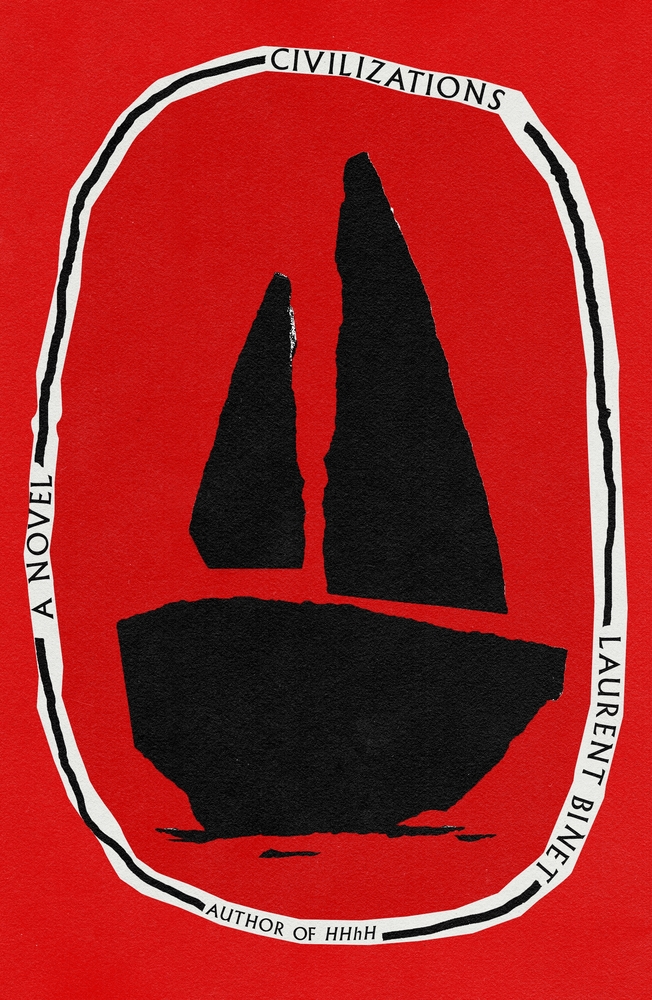

Sunday, May 26, 2024

2021 Books: June-December

 2021 Books: June-December

  I'm consolidating the total number of posts on this blog.  I'd like it to be something under 200 active posts with 100 of those being consolidated posts.  In 2021 I had finished the 1,001 Books to Read Before You Die project and 1,001 Novels: A Library of America hadn't started yet so I was just trying to put books together during this period- focused on books in translation and books by women authors in 2021.


Published 7/13/21
Savage Theories (2017)
by Pola Oloixarac

  I thought I read Savage Theories because it was nominated for a Booker International Prize but I was wrong- it was not nominated for a Booker International Prize.  I loved Mona- the new novel by Oloixarac, but I listened to the Audiobook of Savage Theories, I think, simply because it was readily available from the library, another advantage of reading translated fiction- no one checks it out from the library because library patrons are vulgarians.   I am a fan of Oloixarac, she reminds me of Ottessa Moshfegh, or vice versa,  a woman who writes with wit and style about something other than motherhood, coming-of-age or the immigrant experience. Why should male writers have all the fun?  Why can't literature be fun. Again, Savage Theories, like Mona, reminded my of Laurent Binet, who is probably the most playful of all the contemporary writers of literary fiction

  Savage Theories is wild- it's got drugs, sex and heaps of Marxism, philosophy and Marxist philosophy.  
leoneross.com
British author Leone Ross
Published 7/13/21
Popisho (2021)
by Leone Ross

  It's a magically-realistic Caribbean idyll by way of Angela Carter for British author Leone Ross in her novel Popisho, a fictional island where everyone has their own magical power.  Other than that, it is a recognizable version of modernity, complete with a oligarchic political system that controls imports and exports for the entire community.  Xavier Redchoose, the island chef, with a perfect sense of taste, is the main protagonist, but he shares duties with Romanza, the son of the island's overbearing a governor, who is in love with another man, to the chagrin of his family.  There is also Sonteine, the governor's daughter, who is set to be married, as well as the Governor himself. 

  Stuffed with plot, character and incident, Popisho was alot to take in via Audiobook- I would recommend actually reading it, although the Audiobook accents were great.


Published 7/13/21
The Hidden Spring: A Journey to the Source of Consciousness
by Mark Solms

   This is a work of non-fiction written by a neuropsychologist but it tackles a question that intrigues across disciplines, "What, exactly, does it mean to be conscious?"  Solms has an answer, but it is complicated, so complicated that I am going to simply include the relevant paragraph from the review of this book that appeared in the Manchester Guardian:

Solms’s challenge, then, is to show that emotions are essential to humanity’s material existence: that a zombie couldn’t be wired so as to mindlessly handle all the crucial tasks our emotions let us navigate. This he attempts in the book’s densest chapters, an uphill climb from the free energy principle in neuroscience, via advanced information theory, to the role of the cortex in the generation of memory, featuring many phrases such as “we can now formalise a self-evidencing system’s dynamics in relation to precision optimisation”. To the best of my understanding, the gist is that feelings are a uniquely effective and efficient way for humans to monitor their countless changing biological needs, in extremely unpredictable environments, to set priorities for action and make the best choices so as to remain within various bounds – of hunger, cold and heat, physical danger, social isolation, etc – outside of which we can’t survive for long. Doing all that without feelings, and doing it as rapidly as survival requires, would take so many computational resources that it would lead to a “combinatorial explosion”, demanding levels of energy a human could never muster.  Manchester Guardian review written by Oliver Burkeman

  Is Solms right?  Is he wrong?  I'm 100% sure I have no idea, and I could barely follow the explanatory path outlined above.  My summary of the above, paragraph long summary is that emotions are the mechanism chosen by "evolution" to help human survive in a fast paced environment. 

Published 7/13/21
China Rich Girlfriend (2015)
by Kevin Kwan

  You can't really be sure what constitutes "literature" until about a century after the initial publication.  There are plenty of examples of novels that were either considered "light" and/or "popular" for decades after publication (or weren't considered at all) before ascending to a position in the contemporary canon.  Charles Dickens and Jane Austen are two great examples.  For examples closer to our time, Stephen King is often mentioned as a potential canon level figure lurking on the best-seller list. 

  So it is with an open mind that I have approached Kevin Kwan and his Crazy Rich Asians trilogy- China Rich Girlfriend is the second book in the trilogy.  They've been fun- especially as Audiobooks, because, and I'm sorry I keep mentioning this in the context of Audiobooks- I LOVE the accents. Of course, it's not as good as the first book, but I'm still going to listen to the third book.

Cover of the yet to be released American edition of Civilization
Published 7/22/21
Civilizations (2021) 
by Laurent Binet

  One of the amusing facets of international culture markets is the way distribution of new works still follows the geographical borders of nation-states, or "marketing territories."  Civilizations, for example, which was translated from French into English, has been out in the UK for half a year, but doesn't come out in the United States till the fall.  So while you can buy a copy easily enough on any number of UK websites, you can't read anything about it written in the United States.  It's not like it's illegal to write about an English edition of Civilizations, but a casual internet search reveals nothing written on this side of the Atlantic. 

  Which means I'm left being excited about this book all by myself.  If you were to ask me for a list of favorite current authors, Binet would be top three. HHhH is a canon level classic, and The Seventh Function of Language is a great book to recommend to the right person.  Other than the people to whom I've recommended The Seventh Function of Language, I haven't met anyone else who has read Binet let alone loves him.  And I get the criticisms- mostly from what I would call the literature-as-feelings or literature-as-origin story schools of thought, about Binet not really meaning anything- I get it.  But his books are actually fun to read, they make you think, they make you think about the novel as an art form. Like Michel Houellebecq- another French author I love and am vaguely embarrassed to love, Binet is clever, funny, dark and kind of a dick (or at least he comes across that way in interviews).

   Civilizations is his take on an alternate history, one where a rogue Incan Prince escapes from a South American civil war, manages to retrofit the ships Columbus abandoned after his expedition failed and sail to a Lisbon that has just been devastated by an earthquake.  The mechanism that Binet uses to launch his story is an opening chapter where Freydis, daughter of Eric-the-Red, continues Viking expeditions South, spreading knowledge of iron and inoculating local tribes in the Caribbean and Central America.  Thus, when Columbus arrives, the locals have horses and metal weapons, and the Europeans are entertainingly humiliated, with the remnants enslaved by a Caribbean tribe. 

  Atahualpa, the Incan prince is the central figure in the story.  He is engaging figure, and I'm looking forward to the prestige television version of this book hopefully adapted by Taika Waititi.  If you read this book, and you just think it's kind of a flip, sarcastic take on the genre of counter-history, I think you are missing the point, and maybe you don't know alot about the time period in question- because, as someone who knows about both areas- American and European history in the 16th century, I thought Civilizations was sharp.

Published 7/22/21
2034: A Novel of the Next World War (2021)
by Elliot Ackerman

   I think I plucked this Audiobook straight from the New York Times best-seller list (which is, at the best of times, a wasteland for literary fiction.)  Elliot Ackerman is an interesting American author with a military background and several well-received works of literary fiction centering on military-middle-eastern themes- no hits, though.  2034 is a hit, and it no doubt represents an exciting breakthrough for Ackerman, even if he had to co-author this book with some Admiral (who is actually the author interviewed at the end of the Audiobook I listened to on the Libby library app.)  The Amazon  product page has over 6,000 customer reviews which is larger by a "zero" than what even a succesful work of literary fiction is likely to get. 

   Which is not to say that 2034 is a work of literary fiction.  I think it's closer to what you would call an international political thriller with the thrill replaced by the agonizing dread of the seemingly inevitable march towards a so-called "tactical" nuclear war between the US and China, basically over Taiwan, in the end, though the series of provocations leading up to the war is what takes up most of the book.  The road to war, if you will.   The Americans, Chinese, Indians, Iranians and Russians each get their own narrators, America, of course, gets two- an Indian-American foreign policy expert working for the President and a gung-ho top gun pilot who ends up with the job of nuking Shanghai. 

  Obviously, the idea behind writing this book is to avoid the dire future (Bye San Diego! Bye Galveston!) foretold, and personally, my take-away is that we need to let China have Taiwan and the South China Sea.  They want it, they should have it, why would try to stop them?  If they showed up off the coast of San Diego and started telling us what to do in the Pacific Ocean out there past Mexico you can bet we'd be pissed. 

  My own obsersavtion about China and their geo-political aims is that they have literally, in several thousand years of civilization, had an expansionary outlook for about fifty years.  Other than that they have been concerned with their traditional land area in Asia.   Even if we let them have literally everything they want they would literally not be a threat to our actual country. Compare that to 20th century nemesii like Nazi Germany of Soviet Russia, both of which actually possessed ideologies that paid lip service to world domination. 

Published 7/24/21
The Living Sea of Waking Dreams (2021)
by Richard Flanagan

  Australian (Tasmanian) author Richard Flanagan burst into international consciousness in 2014 when The Narrow Road to the Deep North, his novel about the Australian POW experience in South-East Asia during World War II, won the Man Booker Prize.  He followed the Booker win with First Person, in 2017, which to my knowledge, didn't even get a release in the United States, and which doesn't even have it's own Wikipedia page.  

  I didn't read The Narrow Road to the Deeper North until 2018, even though I purchased the American hardback edition in the aftermath of the Booker Prize win.   I typically avoid books about World War II and the Civil War- whether they be fictional or non-fiction, simply because those two subjects suck up so oxygen in the fields of American History and Historical Fiction (ok, not as much as in non-fiction, but still).   I respect Australia as a literary market, they seem to be good for about one internationally recognized author per decade, so Flanagan makes a good bet for the 2010's and possibly the 2020's if he can get another hit.

  Brother, The Living Sea of Waking Dreams is not it, in that regard- it's not a hit.   It is a well done piece of literary fiction about end-of-life issues viewed through the eyes of a woman and her two brothers as their mother wastes away in a hospital in Tasmania.  Although it is a work by an Australian author set in Australia, it feels like this book could take place in a half dozen English speaking cities- LA and San Francisco, New York and Boston, London and Manchester- the dynamic being the urban child having to return to the more remote locale of birth and upbringing, since the dying mother is still there.

  Anyway you want to slice it, The Living Sea of Waking Dreams is a somber and often depressing novel, which I guess is one criterion for greatness, but it doesn't make for a hit most times.  Asa prior winner, any qualifying title is a favorite for at least a Booker longlisting, but since he's won already he is easier to ignore.   We shall see next week when the longlist is announced for this year.

Sunjeev Sahota | Penguin Random House
Sunjeev Sahota landed his second Booker Prize nomination this week for China Room, his new novel.

Published 7/27/21
China Room (2021)
by Sunjeev Sahota

    Congratulations to Sunjeev Sahota and all the other authors on the Booker Prize 2021 Longlist!  Here is the full list:

A Passage North, Anuk Arudpragasam (Granta Books, Granta Publications)
Second Place, Rachel Cusk, (Faber)
The Promise, Damon Galgut, (Chatto & Windus, Vintage, PRH)
The Sweetness of Water, Nathan Harris (Tinder Press, Headline, Hachette Book Group)
Klara and the Sun, Kazuo Ishiguro (Faber)
An Island, Karen Jennings (Holland House Books)
A Town Called Solace, Mary Lawson (Chatto & Windus, Vintage, PRH)
No One is Talking About This, Patricia Lockwood (Bloomsbury Circus, Bloomsbury Publishing)
The Fortune Men, Nadifa Mohamed (Viking, Penguin General, PRH)
Bewilderment, Richard Powers (Hutchinson Heinemann, PRH)
China Room, Sunjeev Sahota (Harvill Secker, Vintage, PRH)
Great Circle, Maggie Shipstead (Doubleday, Transworld Publishers, PRH)
Light Perpetual, Francis Spufford (Faber)

    The biggest change in Booker eligibility recently was the addition of the United States- historically the prize was limited to books published in the UK Commonwealth- so South Asia, Anglophone Africa, the Caribbean,  Australia/NZ, Canada and of course the nations of Great Britain.   Of course, there was criticism of the decision to admit writers from the United States, but I really think it has solidified as the top literary Prize that isn't the Nobel- especially with their renewed commitment to the parallel Booker International Prize.

    Handicapping the shortlist and eventual winner starts by looking at the list for prior nominees and winners.  This year there are five books in that category- Ishiguro, of course, who just won the Nobel Prize, Sahota, Richard Powers, Damon Galgut and Mary Lawson.  Interesting to see if Ishiguro rate the shortlist for Klara, but I believe many of his books have divided reception- the Nobel Prize closes that argument, but not for everyone, I suppose.  Richard Powers and his not-yet-released Bewilderment is an interesting possibility- he scores a total zero for diversity points but the book is about neuro-diversity (autistic son and scientist(?) dad)- which could generate him that diversity bump.

  China Room is an intriguing possibility both for shortlist and winner, since Sahota has a prior nomination AND they managed to release it in the US the same week as the announcement- so, they have their act together.  There's also the traditional role of the Booker in bringing the writers of Anglo-Indian background to the attention of the wider world (America).  Galgut is South African and has two prior shortlists from the period before American got into the act- 2003 and 2010.  Galgut doesn't quite get a zero for diversity(He's gay) but he's still a white South African... but third time is a charm? 

   Mary Lawson is Canadian- with one prior longlist from 2006.  I wouldn't think she is a strong contender for either shortlist or winner.   

   Turning to the new nominees, A Passage North has heavy Booker vibes and an appealing post-Sri Lankan civil war theme (for major literary prizes I mean).  Rachel Cusk has hipster cache and connections in Canada, Los Angeles and London.  She is prolific- having just completed her trilogy last year and formally sophisticated- I would rate for the shortlist for sure, but not to win.  No One is Talking About This by American Patricia Longwood is another intriguing shortlist possibility, with even more hipster cred than Cusk, and it's a first novel.  Surely it is going to a huge boost for her book, which is already available in the remaining chain bookstores and every indie bookstore in America- sales hit coming!  Prestige television version! Etc.

   Then you've got the mystery box that is the remaining longlist first time nominees for an American reader of literary fiction.  The Sweetness of Water is a genuine best-seller from the US- Oprah's Book Club and all the trimmings of success.  The African-American author, Nathan Harris, doesn't even have a Wikipedia page- so just the longlist is huge for him.  Karen Jennings is South African with little international attention- hard to see her progressing with Galgut on the longlist and strong women writers up and down the longlist.  The Fortune Men by Nadifa Mohamed ticks all the boxes diversity-wise AND it's a work of historical fiction that involves the United Kingdom reckoning with past injustices.  That sounds like a potential winner!

   Great Circle is another work of historical fiction by an American author- which- looks like a book I want to read but I'm not sure how it makes it onto the shortlist against the competition.  Just the longlist is a great boost for a book like that.  Light Perpetual looks interesting, but English author Francis Spufford does, in fact, score a perfect zero for diversity points so I'd bet longlist is as far as he gets.

So my shortlist would be:

The Promise by Damon Galgut
The Fortune Men by Nadifa Mohamed
The Sweetness of Water by Nathan Harris
China Room by Sunjeev Sahota
Second Place by Rachel Cusk
Bewilderment by Richard Powers

Winner: The Promise by Damon Galgut

    So, yeah, China Room is good.  I assume there is at least one slot on the shortlist for a writer from Sri Lanka/India/Pakistan/Bangladesh.  Sahota combines the contemporary tale of a drug addled second generation English university student of Sikh-Punjabi decent who is trying to kick a nasty heroin addiction in his ancestral homeland during his summer break.  Things are not going well- people around him in India literally do not seem to know what drug withdrawal is ("Dengue fever" the village doctor opines) and his Uncle sends him to rehabilitate the family farm, where he meets a local doctor, a woman, etc.  This tale is intertwined with the tale of three brothers and their three wives in the 1920's, on said family farm.  It's a clever intertwining of two related stories and Sahota essentially manages to write two good short novels into one great regular novel.  That's the stuff that prizes are made of! Even if he doesn't win this year, chances are he will be back.

4 facts about Can Xue, China's foremost avant-garde writer - Inkstone
Chinese author Can Xue
Published 8/5/21
 I Live in the Slums (2020)
by Can Xue

   Can Xue is generally regarded as China's top writer of "avant-garde" literary fiction, which makes sense given the topic of the short stories in her collection, I Live in the Slums, which was longlisted for the Booker International Prize.  It caught my eye, coming from China and being written by a woman.  If you read the Chinese literature that makes it into translation- all of which was first approved by the censorship authority of the Chinese Communist Party, it's clear that Chinese writers are allowed to talk about many subjects, but it had better be about events in the relatively distant past OR couched so obliquely that an average reader wouldn't interpret any criticism as referring to the contemporary Chinese Communist Party.    Can Xue, with her slum-rat protagonists, falls into the later category.  You can interpret her stories as criticizing Chinese society but the Government never comes into play.

 Her work is often called "Dream like" and she is compared to writers like Kafka and Borges, and in the context of a short story collection, all the indirection can be tiring.  Many have tipped Can Xue as a Nobel Prize contender, which, reading this collection- I can see it.  

Published 8/12/21
Under a Whilte Sky (2021)
by Elizabeth Kolbert

   Elizabeth Kolbert is a writer for the New Yorker.  Generally speaking, non-fiction works by writers from/for the New York and/or the Atlantic Monthly occupy the slots of what you might call "serious non-fiction science writing."  It's a genre that tends to appeal to politically liberal and well-educated folks, other non fiction audiences having less of an interest in all things scientific.   The theme in this volume is man-make attempts to remedy the catastrophic effects of man-made climate change.  Obviously, Kolbert is a skeptic of every step of the path which leads from our past/present to a future where government's spray dust into the upper atmosphere to cool the surface temperature. 

  Half of the book just sets up the chapters on geo-engineering by looking at past efforts to remedy man-made climate disaster, with a memorable chapter on the Asian carp infiltration of the Great Lakes/Mississippi river eco-systems.  The climate engineering chapters range from the seemingly benign (pumping carbon dioxide back into the ground to turn it into rock) to Strangelovian and/or resembling the actual back-story to the Snowpiercer media property, which goes curiously unreferenced in the pages long interviews with climate scientists that pepper the pages. 

   If you look at climate change from a historical perspective we are no doubt doomed, see the role of climate degradation in the collapse of every pre-modern civilization that didn't make it into the modern era.  Cutting down all the trees, mismanaging the ground water, wasteful agricultural practices- the history is as old as humanity itself. 

Scholastique Mukasonga is the First African Woman to Win the Simone de  Beauvoir Prize for Women's Freedom
French-Rwandan author Scholastique Muksonga
Published 9/8/21
Our Lady of the Nile (2012)
by Scholastique Muksonga

   The first I'd heard of French-Rwandan author Scholastique Muksonga was when her memoir, The Barefoot Woman, was named a finalist for the brand new National Book Award for Translated Literature.   I enjoyed The Barefoot Woman, which is largely about the experience of Muksonga's mom in exile in the aftermath of the Rwandan genocide.  The tragic events of 90's Rwandan genocide (majority Hutu's against minority Tutsi's) were merely the latest chapter of a century of Western interference in the Hutu/Tutsi/Pgymy tribal kingdoms of the central African lake district, with the French speaking Belgians preferring the "genetically superior" Tutsi's (taller, lighter skinned and with narrower noses) to the inferior Hutu's, supposedly smaller, darker and shorter. 

   If The Barefoot Woman captures the 'after,'  Our Lady of the Nile is a portrait of the "before"- set at an African Catholic girl's school circa 1980.  The student population is mostly Hutu, reflecting the transition from a colonial rule that favored the minority Tutsi to majority rule favoring the Hutu.  At the beginning of the book, there is an uneasy truce, but with Tutsi's clearly on the road to persecution.  There is much to enjoy here- the relationship between the school girls, their perspective on outside events and a subplot involving a French plantation owner convinced that the Tutsi's are the descendants of the Egyptian Pharaoh's. 

Published 9/8/21
Black Mamba Boy (2010)
by Nadifa Mohamed

  British-Somali author Nadifa Mohamed made the 2021 Booker Longlist with her yet unreleased The Fortune Men.  Since I can't read The Fortune Men yet, I settled for reading Black Mamba Boy, her 2010 debut bildungsroman/roman a clef which fictionalizes the extraordinary childhood and young adulthood of a character based on her father.   There is nothing particularly unusual about the plot points in Black Mamba- young Somali boy seeks his place in the world with little help from fate, but the setting- beginning in pre-World War II Yemen before switching to the horn of Africa during World War II and Egypt and Great Britain after World War II, is breathtaking.

   But again, the plot itself- the incidents, the Oliver Twist-esque suffering, is a bit much and perhaps it explains why Black Mamba Boy didn't take off.  Looking forward to reading The Fortune Men when it comes out!

Published 9/8/21
The Council of Animals (2021)
by Nick McDonell

   I hadn't heard of author Nick McDonell before reading The Council of Animals, his strange novella written from the perspective of post-apocalyptic sentient animals who have gathered to render judgment on the shattered remnants of humanity.   This is McDonell's first delve into the world of fantasy/science fiction, his prior works being a enfant terrible style debut about spoiled rich kids in New York (Twelve) and a host of non-fiction work mostly concerning Iraq, Afghanistan and the impact those wars have had on its participants and observers. 
  
  I listened to the Audiobook version, which was a mistake.  The style that McDonell has chosen for his sentient-animal narrators is understandable but it doesn't translate well into Audio, or at least, it didn't in this version.  I wish I had just read it.  Hard to recommend on any grounds.

Pupblished 9/8/21
What Strange Paradise (2021)
by Omar Akkad

  I really enjoyed Omar Akkad's debut novel, American War, a well imagined tale of future dystopia in post-Civil War 2 America. For his second novel he's chosen a less genre milieu: Present day coastal Mediterranean Europe, under siege from would be immigrants from the African side of the sea.  The main protagonist is Amir, a refugee from war-torn Syria by way of Egypt who is the sole survivor of the wreck of the Calypso, an overloaded smuggling boat.  His perilous state is rendered slightly less so by Vanna, a girl of the same age as Amir, who takes him under her wing and tries to help him.   Help,  in this book, means getting off the island, and that is what Amir and Vanna go about doing.

  The narrative flashes between the present day flight from danger is interspersed with the story of Amir's flight from Syria and trip across the Mediterranean.   Clearly, Akkad is in the business of generating empathy for Amir and his kindred spirits, who are too often dehumanized in the debate over southern European immigration.  Personally, as someone who works on the southern border of the United States defending people accused of illegal entry, alien smuggling etc, Amir's struggles seem fairly mundane- nothing I haven't heard a thousand times before, with the possible exception of the horrific wreck of his smuggling vessel. 

   Akkad is not without sympathy for his villains- a theme in his work that continues from American War.  By doing this he encourages empathy for all sides, not just the folks he favors.

Published 9/8/21
To Walk Alone in the Crowd (2021)
by Antonio Munoz Molina

   This is a new English language translation of Munoz-Molina's 2018 ode to the flaneur.   Originating in 19th century France, the flaneur was (usually) a man who took pleasure in lengthy walks around a city (Paris) and coming into contact with different levels of society.  Prior to the entry of the flaneur into Western culture, the idea that someone with means would purposefully chose to expose themselves to the lower rungs of society was controversial, to say the least.  Indeed, often times the whole idea of wealth and status was to segregate yourself from the less fortunate.   Flaneurs were also among the first to actually LIKE the experience of living inside a city, and appreciate the aesthetics of the city itself, again, controversial at the time.

   Flaneur-ism has maintained a vibrancy that has long outlasted the original French version.  There is an entire literary movement, called "psycho-geography" that mostly consists of lengthy descriptions of prosaic urban environments in time and history, and it's impossible to ignore the impact of flaneurism on most literary subcultures since the advent of modernism.   

  To Walk Alone in a Crowd is not exactly a novel, but it is centered around writers and their experiences in various cities, Walter Benjamin, on the run from the Nazi's,  Fernando Pessoa in Lisbon, Edgar Allan Poe in Boston and Baltimore.  Melville in New York.   He combines personal observations with actual history based research, for example:

  A great step forward will take place when different routes are juxtaposed. From 1846 to 1849, Poe, Whitman, and Melville are all living, working, and walking simultaneously through New York City, orbiting around a small number of magnetic poles: a particular bookstore, the offices of a handful of literary journals, the houses of a few cultured people that hold soirees.

  He speculates on the intersection of literary lives:

There is a kind of invisibility to Herman Melville, as if lost or perpetually estranged among the people walking down the street with him, or in the smaller sphere of his literary circles, the bookstores and cafés. Walt Whitman, who was his exact contemporary, must have crossed paths with him. When Melville’s first book was published Whitman wrote a favorable review in a Brooklyn paper. Melville was a reader of Poe, and both frequented the same bookstore in New York, whose owner they knew well. But they never met, or if they ran into each other now and then, to the point of becoming familiar strangers, we will never know it. Melville walked quickly, in long strides. He said Broadway was a Mississippi flowing through Manhattan. During a trip to London in 1850 he spent his days exploring alleyways and courtyards, bookstores, theaters, cafés, dubious streets he would have avoided in other people’s company, where women stood at the corners offering themselves under the gaslight.

   The rest of the book is mostly about the narrator and his desire for a rootless existence:

YOU CHOOSE WHAT YOU WANT AND WHEN YOU WANT IT. I want to live like this, unencumbered, taking walks, reading books, carrying a backpack with notebooks and pencils, wearing a pair of sturdy hiking boots that give a slight elastic impulse to my heels and to the muscles in my legs, the head of the femur sliding in the hip socket, the strength of the hip, an ancient bone, the base on which the spinal column rests. I want to live on foot, by hand, by pencil, at ease, responsive to whatever I meet, loose like the air that moves around my body as I walk or like a graceful swimming stroke. I want to remain astonished.

   I unabashedly loved To Walk Alone in a Crowd, and I find myself thinking about it weeks later, and going back to some of the authors he mentions- Edgard Allan Poe, for example, and rereading some of his tales.
  
Published 9/8/21
Birth of a Bridge (2010)
by Maylis de Kerangal

     I'm unsure how I heard about Birth of a Bridge, a novel by French author Maylis de Kerangal about the building of a bridge in a fictional Southern California city.   I know why I read it- How often does a writer from another country write a novel about building a piece of American infrastructure?  I'm glad to report that Birth of a Bridge is EXACTLY what you would expect- de Kerangal to different voices- the construction boss, the female cement engineer, the yokels who actually have to put the bridge together.  There is a French crane operator, a grasping Mayor.  It all hung together fairly well, though the generic Southern California city location seemed silly at times.  Where is Coca?  Everywhere. Nowhere. 

   The author doesn't use Birth of a Bridge to make grand statements about modern society, she just tells the story of putting together this bridge.  It's an interesting story even if it isn't going to change the world.

Published 9/8/21
Boy in the Field (2020)
by Margot Livesey

   Boy in the Field is another gender-equity pick but there is no doubt that Boy in the Field is a hit for Livesey- with over a thousand Amazon reviews- big numbers for a small-scale work of literary fiction about three young siblings who find a young man battered in a field by their route home from school. Mom and Dad are are also major characters, but their can be no doubt that Livesey has written this book from the point of view of the kids.  Luckily, they are interesting kids. 

  The plot is less so- it looks like Livesey has some background in crime fiction- I saw comparisons to Patricia Highsmith for her earlier work- and there are some crime elements- the violent assault of the eponymous boy in the field- but there is no doubt that we are firmly in literary fiction land, where people sit in their house and think deep thoughts about the why of it all.  There can be no doubt that Livesey is an acute observer of the inner lives of children, but let's be honest, kids usually aren't that interesting, and upper-middle class ones from the wealthy, English speaking parts of all are least of all.

Damon Galgut – Movies, Bio and Lists on MUBI
South African writer Damon Galgut, will the third time be a charm for the Booker prize.

Published 9/8/21
The Promise (2021)
by Damon Galgut

   You'd have to consider The Promise by Damon Galgut a favorite for Booker shortlist status since he's already made it twice before (but never won.)  I'd say he's also a top pick for actually winning the Award- if he makes the shortlist how can they not give it to him.  So far I've read six of the Longlist titles and The Promise is certainly shortlist worthy.   Is The Promise an out-and-out winner? No, but the Booker winner criteria seems to change with each successive jury.

   It's impossible to discuss Galgut to a general audience for literary fiction without comparing him to J.M. Coetzee, specifically as a potential successor (awkward because Coetzee is still writing novels) or heir to Coetzee's legacy.  In the Booker related interview I read in the Guardian, Galgut (who must be sick to death to Coetzee comparisons to the point where it must be extremely bad form to bring it up to him) talked about his respect for Cormac McCarthy- to the point of once trying to psych himself up to knock on the door of his house when he was in New Mexico. 

  Andddd... I guess I can see that influence in The Promise though I can' entirely put aside Coetzee. Can anyone out there blame me?   I didn't love The Promise, it's one of those books that is so well drawn that it is awkward to read.  There is no experimental structure but he does manage to write the tragic history of this South African family in a way that rewards a reader who makes it to the end.   That is a sign of a good author and a good book- it makes the reader think it is one thing and then it turns out to be another. 

Published 9/10/21
Great Circle (2021)
by Maggie Shipstead

   Great Circle is another 2021 Booker longlist pick, written by American author Maggie Shipstead.  At 569 pages, Great Circle puts the "long" in longlist but fortunately it's a fast ride.   Shipstead skips between past and present as she tells the intertwined tales of Marion Davies, a 20th century aviatrix with LGBTQ tendencies and Hadley Baxter, a contemporary actress who is enlisted to play Davies in a feature film after she gets terminated from her star-making Twilight-esque role in a YA fantasy franchise.  Also along for the ride is Jamie, Davies' artist-twin brother as well as a host of secondary characters- enough to fill two basketball teams.    

  Other than the late developing LGBTQ angle, it's hard to pinpoint the attraction of the Booker panel to this title as a longlist contender.  True, they love an epic work of historical fiction (See 2013, The Luminaries by Elanor Catton and the two wins by Hilary Mantel for her Thomas Cromwell trilogy.  It's nice to see a book on the longlist that can plausibly be described as a "fun read" or "page turner" but again, at 569 pages it had damn well better be.   I thought her depiction of contemporary starlet Hadley Baxter was particularly clever but even after I finished I was left asking questions about the relationship between the two characters.  I believe the idea is that the same actress would play both roles in a movie/tv version (which would be a movie/tv version of a book that is essentially about the process of making a movie based on a book...trey meta.)

  The short list gets announced next week on the 14th.   Excited to see who makes the cut!

Published 9/17/21
No One is Talking About This (2021)
by Patricia Lockwood

     Congratulations to all the Booker Prize short-list nominees!  I feel like making the short-list is huge for most authors- almost as good as wining, whereas making the longlist is only a so-so experience, heavy readers like me are way more likely to take your book for a spin, but a longlist nomination doesn't do much for the general Audience, like in the United States, straight up nobody gives a fuck about the longlist titles.   I was surprised to see No One is Talking About This made the shortlist- one of three American books next to the forthcoming Bewilderment by Richard Powers (which also made the National Book Award longlist- announced today) and Great Circle by Maggie Shipstead- another surprise to me.

  I had been hearing about No One is Talking About This here and there for months, basically in headlines that announced it as  "The Great Internet Novel" or questioning that idea.  Knowing that I was going to read it eventually, I skipped the debate.  The truth that No One is Talking About This is half internet novel, half novel about a difficult childbirth, I think the two portions are literally split in two as in "Part One" and "Part Two." 

  I didn't love the plot- it seemed pretty maudlin to me, which I think is probably the point- moving beyond the internet and cynicism to find real meaning in the horrors of everyday life, but as a criminal defense attorney who spends most of his time defending indigent defendants from the vagaries of the Federal criminal justice system,  I am well acquainted with the emotions Lockwood describes.  I just can't imagine this is going to win the Booker Prize, but the shortlist is huge, and it really sets up her next book.

   Also, the Audiobook is great, narrator Kristin Sieh really nails a narrator who could be hyper annoying in Audio form, but is not.

The power of Oprah!
Published 9/23/21
The Sweetness of Water (2021)
by Nathan Harris

  It is not every year that an Oprah's Book Club selection makes the Booker Prize longlist, but here we are, a genuinely in-stock, best-selling American novel that also made the Booker longlist.  Not the shortlist, which was announced last week, but considering The Sweetness of Water was already a sales success, the lack of shortlist status shouldn't matter in the least for Nathan Harris.  The Sweetness of Water is a work of historical fiction, set in the Faulkner-esque Southern town of Old Ox in the aftermath of the Southern defeat in the American civil war.   Harris provides characters of both races, genders and sexuality, with a melting pot mentality I found rewarding (and often lacking in the sometimes binary world of literary fiction)

   I liked The Sweetness of Water, but didn't love it.  Ultimately Harris pulls up short in bringing the events to an unforeseen or deeply significant ending- maybe this is why he Booker jury didn't pick him for the short-list.  Or maybe it's the Oprah Book Club thing.

Published 9/23/21
A Town Called Solace (2020)
by Mary Lawson

   Here is another Booker longlist title that didn't make the shortlist cut.  Canadian writer Lawson picked up another Booker longlist nomination in 2006 for her second book, The Other Side of the Bridge.  It's clearly central to the Booker Prize to throw at least one longlist nomination to a Canadian writer, you could call it a "slot" alongside slots for African writers, writers from South Asia, writers from Aus/NZ, the English spot, the non-English UK slot, the Caribbean slot and the American slot.  I guess you would call Lawson a regionalist, the region being "Northern Canada"- is that the suburbs of Toronto?

   A Town Called Solace is a classic Booker longlist pick, a quiet book about little lives in a small town in Canada with some interesting themes and a well developed plot. If you actually pick up A Town Called Solace, sit down and read it, you won't be sorry, but getting started might be tough.  It's impossible to explain without spoiling aspects of the plot. 

Published 9/27/21
Second Place (2021)
by Rachel Cusk

  Rachel Cusk is another good example of an author who I read because she gets a nomination to the Booker longlist, as she did this year for Second Place.  Second Place comes hot on the heels (relatively speaking) of the completion of her Outline Trilogy, which wrapped up in 2018 with Kudos.  Kudos was very much on my radar screen in 2018, but I just couldn't muster the energy to go back read the first two books in the trilogy.   

  I quite enjoyed Second Place, narrated by an unnamed woman who invites a notorious painter to her out-of-the-way estate.  Listening to the Audiobook, the painter sounded like a cross between Andy Warhol and Lucian Freud.   The truth is that I didn't want to enjoy Second Place, but I most certainly did.  I honestly can't get enough listening/reading to novels that revolve around artists and their behavior.  I can see why it didn't make the shortlist- it's not a signal masterpiece and the ending isn't fantastic- but it isn't some kind of experimental odyssey that makes no sense. 

Published 9/27/21
Bewilderment (2021)
by Richard Powers

   Is Richard Powers a potential Nobel Prize winner?   It might have seemed highly unlikely before The Overstory won the Pulitzer Prize in 2018.   Before that he had only some longlist/shortlist nominations and a single National Book Award for The Echo Maker.   Now he's got the National Book Award, The Pulitzer and a legitimate shot at the Booker Prize this year after Bewilderment made the shortlist.   I was surprised by the shortlist pick, if only because nominating an American writer with a large popular audience for the longlist as a way to drum up interest in the lesser known writers seems like a very Booker thing to do.

   I think if Powers actually wins a Booker he'd have to be considered as a Nobel Prize contender.   Surely, if a novelist is picked because of the importance of novels and their relationship with the hard sciences, Powers would be one of a select few.  Historically, the Nobel seems to favor "political" or "socially conscious" writers over those concerned with science, but perhaps the times are changing. I mean really, after handing the Literature award to Bob Dylan, it really feels like anything is possible.

   The elevator pitch for Bewilderment is "Richard Powers does Flowers for Algernon."  Flowers for Algernon is the famous and oft read short story turned novel about Charlie, a "retarded" janitor who receives life changing intelligence boosting surgery.   In Powers' take, the narrator is the single father of a "neurodivergent" pre-teen boy who suffers from non-specified differences that combine aspects of ADHD with Austism/Aspergers syndrome.  Powers is scrupulously aware of avoiding labels, probably because he understands how distracting the labelling process can be in the course of attempting to tell a story.

   It's obvious that there is a slot for neurodivergency in the canon, presumably to be meted out either to an Author who is actually nuerodivergent themselves or some kind of cross-over writer who first nuerodivegency and some other slot- gender/sexuality seems like a likely pairing.  Alas, that writer has not emerged, leaving the field to interpreters of neurodiversity like Powers.   Speaking as the older sibling of a neurodivergent child, I think that Powers gets it right.  

   It should come as no surprise to anyone that the flag-wavers in the neurodiversity movement  tend to be otherwise socioeconomically privileged individuals.  Specifically, the overlaps between parental/societal expectations that a specific child should "do well" in school and the failure, for whatever reasons, of said child to do so frequently leads down the path depicted in Bewilderment, whereas less advantaged children simply stop going to school or even up in alternative scenarios.   Just speaking from my own personal experience, the overriding obsession with the special needs of a neurodivergent child to the exclusion of all other concerns seems to be the prerogative of a very particular (white, well educated, financially secure) type of parent.

   So in that way, Bewilderment, with it's tenure level Astrobiologist single father is par for the course.  Although the narrator himself is the child of a schizophrenic mother and the husband of a deceased life who struggled with serious depression, he never appears to question the wisdom of having a child in the first place, and seems genuinely surprised with how everything turned out.   My experience is that, even when the raising of a neurodivergent child goes well, it's basically a life ender, in that the parent ends up just spending the rest of their life dealing with it.  It's enough to put you off wanting children, but not this guy. 

Author Lauren Groff on the Trips That Have Inspired Her Books: Women Who  Travel Podcast | Condé Nast Traveler
American author Lauren Groff
Published 9/27/21
Matrix (2021)
by Lauren Groff

  I loved, loved, loved this new novel by American author Lauren Groff, which is nominated for the National Book Award this year.   I liked Florida (2018) and Fates & Furies (2015) and I was excited for her new book even before I learned it was the reimagining of the life of a nun during the pre-Black Death Middle Ages.  Her protagonist, Marie de France, is the bastard child of a French noblewoman (a rape at the hands of an English royal during hostilities in France.)  After her beloved Mother expires, Marie spends three years undetected pretending that her Mother is still alive.  Discovered, she is packed off to England "Angle Terre" to revive a decrepit Nunnery in the English country-side. 

   While it isn't exactly a cheery place, the Middle Ages before the upheaval of the Black Death was relatively stable. Groff seems well versed on recent development in scholarship on this period of history, because Marie's nunnery doesn't seem like a such a bad place to land, especially after Marie starts taking care of business.  Also, at 220 pages, Matrix isn't a slog- it's actually quite unlike a normal work of historical fiction, where the author seems set on making darn sure that the reader knows how much the author knows about the period.   Can a television version a la The Favourite or Catherine the Great on Hulu.

Published 9/28/21
So Long, See You Tomorrow (1979)
by William Maxwell

   In August, New York Times film critic A.O. Scott published a lengthy article on American author William Maxwell as part of his series of "The Americans"- artists who help to define what is to be American.  The whole idea is to revive interest in "overlooked or under-read" authors (his formulation).  So far he has published essays on Wallace Stegner, Edward P. Jones and Joy Williams.   This process of artistic revival is very much at the heart of this blog- seeing how, if and when it works to bring an Audience to an author who is either non-canonical or canonical for other types of work besides literary fiction.  

  Answering the question of why William Maxwell came to be "overlooked or under-read" seems pretty easy, he wrote about an unfashionable part of the world (the American Midwest) during an unfashionable time, the middle part of the 20th century, after all the slots for canonical writers from the Midwest who wrote about the eartly 20th century/late 19th century, were filled.

  So Long, See You Tomorrow was his last novel by about 20 years, his second-to-last novel appearing in 1961 and this first appearing as a New Yorker short story (split into two parts) in 1979 before being published as a book in 1980.   A reader for looking for reasons Maxwell is "overlooked or under-read" might point the timeline of his bibliography:  novels published in 1934, 1937, 1945, 1948 and 1961.  Short story collections in 1956, 1966, 1977, 1988 and 1992.   That is not the kind of productivity meant to inspire the cultural-industrial complex to do it's best promotional work. 

  Next, you might consider his subject matter Wikipedia calls it "domestic realism," which, really didn't come into vogue as a subject of literary fiction worthy of canonical status until the 1970's, and didn't fully arrive until decades after that.   I've noticed that domestic realism penned by American authors from and about the Midwest seems to be a favorite for re-issue houses, probably on the grounds that republishing an American author has a better chance to catch on than publishing non-American authors. 

      So Long, See You Tomorrow recaps the events leading to a murder in a small town as experienced by various participants- a couple of broken marriages, allegations of infidelity, a divorce trial, back before you could just get divorced.  The events take place in the 1920's,  and I'm not sure I would be able to guess that it wasn't written back then- Maxwell has a style heavily influenced by the high modernism of Virginia Woolf, and everything about So Long, See You Tomorrow, feels like high modernism from the early 20th century.

Published 9/28/21
Strange Beasts of China (2020)
by Yan Ge

  Reading contemporary Chinese literary fiction is interesting because...if it comes from China, it means that the text has passed the censor's pen and been granted permission to be published by the Chinese Communist Party.  But what does that mean?  It's not a blanket prohibition on criticizing Chinese party because many of the Chinese language books I've read can be easily interpreted as a critique of contemporary aspects of Chinese society, materialism for example.  Criticizing the impact of capitalism or "business culture" on workers seems to be all right.   

  Mostly what you get is oblique allegories where it is impossible to determine what secret more or political truth is being described.  Some of the difficulty stems from inability to directly criticize the Chinese Communist Party and I think some of it comes from the collection of ideas that can be described as "things lost in translation." 

   The gently surreal world of Strange Beasts of China is one where everything is basically the same with the exception of different tribes of human-like monsters who co-exist under difficult circumstances with their human counter-parts.  I was hopeful for Strange Beasts of China, but everything is just so oblique.  I honestly don't know what to make of it.

Published 9/29/21
An Inventory of Losses (2020) 
by Judith Schalansky

   I've appreciated the recent increase in English language attention to works of literary fiction translated into English.  First, the Booker revamped its every-so-often recognition of a translated author to a yearly prize with the same format of its other awards(longlist/shortlist).  That was followed in short order by the National Book Awards announcing a new category for Translated Literature, which presumably should consist of all their formats, but seemingly omits poetry and children's literature in favor of a longlist that resembles the English language longlist in fiction.

   Something I've noted about both the National Book Award for Translated Literature and the Booker International Prize is that the authors tend more to the experimental/"High" literature than the English language longlist, which typically favor bangers written by proven commodities or first-novels written by promising new comers.  Experimental fiction tends to be relegated to maybe one or two titles for each English longlist, here it is the reverse.  The only non-experimental "banger" type book I've encountered so far on either longlist for 2021 is  Waiting for the Waters to Rise by known commodity Maryse Conde, a perennial Nobel Prize contender and actual winner of the one-off alternative Nobel handed out a couple years ago when the actual Nobel took the year off. 

  The New Directions Publishing product listing for An Inventory of Losses cites W.G. Sebald and Bruce Catwin- which are both good comparisons.  Also Rebecca Solnit, who I haven't read.  Those familiar with Scalansky's last book, An Atlas of Lost Islands, should know what they are getting into, those who aren't familiar with Atlas are probably not going to like An Inventory of Losses.  Inventory has discrete moments of joy- like when she describes the lost objects at the beginning of each chapter, but the actual chapters themselves are hard to connect. I honestly couldn't tell you what each is about without going back and referring to marked passages and notes, which I didn't bother to keep for this book.  It was like looking at a book of interesting photographs more than reading a book.

Published 10/1/21
New Teeth (2021)
by Simon Rich

    I actually thought Simon Rich was English, maybe because the narrator of the New Teeth, Rich's new collection of short-stores, has an English accent.  Turns out he's not, but rather an enfant terrible of American comedy, with "youngest writer ever on SNL" and "son of New York Times columnist and writer Frank Rich" prominently featured on his Wikipedia page.   Anyway, credit where credit is due, New Teeth made me laugh, repeatedly even though you would think some of the themes (a baby detective investigating the disappearance of his younger sister's toy, A half man-half ape city-rescuing superhero asked to work a desk job in the city bureaucracy) sound too much like other contemporary culture products to be interesting.   Fact is, I loved the story about the baby detective and I loved the story about the half-man, half-ape superhero reckoning with his obsolescence(Clobbo.) 

   And so, even though I try to avoid books of short-stories by American Humorists if at all possible, I liked this book of short stories by this American humorist.   I highly recommend the Audiobook, which was a great format for this book.

Published 10/5/21
Waiting for the Waters to Rise (2010)
by Maryse Conde

   Maryse Conde is a perennial contender for the Nobel Prize in Literature (which is  being announced later this week).  Like many non-English language writers with top international profiles, her record of being translated into English is spotty.  Take Waiting for the Waters to Rise, originally published in French in 2010, the English translation came out last year and got nominated for the National Book Award for translated fiction longlist (it didn't make the shortlist, announced this week.)  I'm baffled by the shortlist omission- I thought Waiting for the Waters to Rise was a real banger.  Babakar, the protagonist, is an obstetrician living in the French overseas (Caribbean) territory of Guadelope,  As the book reveals, he has an interesting history, born in Mali to a mixed Malian/French couple, he moves to Mauritania to practice as a doctor, only to be sucked into a civil war.  He relocates to Guadelope, where the beginning of the book finds him spontaneously adopting the orphaned newborn of an illegal Haitian immigrant who dies in childbirth.

  Eventually he finds his way to Haiti, where Conde does an amazing job of portraying the day-to-day life in a place where day-to-day life seems quasi-unimaginable to the average English language reader.  It was hard not to read Waiting for the Water to Rise without thinking of V.S. Naipaul- and maybe the similarity is what kept Waiting off the National Book Award shortlist.   Fingers crossed for the Nobel announcement- I think she would be a great pick.

Published 10/7/21
Palmares (2021)
by Gayl Jones

  Gayl Jones is a legit 20th/21st century literary enigma.  She burst onto the scene in the late 1970's after being sponsored by Toni Morrison.  She published two novels in the late 70's, one book of short stories in both the 1980's and the 1990's, and then two novels at the end of 1990's, and that was it until Palmares was published last month.  There is much to love in Palmares, a sprawling (500 page) picaresque about the adventures of Almeyda. Almeyda is born a slave on  a Brazilian plantation in the 1600's.   Slavery in 17th century Brazil was a different institution than the ante-bellum slavery of the American south in the 19th century.  The oppression Jones depicts is just as virulent, and in many ways more violently repressive, but less succesful at controlling resistance than the American institution that evolved centuries later.

   Thus, the title, Palmares, refers to a settlement of escaped African slaves and free blacks that really existed between 1604 and 1694.   Almeyda spends half the book trying to get there, gets there, survives an extinction level attack by the colonialists and spends the rest of the book looking for her lost husband, Martim Anninho, a free black Muslim who is equally interesting.  Much of the length of Palmares is due to so many characters having a chance to tell their story, often in subchapters titled "So and so tells their story,"  The plot, which is itself complicated, twists itself around the different monologues.   I loved listening to the Audiobook version- which is something like 25 hours long- but I also would have liked to read a physical copy to see all the names and places written down. 

   Anywho, big thumbs up for me, Palmares is just the kind of book I like to read.  Looking forward to more of her work being published, and going back and reading her prior books.  The fact that I hadn't already heard about her is borderline embarrassing, but her twenty years away from the game is a pretty good explanation.

Published 10/7/21
When We Cease to Understand the World (2021)
by Benjamin Labatut

   Chilean author Benjamin Labatut scored a rare triple for this blog.  His novel, When We Ceast to Understand the World was published by the New York Review of Books and nominated for the shortlist (and potentially the winner) of both the International Booker and the translated fiction National Book Award.  When We Cease to Understand the World is a novel about advanced physics and mathematics, and the quirky lives of those actual pioneers.  Personally I think there is a strong argument to be advanced that physics is *the* primary scientific metaphor of the 21st century, in the same way that biology/evolution dominated the 19th century and electricity dominated the 20th.   Unfortunately, unlike biology and electricity, advance physics makes, at a very basic, level, no fucking sense.

     It was a genie that Albert Einstein let out of the bottle and then spent the rest of his life trying to capture: The idea that there was no solid reality and that matter is just a collection of empty space and tiny, unpredictable particles forming waves of energy. What is so amazing about these pioneers of advanced physics is that they conjured this stuff up in their head- there are few if any actual experiments in the early history of advanced physics, and then decades later the entire world spent billions and billions of dollars to build enormous particle accelerators which then proved that these early pioneers were right on the money.

     Any work of fiction that seeks to tackle some of these ineffable mysteries is a worthy effort, and I think Labatut handles these subjects better than most- and in a spare 190 pages.  This is the kind of book that wins international literary awards. 

Published 10/10/21
Cloud Cuckoo Land (2021)
by Anthony Doerr

  I literally did not know who Anthony Doerr was before a chance conversation with a fan this summer.  Doerr has one previously published novel, the huge hit All the Light We Cannot See, which was published in 2014 and won the Pulitzer Prize in 2015.  I'm not a big fan of the Pulitzer format- they don't have a longlist/shortlist format, they just announce the prize and then give you a couple runners up.  The winners are never a surprise- just find the three top selling works of "serious" literary fiction and look for the book that has the most widespread critical acclaim, tie breaker to the author with the higher profile, that's your winner.  Doerr published two books of short stories before he published Cloud Cuckoo Land, so that's like a classic ascent for an American writer of literary fiction working in the 21st century.

   Seven years later, we've got Cloud Cuckoo Land, his first book of any kind since All the Light We Cannot See.  Along with many others, I noticed the similarities between Cloud Cuckoo Land and Cloud Atlas (2004) by David Mitchell.  Beyond both books having "Cloud" in the title, both titles reference "imaginary" books as a unifying principle- there is no Cloud Atlas in Cloud Atlas, and Cloud Cuckoo Land references a fictional lost text by an ancient Greek author.   Both books combine past, present and future.  Here, the past is represented by a girl street urchin living in pre-Ottoman Constantinople and a Slave farm boy living outside the city.  The present is represented by the residents of a small town in the Pacific Northwest experiencing suburban sprawl.  The future is a girl living on a star-travelling generation ship that has escaped a dying planet Earth. 

    Cloud Cuckoo Land is already a certified hit- Number 3 on the Amazon sales list for "Fiction" and a National Book Award finalist.  I'm not a fan of Cloud Atlas or David Mitchell, so I'm not going to harp on Doerr for knitting a similar tapestry.  Nor would I expect the large audience for "fiction" on Amazon to care about whether the two books seem particularly related, I mean obviously, Doerr and the publisher must have considered it during the editing and publishing of Cloud Cuckoo Land.  I am surprised by the near universal critical acclaim.  I haven't seen a single takedown, and really I didn't read anything in the run-up comparing the two books. 

   Well, I'm not going to crap on Doerr's parade. If Cloud Cuckoo Land can be a National Book Award Finalist it can win a second Pulitzer.  If it wasn't such a big literary event, I probably wouldn't powered through it in a week like I actually did, but having done so, I didn't feel like there was a great pay off. Of course, Cloud Cuckoo Land is good, but I wasn't wowed.  And I couldn't make it half way through All the Light We Cannot See when I gave the Audiobook a spin last month.

Published 10/10/21
Zorrie (2021)
by Laird Hunt

   The 2021 National Book Award finalist designation for Zorrie by Laird Hunt has the feeling of a career achievement nod, Hunt being the author of six previous novels, most on a small press.  Zorrie was published by Bloomsbury, firmly placing him in the big leagues of marketing attention. Perhaps that has something to do with the National Book Award achievement. I'm not sure how else to explain the recognition for Zorrie, a Alice Munro-like portrait of the life of a woman who is born, lives and dies in a  part of rural Indiana.  She marries, does not have children, her husband dies in World War II and then she stays single for the rest of her life. 

    Of course, there is something extremely impressive about managing to capture an entire life in 128 pages.  It is hardly a life filled with incident, but isn't that the point? This is an excellent piece of domestic fiction, written about the American Midwest, about the life of a character who is underrepresented in the literature of that time and place.

Published 10/11/21
The World Gives Way (2021)
by Marissa Levien

   This book caught my eye because it is a well-reviewed (NYT) work of genre fiction (science fiction) by a woman.  Added bonus, it has literary fiction cross-over potential.  And it was available from the library as an Audiobook with no wait, so, slam dunk for me.  The World Gives Way takes place on a cosmos crossing Generation Ship (second mention of this concept in two days on this blog, see Cloud Cuckoo Land for the other.)  Levien's Generation Ship is a luxe model, that sounds more like a cross between Las Vegas and Disneyland than the grim, bare bones structure depicted in Cloud Cuckoo Land.   Populated in equal parts by wealthy patrons who bought their way on and permanently indentured servants who have traded their freedom and the freedom of their children (and their children's children) for a ticket off the dying Earth,  The World of The World Gives Way is part post-scarcity economy part Handmaiden's Tale.

  Myrra, an indentured servant working as a nanny for a wealthy power couple, splits protagonist duties with Tobias, the child of two paid passengers who turned to life of crime, now working as a police investigator.  When Myrra's employers turn up dead and Myrra goes on the run, Tobias fears the worst, etc.  The hook is that the reason Myrra's employers commit suicide is because they know that the ship has suffered a hull breach and is in imminent danger of implosion.  Escape is impossible.

  That's the set up.  I liked parts of The World Gives Way, and other portions I found tedious, but there is no denying the inventiveness of the scenario, and Levien is an above-average writer, more like a writer of literary fiction than a genre hack.

Published 10/11/21
The Twilight Zone (2021)
by Nona Fernández

    The Twilight Zone, written by Chilean author Nona Fernandez, is a finalist for this years National Book Award for Translated Fiction.  Fernandez is one of two Chilean authors on National Book Award shortlist, the other being Benjamin Labutut, nominated for When We Cease to Understand the World.  Unlike Labutut's book, The Twilight Zone is actually about Chile, specifically the aftermath of the post-Allende anti-Communist dictatorship, which paired mid 20th century Fascist style police-state repression against Leftists with a thorough implementation  of international-trade friendly neo-liberal economics as advance by University of Chicago Professor Milton Friedman and his acolytes. 

    Where does all that leave Fernandez? Her book is squarely in the post-reconciliation genre of recovery literature that finds kinship with 2015 Nobel Winner Svetlana Alexivech.  Fernandez is, after all, free to publish The Twilight Zone inside Chile, something that couldn't be said for many Spanish language writers in the 20th and 21st century. Chile is also an important enough literary market to get her a translation deal in the United States, where Graywolf Press, the well-regard indie, put the translation out. 

  There is great power in Fernandez's musings about the vagaries of vile human rights abuses and the consequences (or lack thereof) to those who perpetrate them.  The focus of this book is a member of the Chilean police who comes forward about the abuses committed by the Government against his people.  The Twilight Zone consists of the narrator coming to terms this man's existence and his status as a valued witness.  

    It's funny- I can't think of any Nazi's who turned "state's evidence" in the Nuremberg trials, although I suppose there must have been engagement with the non-Nazi parts of the German military.  The whole institutionalization of post-atrocity "forgiveness" possesses a macabre quality, which, I think is the point of calling the book The Twilight Zone.  It strikes me that this could very much be a winner of the National Book Award for Translated Fiction this year.

Published 10/18/21
The Animals in That Country (2020) 
by Laura Jean McKay

   The Animals in That Country, by Australian author Laura Jean McKay ticked several boxes that made me want to read it.   First, it's a prize winner from another English speaking country that won an international award (Arthur C. Clarke) as well as a domestic award (Victorian Premier's Literary Award.)  At this point, with a well publicized release in both the UK and the US, it counts as a borderline literary/science fiction cross-over sensation.  And did I mention the original publisher was a small press in Australia?

    It is always a fair bet that if you even hear about a book from another English language country getting a wide release in the United States, it means that book has what it takes to be a hit with both critics and audiences.  Otherwise, a publisher wouldn't even bother.  This is a different phenomenon then when books published in other English language countries get released in the US without a separate campaign- that's just a dumping, or cross-posting situation.

   The idea of The Animals in That Country is that a virus infects the population and allows them to understand what animals, and eventually insects, are saying.  One might naturally suppose that this means that humans can "talk to animals" but that isn't really the case- the reality turns out to be much more horrifying, as humans face the consequences of their casual cruelty to most of god's creatures.  The narrator- is Jean, a washed-up, alcoholic grandma who ekes out a living as a hanger-on at an outback wild life park in Australia, serving at the sufferance of her daughter-in-law (now separated from her son), who runs the park. 

   The plotting is conventionally genre, but the writing is not, and anyone who doubts that McKay is a writer of literary fiction trying to make a name for herself in the kiddie pool might consider that the name of this book comes from a poem by Margaret Atwood, who knows something about the line between genre and literary fiction.   What isn't conventionally genre is the writing, particularly McKay's deft handling of the animal voices.   The Animals in That Country is deeply unsettling and worthy of the international audience it has obtained. 

Published 10/19/21
Peach Blossom Paradise (2020)
by Ge Fei

  Ge Fei is the pen name for Chinese author Liu Yong, well regarded as one of the preeminent writers of "experimental" writers in China for the past several decades.  Fei is little known in English- Peach Blossom Paradise, originally published in 2010, is only the second book from his bibliography to receive an English language translation.   Part of a trilogy,  Peach Blossom Paradise mostly tells the story of Xiumi, the neglected daughter of a wealthy land owner growing up in turn of the 20th century China.
Xiumi is married off, only to be kidnapped by by bandits.  Her family refuses to ransom her, and she ends up the sex slave of a coterie of bandits.  Eventually freed as a side-effect of inter-gang warfare, she makes her way back to her ancestral village and begins a program to revolutionize the people.  Xiumi is not a Communist, rather this refers to the pre-Communist revolutionary activities of a coalition of intellectuals and criminals who acted through secret societies. 

    It's hard to say why this would be considered "experimental" literature in any language, it's more like a straight forward historical novel than anything else. Like many works of Chinese fiction in translation, it can be hard to pick up on the reference points.  For example, this entire book is a reworking of the well known Peach Blossom Paradise myth, but who is going to know that in the English speaking world?  Peach Blossom Paradise is nominated for the National Book Award for Translated literature shortlist, but it would seem like a longshot to win.

Published 10/20/21
Earth Abides (1949)
by George R. Stewart

   I recently read an article about American author George R. Stewart (1895-1980), a Berkeley CA based writer who wrote widely across genre, with a good deal of popular success but little lasting critical impact.  Today he is remembered for two books: Storm, which is about, well.. a storm, and is credited with being the inspiration for naming hurricanes after people to tell them apart.  Storm just got a New York Review of Books reprint in August of this year.   His other famous book is this one, Earth Abides, which is widely credited as being the direct or indirect inspiration for a generation of post-World War II post-apocalyptical fiction.

    Earth Abides is at times hilariously out of date, like all books of science fiction it is much a reflection of the actual times of the author than any work of imagination on his or her part.  For example, the main character continues to smoke tobacco cigarettes from "before the fall" for decades after the collapse (caused by an unidentified virus, with minimal societal disruption), while his after the fall community in Berkeley California never mentions marijuana. 

    Stewart's apocalypses is a relentlessly PG affair, with none of the horrors that contemporary readers associate with the genre.  The single act of violence in the book is the murder/execution of a diseased drifter with ill-intentions at the hands of the community.  The infrastructure of pre-collapse, specifically, running water, continues to operate for decades after the fall.  

 Isherwood Williams, the protagonist, is an intermittently interesting guy prone to paroxysms of guilt over his failure to lead his burgeoning community past a semi-parasitic existence of hunting the abundant free roaming cattle and eating out of still-good cans of food.  I mean, you would think these people would be able to get a vegetable garden going.   There are horses available, but they choose to rely on dogs for their limited travel needs.  They are a profoundly unambitious bunch by the standards of the genre and their world is basically a paradise.   It's all very mid 20th century. 

Published 11/7/21
The Harlem Shuffle (2021)
by Colson Whitehead

   What more can Colson Whitehead, a winner of consecutive Pulitzer Prizes for his last two novels, accomplish?  I guess that would be a Booker Prize, which seems possible or a Nobel, which seems less likely but still not impossible where Ishiguro is a recent winner.  
   The Pulitzer and National Book Award must have breathed a sigh of relief when they heard that Whitehead's new book was going to be a work of historical crime fiction. Exciting, as would be an announcement for any new Whitehead title, but not, you know, a book that is likely to merit a third Pulitzer, simply by virtue of genre.  I haven't checked, but crime fiction doesn't win any prizes outside of those exclusive to the genre. 
   Like Zone One, Whitehead's zombie book,
The Harlem Shuffle is both a work of genre, observing relevant genre specific rules, and a work of literary fiction, using authorial skills of character depiction and plot mechanics to create something separate from a strictly genre work.  

Published 10/11/21
The World Gives Way (2021)
by Marissa Levien

   This book caught my eye because it is a well-reviewed (NYT) work of genre fiction (science fiction) by a woman.  Added bonus, it has literary fiction cross-over potential.  And it was available from the library as an Audiobook with no wait, so, slam dunk for me.  The World Gives Way takes place on a cosmos crossing Generation Ship (second mention of this concept in two days on this blog, see Cloud Cuckoo Land for the other.)  Levien's Generation Ship is a luxe model, that sounds more like a cross between Las Vegas and Disneyland than the grim, bare bones structure depicted in Cloud Cuckoo Land.   Populated in equal parts by wealthy patrons who bought their way on and permanently indentured servants who have traded their freedom and the freedom of their children (and their children's children) for a ticket off the dying Earth,  The World of The World Gives Way is part post-scarcity economy part Handmaiden's Tale.

  Myrra, an indentured servant working as a nanny for a wealthy power couple, splits protagonist duties with Tobias, the child of two paid passengers who turned to life of crime, now working as a police investigator.  When Myrra's employers turn up dead and Myrra goes on the run, Tobias fears the worst, etc.  The hook is that the reason Myrra's employers commit suicide is because they know that the ship has suffered a hull breach and is in imminent danger of implosion.  Escape is impossible.

  That's the set up.  I liked parts of The World Gives Way, and other portions I found tedious, but there is no denying the inventiveness of the scenario, and Levien is an above-average writer, more like a writer of literary fiction than a genre hack.

Published 11/8/21
The Vorhh (2015)
by Brian Cartling

  This book was recommended to me by a friend. It's what you would call a low fantasy, it's a recognizable version of our actual world, set in a faux-German colonial outpost in late 19th century Africa.   The city sits at the edge of an ancient forest, which is called, for reasons unexplained,  the Vorhh. 

  Cartling introduces a dozen major characters including real life French surrealist Raymond Roussel and famous English photographer and orthological eccentric Eadweard Muybridge.  There is also a horny cyclops and myriad eccentric and supernatural denizens of the forest primeval.  And a couple of strong female characters who are involved with said horny cyclops.

   What is it all about? It's hard to say. Rare indeed when a work of fantasy leaves me scratching my head over the broad contours of the plot, as was the case here.  Colonialism is certainly a theme, racism, as part of that.  The Bible and Christian eschatology are in there but again I couldn't exactly say how.   Certainly Catling is miles away from a conventional fantasy plot revolving around a quest for a hidden ring and such, although there are elements of the hero's quest as one among the many threads.  The Vorhh is the first book in a trilogy, and I presume the story becomes clearer the further you read, because after the first volume, I had little idea what lay ahead.

Published 11/14/21
Immobility (2013)
by Brian Evenson

   I saw this book on a list of post-apocalyptic lit on a book blog, though I can't precisely remember which one.   I do like a good book blog list, even if it seems to me like most book blogs are trying to way too hard.  They are all better than mine, of course.  I'd never heard of author Brian Evenson before, which now seems borderline strange since he occupies that narrow space between genre and literature that interests me.  Immobility is also Evenson's only  library available Audiobook.

   Evenson paints a super bleak scenario for what comes after the fall of man.  It is a barren, lifeless landscape poisonous to humans.  The narrator is something other than human, no one is really sure what, except that he doesn't die when exposed to the toxic atmosphere or earth, and he is basically immortal.  Nothing really gets explained beyond that level, and the post-collapse society that Evenson draws in this novel is more sophisticated by an order of magnitude that what you typically see in work in this creative space. 

Published 11/16/21
The Cabinet (2021)
by Un Su Kim

   I really enjoyed The Plotters, which was the first book by Korean novelist Un Su Kim to be translated into English.  The Plotters was a crisp, stylish work of crime-fiction, a book obviously inspired by the conventions of the noir genre but rendered eerie by the Korean locations and the writing style of Un Su Kim.   The Cabinet is not a work of crime fiction, though the third act contains some bloody surprises which are sure to delight those familiar with his previously translated book.  Mr. Kong, the narrator and protagonist, is a listless office worker who finds a sideline minding the client files of Cabinet 13, a bunch of genetic mutations who require constant attention from Kong's mentor.   When his mentor dies, Kong becomes the subject of attention for different shadowy forces who seek to profit from the secrets of Cabinet 13. 

   Part social satire, part...something else, The Cabinet is just as rewarding as The Plotters, and it won the Korean Pultizer- the Munhakdongne award as well.  If you start The Plotters, make sure you stick around for the third act, you will not be disappointed.

Published 11/16/21
Rabbit Island (2021)
by Elvira Navarro

    This collection of short stories by Spanish author Elvira Navarro was longlisted for the National Book Award prize for translated fiction.  Like many works of Spanish language short fiction that make it on the longlist of English language prizes, there is a heavy element of the bizarre and surreal.  The title story, about a weirdo who tries to control the bird population on an island in the middle of a river near Madrid by releasing 20 rabbits, takes a macabre and disturbing twist.  In another story an animal paw grows out of the ear of the narrator.   Strange, disturbing, that is the vibe.


Germs
New York Review of Books cover art for Germs by Richard Wolheim

Published 8/12/21
Germs (2021)
by Richard Wolheim


    Squarely within the genre of rich lonely boy memoirs, Germs, by Richard Wolheim is a late comer to the genre.  Wolheim was a reknowned 20th century philosopher, known for his so-called "paradox of democracy" (a voter wants his or her candidate to win but also wants the candidate with the most votes to win even if it is not their candidate.)  Wolheim is also credited with coining the term "minimalism," in his essay, Minimal Art. He was finishing up Germs, the memoir of his precious childhood, when he died in 2001.  Germs was published in 2004.
 
   I didn't have any plan or reason for reading Germs other than the publisher being New York Review of Books.   I highlighted this passage, which really gives you the vibe for the whole book:

One morning, over two decades ago, in the course of what were to prove for me ten very consequential days teaching in Boulder, Colorado, I had the distinct feeling that I was about to start work on this memoir in earnest. The desire to write it had been with me for a year or so, ever since I had reluctantly abandoned another project, which was a novel about life in the servants’ hall of a large Irish country house, upon which the Empress Elizabeth of Austria, the wife of Franz Josef, descends with her own retinue, including courtiers, grooms, ladies’ maids, and her favourite “pilot” in the hunting field. The novel would tell of the carnival that followed, servants aping their masters, mistresses corrupting their maids, and the seed for it had been sown in a bookshop where I had leafed through a popular biography of the Empress, which contained in a paragraph or so a description of her visit to Ireland.

   If you liked the texture of that paragraph, you will love the rest.

Published 11/16/21
Stranger to the Moon (2021)
by Evelio Rosero

    Stranger to the Moon is another bizarre Spanish language translation that has made it to American bookstores. Evelio Rosero is a well known and prolific (18 novels published in his native Spanish) Colombian author- he also writes poetry and children's books.  Stranger to the Moon is a disturbing allegory that recalls (in the words of the publisher New Directions, "Both Kafka and De Sade." I would add Italo Calvino to that list.   The world of Stranger to the Moon is contained inside one house where "the naked" live in a state of abject degradation, naked, with no access to the outside world- or with such access so limited that to go outside is to court death, they are occasionally visited by "the clothed" who abuse them sexually and otherwise serve as their captors and tormentors.   Stranger to the Moon is quite clearly an allegory, though what, exactly, is the subject or topic of that allegory seems to be up for grabs.  

  At 96 pages, Stranger to the Moon won't keep you waiting around for an ending, basically you get the set up, one thing happens, and the book is over.  It makes sense for a book that is set entirely inside a single "house" but it reads more like a short story or novella than a novel.

Making music in hopes of healing, as Japanese Breakfast
Musician and Author Michelle Zauner
Published 11/16/21
Crying in the H Mart (2021) 
by Michelle Zauner

  Does Michelle Zauner read all her online press? It is very much not beyond the realm of plausibility that I might come face to face with Zauner back stage at a music festival, so this review certainly falls into the category of, "don't say anything you wouldn't say to the subjects face the first time you meet." or at least to assume that whatever you say will be accessible to that subject.  Zauner, of course, is the performer beind Japanese Breakfast- I'm still unclear if there is anything to the band aspect besides people Zauner has picked up.   I don't listen to Japanese Breakfast, but I was intrigued both by the cross-cultural aspect, Zauner is Korean-American, with a Korean mom and white American Dad, and by the main story being about Zauner's mom dying of cancer while she was still struggling to put together her career in the arts.  That mirrored the story of Kristin from the Dum Dum Girls- she talked about her mom in interviews but didn't write a book about it.   I'm always intrigued by young memoirists- another one I know is Moshe Kasher- who is the younger brother of a long time friend.  It just seems crazy to put such personal information about yourself out there.   I'm sure I could never do that. 

    Anywho- if Michelle is actually reading this- wow- I could never! Just, the bravery of it all. And I think it is very much a positive that Zauner doesn't try to portray herself as some kind of virtuous angel- it's a wards and all situation, and as someone who grew up with artsy people on the west coast who ended up going to Bryn Mawr (Zauner is from not-Portland Oregon, I grew up in the Bay Area a decade before her), I feel her.  I wish I could have read this book when I was in high school, since I knew plenty of Asian and half-Asian students and had little insight on their perspective. 

   I listened to the Audiobook edition, narrated by the Author, which I highly recommend, since the tone of the writing suits the Audiobook format, and the author herself reads it to you.

Published 11/17/21
Hell of a Book (2021)
by Jason Mott

   This National Book Award finalist nomination  win for Hell of a Book was a huge break through for American author Jason Mott, who has previously authored more or less conventional works that traverse genre fiction, the bestseller list, and literary fiction.   Mott almost uncannily combines a book tour milieu reminiscent of recent Pulitzer winner Less by Andrew Greer with the sharp edged satire of Booker winner Paul Beatty to produce Hell of a Book, the 2021 National Book Award winner for fiction.   Mott's protagonist is a best-selling author on a book tour of America's great and not-so-great cities.  Originally, from North Carolina, he is haunted by the ghost (or is he?) of a murdered African American child from his home town.   The great achievement is Mott's troubled protagonist who manages to be deeply feckless in the midst of a very meaningful plot, like something you would expect from Martin Amis.  Mott's narrator protagonist has deep bouts of almost disassociative imagination, something he describes almost as an occupational hazard of a writer.   It gives the most prosaic moments unexpected panache, and helps the plot leap free of the mundane realities of a 21st century book tour by a succesful author of "serious" literary fiction. 

    And it is again worth pointing out that Mott has several works in different genres and areas of literary fiction that have sold well, so kudos for him for making the leap to major prize winner mid career.

Farah in 2010 before a lecture at Simon Fraser University.
Somali diaspora author Nuruddin Farah
Published 11/19/21
North of Dawn (2018)
by Nuruddin Farah

   I usually think about Somali author Nuruddin Farah once a year right before the Nobel Prize in Literature is handed out, Farah being oft-cited year after year as a potential winner of the prize.  He came pretty close this year, losing out to Abdulrazak Gurnah, a Tanzanian-British writer who has a similar profile in terms of writing from a position of self-imposed exile in the West.  Gurnah, a professor in the UK, Farah presently working as a professor in the Minnesota. 

   Anyway, I loved North of Dawn, about the life of a Somali diplomat living in Norway after the Somalian collapse, and his wife, and the wife and children of their deceased son, a jihadi who blew himself up on behalf of Al Shabab.   I was genuinely excited to find that an Audiobook had been commissioned by the publisher- Farah's only available Audiobook despite decades of novels. 
  
   The book is about the diplomat's wife honoring a promise to her dead son, that she would look after his wife, a refugee camp party girl turned observant Muslim with two teenage stepchildren.  Those expecting a plot that revolves around some kind of race based injustice have come to the wrong place, the Norwegians as portrayed by Farah are scrupulously fair and I wouldn't characterize any part of the plot as concerning injustice suffered by immigrants at the hands of their host.   True, one of the minor children is murdered in the book version the Anders Breivik youth camp massacre in 2011, but she is the only Somali victim among the 75 people killed that day.

   I would gladly read another Farah book, and it is too bad he doesn't have more Audiobooks available.
    
Published 11/19/21
Familiar Things (2018)
by Hwang Sok-yong

   One way I keep myself stocked with books to read is by checking other books put out by the same publisher whenever I read an Ebook or Audiobook via the Libby app.  Chances are with the smaller publishing houses that if I like one title I will find other interesting titles available on the app.  Such was the case with Familiar Things, the 2018 book about South Korean trash pickers that very much reminded my of Tokyo Ueno Station by Yu Miri, the 2020 National Book Award for Translated Literature winner, that was about a homeless man living outside a subway station in Tokyo.  Both books deal with the human detrius of the late 20th century rush towards capitalism experienced in both societies.   Both books weave magical elements into their down-and-dirty depictions of what it is like to be homeless in Japan or to earn a living scavenging in the dumps outside Seoul. 

   I did enjoy Familiar Things, even if there were some moments, mostly centered around meal preparation and eating in the dump, that made me want to gag.   I wouldn't consider South Korea as a place where people live in a trash dump, to me that is more associated with real third world/undeveloped locations in countries like the Philippines, Bangladesh or Latin America.  I suppose like the moments that made me gag, the whole point is to convince you of the reality of this existence, and in that sense, Familiar Things is a total success

French author VIolaine Huisman

Published 11/23/21
The Book of Mother (2021)
by Violaine Huisman

   The Book of Mother calls itself a novel on the cover, but even if you know nothing at all about the author, French writer Violaine Huisman, after reading The Book of Mother you will be left contemplating the difference between auto-fiction and the novel.  I guess it is not technically auto-fiction in that half the book actually tells the story of mother herself, Maman, and her own mother, in that the personal history involves the circumstances behind her (Maman's) own birth,. 

   In the end, The Book of Mother is a closely observed depiction of the consequences of a life afflicted by mental illness, with Maman following the familiar pattern of a high-achieving mentally ill woman who manages to marry and have children in a somewhat normal fashion only to break down over time from a combination of dependency, bad choices and unresolved emotional trauma.   It's hardly a narrative specific to France, but Maman does self destruct with the kind of elan you only see in the French.


Nigerian author Chibundo Onuzo
Published 11/24/21
Sankofa (2021)
by Chibundo Onuzo

   Genuinely loved this novel by Nigerian author Chibundo Onuzo, about a mixed race British woman, raised by her white mother, who discovers that her husband is the liberator and "Big Man" (and Dictator) of a fictionalized West African nation that combines elements of many different African experiences.  Anna Graham is the narrator and protagonist, 50ish, separated from her white husband.  Her white daughter is a workaholic who struggles with bulimia.  Anna struggles with her own pain, that of growing up in a London council flat in the 1970's with a Welsh Mother who refuses to acknowledge her race in an attempt to "protect" her.   The mechanics of the plot are set into motion when Graham, cleaning out her Mother's flat after her recent death, discovers the journal kept by Francis Aggery, an African student who stayed as a boarder in her Grandfather's house when he was studying in London.

    Aggrey returns to his fictional home of Bamana when his Mother falls ill and ends up leading the liberation struggle and becoming the dictator of the small, diamond rich country.  Graham's first trip is to the library, where she reads up on her absent dad.  Her reading reveals some good- Aggrey- the liberation struggle, years in prison followed by his post-independence elevation to the Presidency, and an early  Presidency that evokes much of the hope that followed African independence; some bad- Aggrey eventually becomes a dictator for much of his reign before stepping down; and some ugly- the state sponsored murder of five students- the Kinnarko Five.

  After that she becomes determined to travel to Bamana and meet her Dad, an adventure that takes up the rest of the book.  Onuzo writes with style and aplomb, she has a sense of humor for sure, and Onuzo's experiences in Bamana manage to combine the perspective of an African with the impressions of a Londoner.  I highly recommend the Audiobook version so you can hear the accents of the characters.

Published 11/24/21
The Souvenir Museum (2021)
by Elizabeth McCracken

  Only two more books left for me on the 2021 National Book Award Fiction longlist.   McCracken, a short story specialist has three longlist nominations starting with her story collection The Giants House in 1994.  I wonder if her failure to progress from the longlist can be explained by her decision to write short stories.   I've tried to grapple with my dislike of the format, particularly as I've tried to introduce more diversity into my reading list;   McCracken is a very New England author, she lives there, and most of her stories are set there, although large chunks of the stories in The Souvenir Museum are set in the UK and one takes place mostly in the Netherlands. 

  McCracken is funny, and her characters ring true, but mostly they sound like well educated, middle class or upper class white New Englanders who have some sort of issues in their interpersonal relationships and/or unresolved issues in their personal history.  Oh, wait did I just describe every collection of short stories published in the United States this year? Maybe not all of them, but most.

American author Katie Kitamura


Published 12/3/21
Intimacies (2021)
by Katie Kitamura

  Intimacies by American author Katie Kitamura netted a National Book Award Longlist nomination this year.   It's a novel about a woman who was taken a year long contract to work as a French interpreter at the War Crimes Tribunal in the Hague, Netherlands.  While there she experiences the vicissitudes of interpreting for defendants accused of War Crimes (it's draining!) and has an ambivalent relationship with a separated but still married Dutch guy.

   My main attraction to Intimacies were the chapters dealing with the work of being a court interpreter at a court handling war crimes, probably the heaviest duty type of crime you could possibly work as a court interpreter.  In my work in Federal Court, I deal with court interpreters every day and  I know that they are incredibly proficient in what they do but that they have their own perspective, different than that of prosecutors, defense attorneys, court staff and security staff.  No one ever asks what an interpreter thinks about what they are interpreting, but surely they must have interesting thoughts.

  In that sense, I found Intimacies incredibly interesting, in the depiction of the Americanish expatriate translator and her Dutch boyfriend, less so, but overall it was an interesting listen, clearly deserving of the longlist nom.   Did you know she is married to Hari Kunzu?  Isn't that crazy.  If anyone reading this has read both Kitamura and Kunzu, they will get how crazy that it.  What fun they must be at dinner parties.
   

Published 12/3/21
The Morning Star (2020)
by Karl Ove Knausgaard

   There are two major camps when it comes to Norwegian author and international auto-fiction sensation Karl Ove Knausgaard:  Those who have read one or more of his books, probably from the My Struggle cycle of six books, and love him and those who have HEARD of him and read ABOUT him and find him totally insufferable.  The number of people who have actually read one of his books AND find him totally insufferable seems to be pretty small.  Draw from that observation what you will, but I am with the the first group.  I LOVED My Struggle- all of it- even the last book with the 200 page essay about Hitler.  

    So I am very excited about The Morning Star, the first volume in what seems to be a multi-volume series modeled after, and I know this sounds strange, the works of Stephen King.  There's no reason that Knausgaard would be naive about the potential international sales appeal of his books and The Morning Star, which combines Knausgaard's characteristic grousing about the minutiae of day-to-day existence in contemporary Norway and Sweden with the possibility of the imminent arrival of some kind of supernatural demon, does indeed accomplish its goal:  Expand the international audience for Karl Ove Knausgaard.   Ironically, it seems like more of a critical success than a popular one. 

  Maybe the second volume, which seems to promise the kind of well described literary bloody mayhem you might associate with American Psycho, will generate the sparks necessary to elevate the popular profile of both books, but I, like other readers, was struck by just how little actually happened in The Morning Star.  I mean I did love every page, but still.

Published 12/3/21
Termination Shock (2021)
by Neal Stephenson

   Always excited by a new Neal Stephenson novel.  I've dipped in and out of Stephenson's oeuvre over the decades.  Certainly read Snowcrash (1992) in paperback close to when it came out.  Cryptonomicon (1999) is part of the 1001 Books project.  I read Fall; or Dodge in Hell (2019) just because it sounded interesting, and it was, though also a mess.  And the rest of it- the apps- the collaborations, the three volume Baroque Cycle- I've skipped.  Termination Shock is another conventional novel- maybe he is finally settling down in that regard.  It is a barely science fictional plot about a crazy Texan who decides to fix global warming by himself by shooting sulfur into the air using a huge cannon he has built on his ranch in west Texas.  The very Stephensonian case of characters includes Red, a part-Comanche, part-African American ex-military, former farmer, current feral hog klling specialist, Saskia, the Queen of the Netherlands, Wilhelm, her part-Papuan all gay protocol assistant and Big Fish a Canadian-Sikh twenty something who travels to the Punjab to rediscover his identity only to find himself wound up in a Neal Stephenson plot.

   It should go without saying that there is plenty of exposition by the various characters, making parts of Termination Shock read like a New Yorker article.  The central conceit, that a crazy Texas billionaire could single handedly try to counter global warming by starting up an enormous sulfur cannon seemed so plausible to me that it barely required the suspension of disbelief I commonly associated with science fiction genre work.  Rather it is the behavior of the characters, who often seem like marionettes in a puppet show, where suspension of disbelief is required.   Regardless of weaknesses in the character development, I tore through Termination Shock- couldn't listen to the 27 hour Audiobook fast enough. which should tell you I loved it.  

Published 12/20/21
Actress (2020)
by Anne Enright

   My attempt to achieve gender equality in my 2020 reading list appears doomed to failure.  With under two weeks in the year, and close to two hundred books either read or listened to in Audiobook format, the ratio is 55 percent male to 45 percent male.  Actress is another example of my attempt to force gender equity onto my reading list.  It's the most recent book by  former Booker prize winner Anne Enright(she's Irish).  Most importantly the LA library has an Audiobook edition available, and as I've often noted, if you want to read non-American authors your wait time for electronic editions goes way down in the Los Angeles Public library system. 

  Norah, the narrator, is the daughter of Irish actress Katherine O'Dell, a woman in the grand actress tradition of Judy Garland or Norma Desmond, but Irish. It's a dense, sophisticated gloss on a familiar theme. Enright is known for her emotionally sophisticated family interactions but here that view is expanded to the world outside mid 20th century Ireland, as Norah recounts Katherine's adventures abroad before her return home and long decline, witnessed, first-hand, by Norah.   

   
Published 12/20/21
The Eye of the Heron (1978)
by Ursula Le Guin

   Le Guin has been a huge beneficiary of my gender equality efforts.   She writes in an accesible genre, she has a lengthy back catalog and plenty of Audiobooks are available with little or minimal wait in the library app.  The Eye of the Heron is perhaps unfairly relegated to "minor work" status because it is a stand alone effort, not part of a larger universe.   Thematically, it fits with the general parameters of the books in the Hainish cycle, perhaps in a period before galactic civilization encountered Earth but after Earth achieved crude interstellar travel.  Here, the action takes place on the planet Victoria, populate solely by two separate exile communities from Earth.  The first, older group are a bunch of criminals and undesirables who seem mostly to come from Latin America.  The second, newer group are the survivors of an international peace movement who were imprisoned by the North American government of a Canada equivalent. 

  The first group literally lords over the second, who are familiar to contemporary readers as peace-loving non-violent anarchists.  The original inhabitants are in the midst of an attempt to feudalize the second group, which the second group resists through the tactics of non-violence.  Cementing the narrative is a Romeo and Juliet-ish scenario between the daughter of the local caudillo and the young leader of the peace lovers.  There's no magic, no aliens (not even a well described alien flora and fauna), the applicable level of technology is the middle ages of Europe.   I keep thinking I'm going to run out of adult Le Guin titles, and indeed I think this may be it. It's been a ride! I do prefer the Hainish cycle to the Earthsea cycle, but I understand by Earthsea might be the more enduring series.

Published 12/20/21
A Planet for Rent (2015)
by Voss

   Voss is the pen name for Cuban author Jose Sanchez Gomez. A Planet for Rent is the first book in his series about a post-contact Earth where humans are junior partners in a hyper-capitalist galactic civilization.   Like third world countries today, the Earth is exploited for its mineral resources, raw materials and labor.   I saw A Planet for Rent on a list of post-apocalyptic  literary dystopias, and it doesn't quite match that category, being more of a negative take on what an actual intergalactic civilization might be like.  I think, if you just look at the history of the Earth, people usually don't spend a ton of time and money going to someplace new to just show up and be like, "Hey, you guys are awesome let's hang out."  Either they need someplace new to live, or they are trying to expand where they live, or they need something we have or they have some kind of important cultural principle that impels them to reach out across the galaxy.

  Which is all to say that the hyper-capitalist world of giant lizard men and sentient jelly fish that Voss depicts- one part Blade Runner, one part Hitchhikers Guide to the Galaxy, is worth getting to know, and it's an interesting example of non-English language science fiction.   Most of the books that could be classified as science fiction that are translated into English tend to be more literary fiction or experimental fiction than straight forward genre work.

Blog Archive