Dedicated to classics and hits.

Tuesday, May 31, 2022

Collected Criterion Collection Movie Review: May - June 2013


Collected Criterion Collection Movie Review: 2013

   2013 was a big year for me watching Criterion Collection movies.  My wife at the time and I broke up in the fall of 2012, and streaming movies had become a thing recently (see my prior post reviewing movies on Netflix in 2010) and I spent time between relationships watching what was then the Criterion Collection "channel" on Hulu.  These reviews were generally well received but there is just only so much time you can devote watching movies if you are seeing someone who doesn't love watching old movies, that amount of time being pretty much zero, so once I got into my current relationship and started the transition from San Diego to Los Angeles it got tough to keep going.  Also there are only so many Criterion Collection films you can actually stream, so there ends up being a limit on this activity.


Movie Review: 
 Anna Karenina (1948) 
d. Julien Duvivier (5/16/13)

Vivien Leigh as Anna Karenina in the 1948 film


Movie Review:
 Anna Karenina (1948)
 d. Julien Duvivier
starring Vivien Leigh as Anna Karenina
viewed on Hulu Plus


    I had a bit of a revelation last night when a friend logged me into her trial Hulu Plus account.  This is on the heels of Wii related break through, where a 25 year old woman sat down with my Wii counsel for five seconds and showed me that I could download Youtube, Amazon streaming and Hulu Plus onto my Wii a la Netflix.  I mention this because I had been watching Netflix on my Wii for three years without realizing I could get Youtube, Amazon & Hulu Plus- literally had no idea.

  I'd known that Criterion Collection had left Netflix for Hulu Plus, but until last night I didn't realize that there are literally a 1000 Criterion Collection sponsored titles (not all of them are straight Criterion Collection films.)  For years I've wanted to have a filmic counterpart to my ambition to read all 1001 books listed in the 1001 Books To Read Before You Die (2006 edition) and I've always thought the Criterion Collection would be a great counterpart.  And now it is here.  If you look at the list of Criterion Collection titles on Wikipedia,  you'll see that it's not the strictly canonical effort that 1001 Books To Read Before You Die purports to be.  For example, the 100th Criterion Collection title is called, "Beastie Boys Video Anthology."  Interesting, perhaps.  Canonical? No way.

 It's funny, whenever I mention to people (rarely now because I know what people think) that I'm reading all 1001 Books of the 1001 Books Before You Die, I get weird stare and occasionally open condescension or hostility.  And then, in the next breath, the same person will tell me they've watched all 300 episodes of some television show- in a week- 10 episodes at a time- and that, I guess, is normal now.  It seems to me that if I'm going to "waste" a large part of my life consuming culture, I'm better off focusing more on timeless classics, and less on successful network sitcoms from the 90s- I am excluding the Friends TV series from that list- because I would totally watch that.

  Of course the first film I watched was one that Criterion Collection is streaming on Hulu Plus, but is not actually a card-carrying member of the Criterion Collection itself,  Julien Duvivier's 1948 adaptation of Anna Karenina, starring Vivien "You Know Her From Gone With The Wind" Leigh as Anna.  Vivien Leigh was as "A List" as you get in 1948: Gone With The Wind was out in 1939, and her turn as Blanche in Streetcar Named Desire was three years in the future.  Before Anna Karenina she played Cleopatra in Caesar and Cleopatra.

  The director, Julien Duvivier is, according to IMDB, "the most neglected of the "Big Five" of classic French cinema (the other four being Jean Renoir, Rene Clair, Jacques Feyder, and Marcel Carne), partly due to the uneven quality of his work.  The only Julien Duvivier film I had seen prior to last night was the classic Pepe Le Moko.  Anna Karenina then is what you would call a late career misfire.  According to the Wikipedia entry on the film, the budget was 700k British pounds and the B.O. gross was 150k- so that is a loss of a half million pounds right there.  Chalk it up to the sumptuous back drop/scenery.

  Not to be snobby or contrarian, but I almost preferred the 1948 version to the recent Keira Knightley starring version from 2012, simply because Vivian Leigh was splendid.  Her eyes really do flash with hatred when she looks at her husband.  The photograph above is a screen cap from the scene when her husband enters the grand stand during the horse race, right before Count Vronsky is thrown from his horse and Anna Karenina freaks out because she thinks he's dead.

 All the other plots from Anna Karenina the book other then the main story of the Alexi/Alexi/Anna triangle are ruthlessly suppressed   Specifically, the Konstantin Levin/Kitty Scherbatsky marriage plot is cut down to roughly three minutes of screen time. I thought Kieron Moore as Count Vronsky was quite good.  In fact, I liked almost everything about this version, except for the obvious plot consolidation, and it's a bit of a mystery to me why it's critical reputation isn't higher a half century later.

Amarcord  (1973) d. Federico Fellini (5/17/13)

This is a still from Amarcord d. Federico Fellini (1973) one of the many grotesques that appear in almost incidential fashion during Amarcord.


Amarcord
d. Federico Fellini
1973
Criterion Collection #4

  I can't properly express the feeling of joy I get when I think about being able to watch through the majority of the Criterion Collection on Hulu Plus.  Seriously, is there anything else worth doing?  Which is not the same as saying that I'm going to enjoy watching every film.  In fact, I imagine it will be equally as tedious as reading all of the classics of 18th century literature in chronological order, like I did between 2008 and 2011.

This still shows Magali Noel playing Gradisca.  She is perhaps the most central character in the film as she begins and ends it.


  The Criterion Collection is not in chronological order, rather they are simply sequentially numbered like the releases of a record label.  So Amarcord, the 1973 coming of age reminisce by Italian director Federico Fellini, is Criterion Collection #4.  An excellent attribute of every Criterion Collection title is the corresponding web page they have set up with supplemental material.

This is the head of Mussolini, who actually speaks to some of the townspeople during a Fascist rally that is both comical and surreal. Like, the mouth is about to open and address the crowd.


  For example, while I was watching Amarcord, I read the essay, Federico of The Spirits by Sam Rohdie. Considering my utter ignorance and even irrational dislike for the collected work of Fellini (Why? I have no idea) I found Federico of The Spirits to be incredibly helpful in understanding/enjoying the film.  If you contrast the Criterion Collection page to the pathetic Wikipedia entry for the same film, its easy to see what a tremendous resource the Criterion Collection supplemental materials are for someone watching movies in a vacuum.

Fellini's use of color in the form of flags and furniture is used sparingly in Amarcord but often to striking effect.  Here, I was reminded of Matthew Barney's Cremaster cycle, for some reason.


  Amarcord was late enough in Fellini's career that critics were able to instantly hail it as a masterpiece.  It won the Academy Award for Best Foreign Film in 1975 and numerous other critical awards during that time period.  There is no central narrative to Amarcord, rather the film is organized around the turn of seasons during the course of a single year.  The charteristics of late Fellini: a carnivalesque atmosphere and the presence of grotesque looking actors, saturates Amarcord, shades of contemporary film makers like David Lynch, Harmony Korine, Lars Von Trier and artists like Matthew Barney are evident from stills taken during the film.

This is a peacock in the snow from Amarcord directed by Federico Fellini


Movie Review: Beauty and the Beast (1946) d. Jean Cocteau (5/18/13)


Josette Day as Belle in the Jean Cocteau version of Beauty and the Beast (1946)

Movie Review:
 Beauty and the Beast (1946)
d. Jean Cocteau
Criterion Collection #6

  Yeahhh... who I told I was watching this movie both thought I was talking about the Disney piece of s***.  Anything sadder then the co-option by Disney of our public domain fairy tales?  Sad but true.  The Disneyfication of the fairy tale obscures the different origination of fairy tales in their "moden" form.  Of course, the main vehicle has been the seminal work of the Brothers Grimm, but there is also a solid French contribution.  The modern version of Beauty and the Beast has an actual author,  Mme. Leprince de
Beaumont.

Jean Marais as the Beast in Jean Cocteau's Beauty and the Beast (1946)


  Jean Cocteau is another director who I know I should have watched but have not because of not having access to the Criterion Collection, but now I'm on the road to correcting that- Cocteau has four films in the Criterion Collection: The Blood of a Poet, Orpheus, Testament of Orpheus and this one.

Jean Marais as the Beast in Jean Cocteau's Beauty and the Beast (1946)


  This edition of Beauty and the Beast was of course superb, particularly the quality of the film restoration and the "uncompressed" score by George Auric- both aspects of the release brought Beauty and the Beast to life and made watching it a pleasurable experience.

Striking exterior wall with stone deer on top from Beauty and the Beast directed by Jean Cocteau

   I spent plenty of time in college and afterwards watching scratchy VHS copies of non-restored classics, spent time in law school and after watching scratched up non-restored DVD's of classics and earlier in this decade, before Netflix lost the Criterion Collection to Hulu Plus, I would get their scratchy copies of the Criterion Collection movies- but they would always skip and not come with the bonus features.  Honestly, the streaming function of Hulu Plus vis a vis the Criterion Collection is literally the greatest breakthrough in a decade.

  Cocteau's Beauty and the Beast is a world with real suffering intermixed with dreamlike/surreal qualities.  It's quite a package for 1946 and easy to see why the Criterion Collection would release it in the first ten releases of the Collection.


Walkabout (1971) d. Nicolas Roeg (5/20/13)

The Australian desert is a lead character in Nicolas Roeg's Walkabout (1971)

Movie Review
Walkabout (1971)
 d. Nicolas Roeg
Criterion Collection #10

  The more Criterion Collection films I watch the more I realize that my interest lies just as much with the Criterion Collection itself as the individual films in the collection.  I'm interested in the order of release, why they chose the films they released as well as the business side of the Criterion Collection.  At the same time, though having all these Criterion Collection titles available via streaming on Hulu plus is almost like a relief, particularly since I only need to invest a couple hours in a film (vs. 2-20 hours on a book depending on the length.)

Jenny Agutter plays the unnamed "girl" in Walkabout by Nicolas Roeg.

  Walkabout is a stunning outing by director/cinematographer Nicolas Roeg (Australia), produced by the guy who made Clockwork Orange.  It tells the story of a teenage girl and her kid brother, who are abandoned in the outback when there Father commits suicide on a after school outing.  After they are abandoned, they come across an Aborigine who is actually on a real Walkabout- an Aboriginal coming of age ritual that involves the young Aborigine roughing it in the desert for six months.
Lucien John plays the unnamed "boy"- the younger brother of the girl in Walkabout (1971) by Nicolas Roeg
      The source material is a short story that is a kind of Australian analogue to Swiss Family Robinson.  In the original story, they are the sole survivors of a plane crash, here Roeg chose the suicide of the father as the catalyst, making the film a good deal darker then the book in the very first act.  The desert functions as an additional character- and a striking one at that- Roeg intersperses the story of the two children with beautiful shots of the sky and desert wild life.  It makes Walkabout an unforgettable journey, and a journey I would highly recommend, especially if you are wasting your life binge watching network television on Netflix.

Summertime d. David Lean w/ Katharine Hepburn (5/22/13)

Katherine Hepburn in Summertime by David Lean


Movie Review
Summertime
 d. David Lean w/ Katharine Hepburn
1955
Criterion Collection #22

  One of the attributes of people I've learned about from the internet is that it is easier to get people to like another person then a thing.  People are more likely to "like" a band/artist then a record label.  People are more likely to "like" Jesus then Christianity. People like to like other people.  When you apply that principle to works of Art that are group efforts, it means that inevitably the Audience will be more interested in the specific people involved: the star Actor/Direction then the craft of an extremely complicated production.  In music, when a new record comes out, people are interested in the novelty of it and what it tells the Audience about the Artist.  Audience members do not care about how the record was produced

 Summertime presents two obvious focal points:  the director David Lean and the star actress Katherine Hepburn. I should say it now: I have nothing but contempt for actors and their so-called "art."  I can recognize and affirm great Actors but I don't think it's a worthwhile avocation for an amateur artist, specifically that it's inferior to being an author, musician or studio artist. I have more respect for Directors and the most for the system of movie production itself, but of course, no one wants to hear about that last one.


       David Lean is most known for his epics: Lawrence of Arabia and Doctor Zhivago, but the Britiish director had a "long and eclectic career" and this vintage 1950s  Rom with a dash of Com is a good example of his eclecticisim. Katharine Hepburn stars as Jane Hudson, a "fancy secretary" from Akron Ohio who is on a once of a lifetime trip to Venice...solo.  While there she befriends an orphan and has a brief love affair with Renato De Rossi a (married) antiques dealer who may or may not have defrauded her when she bought an "antique" vase from him.  Ah, Italy. Besides Hepburn doing her thing as a lonely, over-educated white lady from the 50s, Venice takes center stage.  Having been to Venice during the off season, I can only contemplate with horror what a nightmare it must have been to shoot this film, in Venice, during the high season for tourism.  It seems literally insane/impossible not to mention like literally the most expensive undertaking outside of shooting a feature film on the Moon or at the bottom of the ocean- just my impressions from a visit to Venice during the dead of winter in 2010.
  
      I wasn't a huge fan of Venice at the time, but it's hard not to like how Lean shows her off: the bridges, the canals, the plazas, the Churches, the other plazas.   Honestly, it seems like not much has changed in Venice since the mid 1950s.  Once again, the restored Criterion Collection edition was a sheer delight to behold.  Also, this is not a Criterion Collection edition where you need the special features, which are listed on the web page as "Original Theatrical Trailer" END OF LIST- so this is a good title to knock out without regard to missing the DVD only features.
  
Shock Corridor (1963) d. Samuel Fuller  (5/24/13)

Movie Review
Shock Corridor
d. Samuel Fuller
1963
Criterion Collection #19

  This is the second Samuel Fuller film in a row I've watched.  The other was The Naked Kiss.  Both have Constance Garnett as the female lead.  In The Naked Kiss she plays a reformed prostitute who murders here pedophile fiance.  In Shock Corridor she plays the cabaret singer fiance of the newspaper reporter who goes undercover into an insane asylum to solve a murder and pays... with his sanity.

Shock Corridor


  Seeing the two films back to back in the their glorious Criterion Collection editions it is easy to see what contemporary critics saw in his movies.  First of all, there is his outre treatment of mental illness- Shock Corridor has a black character who thinks he is white and repeatedly talks about lynching "niggers."   The Naked Kiss was the first movie to directly discuss pedophilia as a mental illness.  Fuller was clearly interested in the subject as a hook to sell movie tickets in the 1960s.  This psychological angle is something that has lasting interest to the film scholar community, but these are not dry, academic films, they are pulpy b movies and rewarding for reasons outside of their long term value- in the same way that you can watch a Quentin Tarantino or Richard Rodriguez film as a genre exercise or a film that plays with the conventions of genre.


 Same thing with Fuller, in fact it seems like Samuel Fuller was likely an inspiration to Tarantino.  I could probably look that up.  It certainly feels right.  There is a sort of studied artificality that surrounds Fuller's films that recalls the work of David Lynch, as well.  Think of Kyle McLaughlin in Blue Velvet


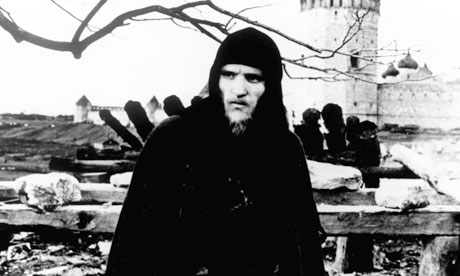
Andrei Rublev (1969) d. Andrei Tarkovsky (5/27/13)


Andrei Rublev d. Andrei Tarkovsky


Andrei Rublev (1969)
d. Andrei Tarkovsky
Criterion Collection #34
185 minutes/Russian subtitles

  From  one perspective, watching a 3 hour film with Russian subtitles seems totally insane, but is it any more insane then watching six episodes of "Cheers" back-to-back on Netflix?  Andrei Rublev is a quality example of a work of art I would literally have never seen were it not for its inclusion within the Criterion Collection. Director Andrei Tarkovsky is best known in the west for his sci-fi epic Solaris, but this is has to be his masterwork.


  Andrei Rublev is theoretically the biography of Russian Icon Painter Andrei Rublev, who lived in the 14th and 15th century.  Little is actually known about the guy, and his biography is simply a cover for sweeping- SWEEPING- historical drama about Russian life in the Middle Ages. The black and white film used to shoot Andrei Rublev makes you think it was shot in the 1920s, and then Tarkovsky pulls away for an epic crane shot with hundreds of Russians and Tartars on horses and you're like, "Ah- no- not made in the 1920s."

Andrei Rublev d. Andrei Tarkovsky

  Watching Andrei Rublev is like watching a film from another universe- only a Communist country would both fund such a work AND ruthlessly suppress it prior to release.  One of the benefits of state funded art I suppose.  Over the three hours I spent watching Rublev- and you have to actually watch it because it is in Russian, with English subtitles, I was trying to imagine what it must have been like being an Artist in Communist Russia- there must have been pros and cons.

  The stand out moments in the epic are the scenes of wanton cruelty of the Czar and Tartars alike towards the peasants.  The cruelty is depicted so matter of factly that it can reach even people who have been desentizied to depictions of cruelty and violence.  It's like seeing Birth of a Nation only the troops are raping people and gouging their eyes out before the heroic Klan arrives to save the day.

   The final chapter of Andrei Rublev tells the story of Fyodor, who is drafted by the Czar to make an enormous bell for a church based on his representation that his dead father, the bellmaker, had imparted his secrets to Fyodor before death.  Then you watch this kid make this enormous church bell- essentially on pain of death- and then when it works, he breaks down and confesses that his father never told him the secret of making large bells, and he basically made it up as he went.  It's a rare cinematic moment, equal to anything that Hollywood has thrown out there, and the fact that it comes at the end of this dark, savage movie about life in the Russian Middle Ages makes it all the more exceptional.


Diabolique (1955) d. Henri Georges Clouzot (5/29/13)

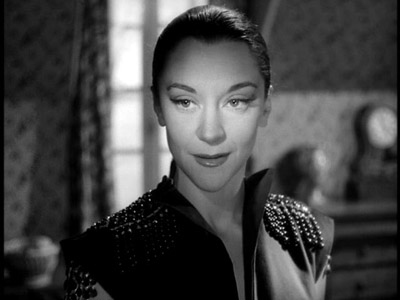
Simone Signoret as Nicole Horner in Diabloique (1955) d. Henri Georges Clouzot


Movie Review
Diabolique (1955)
d. Henri Georges Clouzot
Criterion Collection #35

  OMG this movie is so good, but unfortunately it's got a plot twist that makes talking about it almost impossible without ruining the film for someone who hasn't seen it.  Henri Georges Clouzot is a good example of a film maker who benefits from Criterion Collection editions of his work.  I realized while reading an article Terrence Rafferty wrote about this release that I had see another of his films, La corbeau, about the impact of anonymous gossip in a small town, in a non Criterion Collection version and it was scratchy and unrestored.


   The tag to get you to watch this movie is that this was a story that Hitchcock wanted to film and "got away."  It has elements of film noir, suspense and horror that are characteristic of what would become "Hitchcockian" film making, but was made before Hitchcock himself had rounded into full, mature, artistic form.

  The plot of Diabolique: A spurned wife and beat-up mistress conspire to murder the brutal man they share in common, if classic film noir but as Diabolique moves through it's nearly two hour run time, elements of the supernatural begin to creep in, leading to the blow up ending.  It is quite a ride, and the performances of the lead characters: Paul Meurisse as the brutal husband/love Michel Delassalle, Simone Signoret as the scheming blond mistress Nicole Horner & Vera Clouzot as Christina the spurned wife- are all top notch.

 The value of the Criterion Collection Edition here is that Clouzot was a filmmaker who was very much a victim of the rise of the Nouvelle Vague- it was unfortunate, he was targeted mostly because he was on top vs. being an embodiment of the film culture that Truffaut, Godard etc despised.   Making a Criterion Collection of Diabolique cements his proper place in the canon of film.  Fun movie- worth a watch on Hulu Plus for sure

Branded to Kill (1967) d. Seijun Suzuki (5/30/13)

Movie Review
Branded to Kill (1967)
d. Seijun Suzuki
Criterion Collection #38

  It's clear six movies in that one of the primary purposes of the Criterion Collection is to canonize films that are, at time of publication, outside the canon of generally recognized classics.  This is a well established tactic of the marketing of cultural products, whether it be anthologies with critical notes or reissues of out of print records, the resuscitation of a product that has either a minimal market or is currently unavailable in the the market is always attractive because the acquisition costs are low relative to the production of a new art product in the same format.

Annu Mari as Misako Nakajo in Branded to Kill (1967)l d. Siejun Suzuki

  It makes sense that so many of the Criterion Collection films are either foreign or from "B-Movie" genres, because these are the films that are most often going to be ignored by the American critical/popular Audience for movies.  One characteristic foreign and b-movies have in common is less-then-perfect distribution, including, frequently,  lags of years between production and distribution.  If an art product is produced in year 1, and not shown to any Audience until year 3, there is less of a chance of the work connecting with that initial Audience.


 But one of the things I've learned already is that I've actually seen many/most of the Criterion Collection films already:  Grand Illusion, Seven SamuraiThe Lady Vanishes400 BlowsThe KillerHard BoiledSpinal TapSilence of the Lambs, Sid and Nancy, Dead Ringers, Robocop,Alphaville, M, Nanook of the North, Time Bandits, Armageddon, Fishing With John (TV Show.)   That takes me up to this movie, Branded To Kill, Criterion Collection #38.
Annu Mari as Misako Nakajo in Branded to Kill (1967)l d. Siejun Suzuki


  Anyone can see from that very partial list that there are a bunch of films that are hardly traditional classics: two John Woo movies, Spinal Tap, Silence of the Lambs, Sid and Nancy, Dead Ringers, Time Bandits- and... AND- Armageddon- directed by Michael Bay- in the first 50 titles.  Clearly what we're dealing with here is what the Criterion Collection could get the rights for.


 That set, Branded to Kill, directed by Seijun Suzuki is a solid Criterion Collection gem, one of two Seijun Suzuki films that appear back-to-back 38-39 in the Criterion Collection.  Seijun Suzuki is known as a great rebel of Japanese cinema and kind of seems like the Japanese equivalent of the New Wave bad boys of French Film or more recent Auteurs like Quentin Tarantino or perhaps even Eli Roth.  Suzuki is so well known that I think it's warranted to quote the Criterion Collection biography of Seijun Suzuki itself:

According to critic Manohla Dargis, “To experience a film by Japanese B-movie visionary Seijun Suzuki is to experience Japanese cinema in all its frenzied, voluptuous excess.” Suzuki played chaos like jazz in his movies, from the anything-goes yakuza thrillers Tokyo Drifter and Branded to Kill to the daring postwar dramas of human frailty Gate of Flesh and Story of a Prostitute to the twisted coming-of-age story Fighting Elegy; he never concerned himself with moderation, cramming boundless invention into his beautifully composed frames, both color and black-and-white.

  Accurate description. One of the most interesting aspects of Suzuki, besides the cinematography of this purportedly "B" movies, is their status AS B-Movies.  Film makers are almost always working as employees of a film producing company, and this can lead to artistic disputes and outre behavior on the part of the Artists.  For example, Suzuki was famously fired after Branded to Kill came out because the movie "made no sense."  That is pretty epic.

  Watching Branded to Kill is a sequence of "gee whiz" moments as you recognize the enormous influence that Suzuki has had on a generation of Hollywood directors.  As it turns out I've already seen Tokyo Drifters, but I would also write an amazing review of that film as well, if asked.


Taste of Cherry (1997) d. Abbas Kairostami (6/2/13)


Taste of Cherry: Iranian landscape


Movie Review
Taste of Cherry (1997)
 d. Abbas Kiarostami
Criterion Collection #45

  Iran is a cultural blind-spot in the west. Even well educated American typically only know this history of Iran post Iranian Revolution.  Few know that the Farsi language is part of the Indo-European linguistic family (alongside English, Spanish, French, German, etc.) or that the first Monotheistic religion (Zoroastrianism) was the state religion of Persia when the ancient Hebrews were exiled there.  Iran is typically defined today by its religion: Shia Islam and almost never by ethnicity/language.

   Taste of Cherry actually won the Palme D'Or at Cannes in 1997 and the Criterion Collection edition followed shortly in 1999. Obviously, a film coming out of Iran in 1997 is going to have distribution issues, so it makes sense that this movie would basically go straight from theaters to Criterion Collection with no intermediaries.

 The story sounds like a parody of depressing indie films: Middle-aged Mr. Badii (Homayoun Ershadi) drives through the hilly outskirts of Tehran—searching for someone to rescue or bury him.

This is director Abbas Kiarostami shooting Taste of Cherry.

  That's it- that is the whole story.  Specifically he interacts with four people, a solider, a gatekeeper, a seminarian and a taxidermist, and tries to convince each of them to help him commit suicide by covering him with dirt after he dies.

 Although Taste of Cherry is only 90 minutes long it is a lengthy 90 minutes.  I think I stopped it a half dozen times to get up and do something.   Many of the shots are long static head shots of Mr. Badii driving, because the director was in the passenger seat shooting the film.  The lengthy conversations are interspersed with breathtaking images of Iran- I'm just assuming this movie was shot near Tehran- perhaps in an industrial suburb- rather then Tehran proper.

The Most Dangerous Game (6/4/13)

Movie Review
The Most Dangerous Game (1932)
 d. Ernest B. Schoedsack & Irving Pichel
Criterion Collection #46

  The Most Dangerous Game was a welcome respite after the slow-moving, elegaic & Iranian language Taste of Cherry.  The Most Dangerous Game was the movie made by the group who would make King Kong the very next year, and even features King Kong leading lady Fay Wray playing another damsel in distress.

  Prior to watching this movie I knew of it mostly by pop culture references made in tv shows like the Simpsons.  Who can't imagine Simpsons character/Arnold Schwarzenegger parody Rainer Wolfcastle gravely intoning, "I will hunt the most dangerous game...man." in his faux Austrian parody accent?


Fay Wray- sexy pre code babe


  But, it actually is a film- this film- and it does tell the story of an insane Russian count living in an old Portugese castle in the Pacific who does, in fact, hunt the most dangerous game... that game being man.  His foil is leading man Joel McCrea,  but it's hard too take your eyes away from Count Zaroff, who turns in a crazy Russian bad guy for the ages.  The impact is heigtened by the less-then-subtle camera techniques and a score that litereally goes bonkers every time the film makers are trying to hint at something.

  There is one scene where Zaroff is talking to Fay Wray and she is standing at the top of a lengthy stair case, and he is standing beneath, and he says something menacing, and the camera zooms in- it has to be- 50 feet, across the room to focus in on his menacing expression.  It comes off as corny in 2013, but only because filmmakers have been using the same technique for almost a hundred years.

  The action sequences have the same clumsy, stop-motion quality that they have in King Kong but it doesn't detract from an enjoyable, and brief (The Most Dangerous Game is only an hour long) viewing experience.  It's certainly more fun then Taste of Cherry.

Black Orpheus (1959) d. Marcel Camus (6/6/13)

Movie Review
Black Orpheus (1959)
 d. Marcel Camus
Criterion Collection #48

  Black Orpheus is an outlier.  First, it's in Portuguese, but made by a French director.  Second, it's a filmic "one hit wonder" Marcel Camus never made another classic film.  Third, it won both the Palme D'Or at Cannes and the Academy Award for Best Foreign Film in 1959 so it's not an lost masterpiece.

  Black Orpheus is the retelling of the Greek myth of Orpheus and Eurydice.  In the original, Orpheus is a talented musician and Eurydice is his beloved.  She attracts the attention of a malveolent shepard and she dies while in flight from him, bitten by a snake.  Orpheus tracks her to the underworld and frees her once, but  violates her condition of release by looking at her before they make it back to Earth, so he loses her in the end.

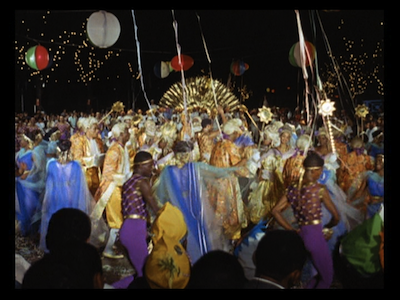
  Here the action is transposed to the favela's of Rio de Janiero during Carneval.  Eurydice is a country girl who has fled into the city- scared of the man in the death costume who is stalking her.  Orpheus is a talented guitar player and leader of a significant crew for the upcoming Carneval.  When set against other foreign films of the late 50s and early 60s, Black Orpheus is a pageant for the eyes and ears.

The Carneval footage and general scenery of Brazil makes Black Orpheus worth a watch even for people who aren't into the Greek myth
       The sound track, created by Antonio Carlos Jobim and Luis Bonfra, is generally credited, by film scholars at least, with sparking the boom in Brazillian bossa nova that took place around the time the film was released.  I'm not sure if this is factually accurate or not, but I can certainly see why it would be true.  It's pretty incredible how a single film can start a larger cultural phenomenon, but the fact that this happens over and over again is a testament to the strength of movies as a medium

Yojimbo (1961) d. Akira Kurosawa (6/10/13)

Movie Review
Yojimbor (1961)
 d. Akira Kurosawa
Criterion Collection #52

  Not particularly looking forward to watching every g d Akira Kurosawa movie, because it seems like every one is in the Criterion Collection.  I know he's a master of world cinema but I just have never got into it.  But I still prefer watching Yojimbo to any of the about 50 Friends episodes I've got stacked up on my DVR.  I can't even contemplate the horror of watching 6 dvr'ed episodes of Friends in a row.  It's like thinking about cutting off a limb, for me anyway.

  At the same time I'm forced to admit that I can't exactly sit down and watch a two hour Akira Kurosawa picture straight, either.  What I end up doing is watching Yojimbo like it's an episodic tv show, with two half hour shows and a one hour finale over the course of 3 or 4 days.  That way I have time to reflect before the film is over and I'm sitting there going "Ugh so boring."

 I've never been a Kurosawa fan but that must have something to do with the fact that I haven't seen the Criterion Collection editions of this work. For example, I can remember watching a pan and scan version of Seven Samurais on PBS in high school and not getting what the deal was.  The deal is the way Kurosawa uses the wide screen format and translates the filimic components of a Western into his Japanese milleu.

  Many Americans who haven't seen Yojimbo have seen the Sergio Leon remake/adaptation from 1964, Fist Full of Dollars with Clint Eastwood.  Actually probably at this point most people who have heard of one have heard of the other- don't know that the cult of Clint Eastwood really exists these days.

Toshiro Mifune as Sanjuro in Yojimbo (1961) d. Akira Kurosawa


The center of Yojimbo is the incomparable (from the criterion collection website) Toshiro Mifune as Sanjuro, the itinerant Samurai/Cowboy who strolls into the frontier town where two gangs are at war with one another.  Sanjuro plays both sides off against one another in his now classic, timeless, manner.  Like the Seijun Suzuki films, to watch Yojimbo is to watch a movie that has directly influenced a half century plus of successful Film makers.

 One  Criterion Collection specific observation I have after watching a dozen or so films is that the wide aspect ratio that characterizes Hollywood film was by no means standard on a world wide basis, particularly outside of America.  Yojimbo has an aspect ratio of 2.35:1 whereas Amarcord, a Fellini film shot in the early 1970s, only has 1.85:1.  The Most Dangerous Game, shot in the pre Code Hollywood era, is only 1.33:1.  Same thing with Diablolique, a French film shot in 1955- 1.33:1.   In fact, the only other film I can think of that shares the 2.35:1 aspect ratio of Yojimbo is Seijun Suzuki's movies.  The 2.35:1 ratio is actually even larger then the current Hollywood standard.  For example Robocop, shot in 1987, is 1.66:1.

 The 2.35:1 aspect ratio gives the filmmaker many possibilities in terms of composing the scene but it makes facial close ups awkward.  Not in the hands of Kurosawa, but it's easy to see how a facial close up in a 2.35:1 aspect ratio would actually cut off the top and bottom of the face.  But landscapes... or "long" shots- beautiful.


Sanjuro (1962) d. Akira Kurosawa (6/12/13)


Toshiro Mifune, star of Sanjuro and Yojimbo

Movie Review
Sanjuro (1962)
 d. Akira Kurosawa
Criterion Collection #53


  Sometimes I'll be a reading a record review and the reviewer will call the record a "victory lap." That means the Artist who made the record has done well with a prior record and is following up that success with a product that is less ambitious, but features many of the same strengths (and songs) as the prior release.

  Sanjuro is like a victory lap for the immortal epic Yojimbo.  Sanjuro is the name of the Samurai/Ronin at the heart of Yojimbo, and Toshiro Mifune returns to reprise the role in this film. The critical essay by Michael Sragow that accompanies the Criterion Collection page for Sanjuro refers to it as the "sassy kid brother" of Yojimbo and I don't know why you would disagree with that statement.
    
     It is a lesser achievement, it is sassier/funnier then Yojimbo (which is also dryly humorous in it's own way) and it does have many of the same pleasures as Yojimbo itself: Namely scenes of Sanjuro being clever interspersed with scenes of Sanjuro being brutal with a sword, and a ton of sneaking around in the bushes spying on people.  Seriously, if you had a yen for every time Sanjuro or another character in Yojimbo and Sanjuro peaks out of a knot hole, or a crack in the wall you'd have about a hundred yen because it seems to happen at least- at least- once every 5 minutes in both films.

Carnival of Souls (1962) d. Herk Harvey (6/7/13)

Carnival of Souls (1962)
 d. Herk Harvey
Criterion Collection #63

Manny Farber is an American critic and professor whose seminal essay applying Auteur theory to B-Movies was published the same year as Carnival of Souls was released: 1962


  Manny Farber was an American film critic and painter.  In 1962, as luck would have it, he wrote an important essay on B-Movies called "Termite Art vs. White Elephant Art."  And basically he was a guy who applied the idea of Auteur theory to B-Movie directors.  Carnival of Souls is a fine example of Auteur theory in action in the context of B-Movie.

 Carnival of Souls was made by "industrial filmmakers on a limited budget."  But it survived in true underground fashion for decades after release thanks to bootleg VHS tapes.  Finally, Criterion Collection issued this version with a new digital transfer of an original film version.


  The idea of creating a lasting masterpiece on a limited budget with limited artistic expectations is a concept that is very near and dear to my heart.  It is something that my friends bands share in common: Crocodiles, Dum Dum Girls & Dirty Beaches all started as what Manny Farber called "termite art" individual creators, working in isolation from the mainstream of their field, creating something that Audiences responded to.

  This process of the revival and elevation of B-Movies to "classics" is something I find fascinating, and I think it's those movies within the Criterion Collection- Samuel Fuller's two films I've already seen are another good example- and I think it's critical to have a firm understand of which aesthetic choices made due to a limited budget can be used to generate positive artistic elements: atmosphere, style, depth.

The Night Porter (1974) d. Liliana Cavani (6/14/13)

Movie Review
The Night Porter (1974)
d. Liliana Cavani
Criterion Collection #59

   The Night Porter was a real Criterion Collection win. It had everything: 70s Vienna, Nazis, S&M sex, concentration camp flash backs and Charlotte Rampling giving an amazing performance.  According to the accompanying critical essay at the Criterion web site, this movie was controversial when it was released in 1974.  Critics accused it of exploiting the Holocaust.  It still packs a punch close to forty years later (in other news, 1974 was 39 years ago so old.)

Charlotte Rampling seen in flashback pre-Concentration Camp in The Night Porter


  Truth be told I wasn't that into S&M but I've had some interesting conversations with people and done a little research in the last several months, and now my thought is that if that makes someone happy, they should just do it and not ask too many questions about it.  Different strokes for different folks, am I right?


     The over all impact of The Night Porter is "Last Tango in Paris meets the Holocaust" but I must confess I was absolutely riveted by The Night Porter.  Starting with the scenery, continuing with the costumes and performances, and ending with the emotional murder of the star-crossed lovers by the creepy former Nazi's who endlessly harass the couple, The Night Porter is a film that will stick with you and it really, really, stands out on a number of levels from the other Criterion Collection films I've taken in up to this point.


Orpheus (1950) d. Jean Cocteau (6/21/13)


Jean Marais place Orpheus in Jean Cocteau's 1950 film.

Movie Review
Orpheus (1950)
 d. Jean Cocteau
Criterion Collection #68

  Today, special effects are treated with condescension by most film critics. Candidates for "Auteur" status are often given demerits for a body of work that relies heavily on special effects.  Consider the still tentative embrace of Hollywood legend Steven Spielberg by the critical/scholarly film community.  Or James Cameron would be another good example.

Maria Casares as Princess/Death

 And yet twas not always the case.  Jean Cocteau relied on cutting edge special effects in Orpheus, his 1950 retelling of the Greek Myth, (and the second such adaptation ALREADY in the Criterion Collection from the 1950s) as well as in Beauty and the Beast (1946).

  In fact, considering that both were adaptations (1) it seems fair to compare Jean Cocteau to say, a Michael Bay.  What exactly is the difference between a special effect driven adaptation of an ancient Greek myth and a special effects driven adaptation of a toy/Saturday morning cartoon.  After all, are not Saturday morning cartoons our modern myths?


  Unlike Black Orpheus, which was a loose adaptation of the myth with no notable underworld sequence,  Jean Cocteau delivers the underworld, which, as it turns out, is governed by a kind of administrative tribunal and looks pretty much like the French country side.

  In this Orpheus, the hero is a pop star of some sort- I imagine him along the same lines as a Serge Gainsbourg.  Death is represented by a wealthy Princess (living in suburban Paris in 1950 of course) and her chauffeur, and it is the chauffeur who ferries off Eurydice to the Underworld.

  Orpheus follows her down and obtains her release after a sort of mini trial, on the condition that he never look at her again.  In the original myth, the stipulation is that he not look at her UNTIL HE REACHES the surface, but it's a small difference.  I'd like to know how that part of the myth came to be. (2)

  The two notable features of Orpheus are the special effects and his use of be bop Jazz to score the sequences of mob violence.  I'm not sure if he was the first to do that- it may have been the case that American directors had been doing that before 1950, but it seems like a pretty early usage of be bop Jazz in that context.

 Orpheus was less tedious to watch then Beauty and the Beast- it's a technically more sophisticated production and the pace is business like and not "dreamy."  The two films make an interesting contrast.  It seems clear from watching both that Beauty and the Beast was a more "shoe string" production, whereas Orpheus is like an "A-list" film from an "A-list" director.


NOTES

(1)  I try to avoid questions of grammar but the adaptation vs. adaption has been haunting me.  I think the proper spelling is adaptation though according to this article they are both valid.
(2) The non Greek influence on the myth of Orpheus can be seen first, in the fact that Orpheus is from "Thracia" which is an area north and east of the Greek heart land.  Second there is the well known Ancient Near Eastern Myth of Inanna an Dumuzi, where Dumuzi (Inanna's husband) rescues her from the Netherworld.

Dead Ringers (1988) d. David Cronenberg (6/24/13)

The Instruments For Operating on Mutant Women from David Cronenberg's 1988 opus Dead Ringers.


Movie Review
Dead Ringers (1988)
 d. David Cronenberg
Criterion Collection #21

  I figured out that many of the Criterion Collection titles that are not available for free on Hulu Plus ARE available on Amazon Streaming Video for 2.99 so I'm like "Yeahhhhh."

 I've been actively trying to watch Dead Ringers since the Netflix revolution, but have been flummoxed.  I am heartened that several of Cronenberg's films are available via Amazon streaming video because he's a director where I'd like to say I'd seen all the hits.
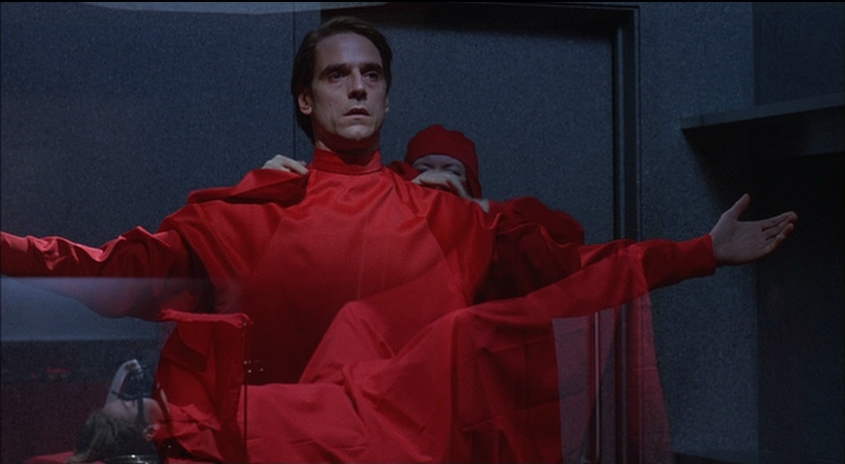
Jeremy Irons playing Beverly Mantle right before he goes bananas and tries to use the above Instruments for Operating on Mutant Women on a non mutant woman.

 Dead Ringers was made in 1988.  Jeremy Irons turned in his stunning portrayal of accused murdered Claus Von Bulow in Reversal of Fortune the very next year, and it's hard for me to pick which performance is better that one or his role in Dead Ringers as identical twins, Beverly and Elliot Mantle, who are top gynecologists.

 Basically, Beverly falls for actress Claire Niveau and basically loses his shit, and takes his brother down with him. By "lose his shit" I mean becomes hardcore addicted to drugs, goes crazy and has his own set of macabre and Cronenbergian surgical tools/"Instruments for Operating on Mutant Women" made- and then uses them to ill, ill effect.

 The not-so-slow decent into insanity by first Beverly and then Elliot and then Beverly and Elliot together is classic Cronenberg and I enjoyed every minute of this classic. If you haven't seen it yet get it on Amazon streaming video for 2.99 WORTH EVERY PENNY.

Cleo From 5 to 7(1962) d. Agnes Varda (6/28/13)

Movie Review
Cleo From 5 to 7(1962)
 d. Agnes Varda
Criterion Collection #73

   I'm not a guy who is particularly into the French New Wave. Just because...if you look at the whole universe of art/film, French New Wave is just one thing.  There's no reason...to fetishize the French New Wave and Auteur theory.  Personally, I think Auteur theory is pretty ridiculous considering how many people work on a typical film.   Especially when you consider the number of so-called Auteurs who actually PAY for their films- even the best are usually working for a pay check.

  But Cleo From 5 to 7 is notable first, because Agnes Varda is a female director and second because the pace is snappy and fresh, and the lead actress, Corinne Marchand playing Cleopatra (or Cleo for short) a Parisian ye-ye girl who is confronting her own mortality while she waits the results of a bopsy for a potentially cancerous tumor.

  Cleo From 5 to 7 is shot in "real time" complete with title that break the movie into separate scenes of a specific time frame.   Cleo hangs out in her pad, goes to a cafe and plays her own song on the jukebox, hangs out with her friend the Artists model, goes to the park, hangs out with a soldier and FIN.

  But Cleo From 5 to 7 is not dull or boring- and don't tell me that all of Godard's films are actually watchable because THEY AREN'T.  Also the character of Cleo the Ye Ye girl is a compelling character- I love when the main character of films are artists. 
  

Collected Movie Reviews: 2010-2013


Collected Movie Reviews: 2010-2013

  It's very clear to me that this blog needs to be smaller in terms of the volume, and also that older posts need to be recycled and combined.  It makes sense to me that a blog like this one would have about 1000 posts and no more.


Movie Review: Pandora's Box d. GW Pabst *1929* (6/30/10)

PANDORA'S BOX directed by G.W. Pabst *1929*

     Inspired by Netflix streaming service, I've decided to make a move into film writing.  I'm not going to review contemporary releases, nor am I going to bitch about Hollywood.  I don't see the point in telling the world about crappy Hollywood movies.  I do see a strong link between film/cinemas/movies and other subjects I write about on this blog: the production of cultural objects, the relationship of artists and audiences and the nature of creativity in the world of mass media.  As a forum for discussing those subjects, film actually surpasses music in that the film industry both proceeded AND directly inspired the music industry.  For example, the practice of calling a cultural product a "hit" was INVENTED by film and ADOPTED by music decades later.  Thus, movies are relevant to the project of this blog, and Netflix streaming service is the break through I need to carry out my project.

      I wanted to start by discussing how I watched Pandora's Box- I started at my office, watching it in two twenty minute increments while I waited for people to arrive for their free consultations.  Netflix actually keeps track of where you start and stop the film.  I noticed right away that the prospect of not having to sit in front of the television to watch a two hour plus silent film cheered me immensely. When I went home, I had dinner, then my wife had a business meeting, so I watched the remaining hour and forty five minutes in two more blocks, interspersing the watching with reading a book.  This was so revolutionary for me that I wanted to write about it, even though it is 'boring' material.

    If you are going to address film in a comprehensive manner, you need to understand the pre-talkies era.  Perhaps the most important fact to understand about the era is how the commonly used "SILENT FILM" term is hugely inaccurate.  Films where never "silent."  The introduction of characters talking on screen was a technical innovation, but films were accompanied by sound from almost the very beginning. Popular films were typically presented with a live orchestra.

   The technical achievements in this era were in no way primitive, but the preservation of the master films was primitive, and that impacts the ability of the audience to appreciate the merit of "silent" movies.  I can personally attest to having seen multiple silent era films that were so poorly preserved as to make them literally unwatchable- and these were commercially available dvd's put out by major film studios.  Also, when watching a silent movie you need to have some concern for the audio soundtrack which accompanies the film.  Silent movies worked because you saw them in a live setting, with people playing instruments.   The "quiet theater" aesthetic of the talkies era was not shared with the silent film aesthetic, which more resembles a circus or vaudevillian show.

   Might I suggest watching silent era films released by Criterion Collection?  Whatever the film, you know Criterion Collection is going to do a bang up job on the re-release.  Pandora's Box (Criterion Collections Spine #358) was released in 1929, directed by G.W. Pabst.  The first talkie was released in 1927.  The thing to understand is that Pandora's Box represents the end of the silent era, and thus the techniques used and themes are as sophisticated as any in silent film.  The film looks beautiful- no small task for a 1929 movie produced in Germany and Criterion has provided four separate sound tracks.  I believe the track that Netflix uses is track one, an "orchestral score similar to what was heard at the big European music palaces of the day."

  It was the first time I had ever been blown away by the sound accompanying a silent film and it made quite an impression.  How can you be fair to these films without considering the impact of a live orchestra on the audience?  It makes for a significantly different product.

  The second fact to understand about Pandora's Box is that Pabst made it in the pre-code era.  It has a frankness and openness about sexual relationships that is in many ways more insightful then the pablum one gets in contemporary rom-coms.

    The third and final fact to know is that Pandora's Box made Louise Brooks a fucking star.  The story of Pabst "discovering" Brooks playing a circus acrobat in a Howard Hawkes film is the ur-Hollywood Starlet story.  I'm not going to lie: I found parts of Pandora's Box extremely tedious.  I could NOT have watched it on DVD- ever- ever- I would have turned it off after twenty minutes.  However, given the opportunity to cut it up into smaller segments over the course of a whole day, I found the viewing experience to be close to exhilarating.  As I watched Pandora's Box, I had plenty of time to think about silent films, Louise Brooks and G.W. Pabst.  All those topics are worth some quiet contemplation.  Louise Brooks: one of the first Hollywood starlet/it girls; G.W. Pabst- a filmmaker sophisticated beyond his place and time; Silent movies- not that annoying if they have a kick ass sound track and you break them up a little.


Movie Review:  Rivers and Tides *Andy Goldsworthy Working With Time* (7/5/10)

Rivers and Tides:
Andy Goldsworthy Working with Time
d. Thomas Ridelsheimer
p. 2002

    Streaming Netflix continues to rock my existence, though I've noticed some limits.  For example, the aspect ratio of older black and white films makes them look terrible when streaming onto my home television using the Wii system, whereas the same films look perfectly fine streaming on my computer.  Also, I continue to be perplexed by the display system of Netflix itself, which seems to conspire against a user trying to get a full list of what, exactly is available, be it streaming or otherwise.

   One of the issues I've been thinking about recently is the systems theory/cybernetics/biofeedback complexity.  Basically, that's three different ways of looking at the way that systems interact.  Systems theory uses the vocabulary of technology, cybernetics the vocabulary of western philosophy, and biofeedback the vocabulary of new age hippie bullshit, but my hunch is that they are essentially correct in that in order to understand ourselves we need to understand the way that our biological systems interrelate within ourselves and the way that humans interact with the various systems that compose our environment.

    Rivers and Tides is a documentary about the British landscape artist Andy Goldsworthy.  Goldsworthy designs sculptures in specific landscapes.  Sometimes he replicates those structures in museums, other times he takes photographs of those sculptures in natural environments.  Prior to this film, the only artist I was really familiar with who fit into this category of art was Christo and his wife- and I only know about them because they are so ubiquitous in our popular culture (ATT ads, for example.)  However, it seems to me that there is something profoundly interesting about landscape art/sculpture in that it specifically places art in the path of the environment, and then takes note of the impact on one on the other and both on the viewer.

    I found Rivers and Tides to be deeply interesting- it pushed me to think about the role of sculpture in the 21st century, as well as the thoughts I mentioned in prior paragraphs.  Goldsworthy comes off as a deeply cool guy- doing his thing without regard to what the public thinks.  He works outside of a studio environment, which is also very cool.  Also, his work combines a traditionally fine art medium (sculpture) with a medium that is less traditional (photography) to create an impact in the viewer that is greater then the impact that either approach would have by itself.

  Rivers and Tides is worth seeking out on streaming netlfix- I think my readers would agree that watching it is a rewarding use of time.


Marina Abramovic & Francesca Woodsman Documentaries: Artists and Audiences (7/12/12)

MOVIE REVIEW
   I'm very interested in the biographies of "serious" Artists to learn about their relationship to their Audience. Even if I'm not a huge fan of the work of the Artist in question, it's interesting whenever someone muses on the relationship between a successful Artist and their relationship, how that relationship is understood by the Artist, etc.

  Two recent,  easily available documentary films that address the Artist/Audience relationship in interesting detail are Marina Abramovich: The Artist is Present and The Woodmans, about Francesca Woodman, the young photographer/Artist who committed suicide in 1981 in her mid-20s.  Both films are excellent and well worth watching for anyone who actually reads this post.


Prior to watching  Marina Abramovic: The Artist is Present (HBO In Demand) the only fact I knew about her is that she had recently had a career retrospective at the Museum of Modern Art in NYC, and the retrospective shared a title with the film, "The Artist is Present,"  and that she is a performance artist.

    I was eager enough about the prospect of learning more that I actually went into the On Demand section of my Cable Provider and watched it after missing the initial showing.  Marina Abramovic is a celebrated performance Artist, a pioneer in her field of Artistic endeavor and she's notable for several reasons within the realm of contemporary art.

   As The Artist is Present discusses in some detail, Marina Abramovic was active in the field when performance art was beginning to exist, one interviewee describes it as "a reaction to painting."  Given the time of her early performances, the early 1970s, this would place her initial efforts roughly after the Warholian factory epoch.

   Watching footage of Abramovic's early performances, where she did things like cut herself with a razor and allowed audience members to assault her, I was reminded of California performance artist Chris Burden, who was doing the same kind of activities in the very early 1970s in the Los Angeles area.   She is obviously highly influential on contemporary Artist/Celebrity Matthew Barney.

   The details of Abramovic's career are fascinating, the critical moment being a split with her long time partner/husband in 1988.  After that, it basically sounds like she decided to get paid- she hooked up with Parisian fashion houses, moved to New York, got a business manager (who provides several key interviews in the film.)  From a Art/Market perspective the film claims that Abramovic was the first performance Artist to sell still photographs from her pieces.   The fact that this film was made, and it centers around a career retrospective at the Metropolitan Museum of Art- is a testament to her status as a successful Artist.

 Of course, the most interesting part of The Artist is Present is the documentation of the piece that Abramovic performed FOR the exhibit, her sitting in a room for eight hours a day, for six weeks, and making eye contact with all comers.  It is totally fascinating to watch this artistic activity unfold over a six week period, and you come away from the film with a deep respect for the Artist in question.

Francesca Woodman photograph: This should be the cover of the Yohuna LP


    Any appreciation of the photography of Francesca Woodman, a young photographer who committed suicide in her mid 20s after compiling an impressive "ahead of its time" body of work, is complicated by the fact of her suicide.   This film deals with this difficult subject in a matter-of-fact way, exploding myths about the romantic Artist and not shying away from asking tough questions while maintaining a respectful tone.

   Again, I didn't know anything about Francesca Woodman other then a vague idea of her existence, and the existence of this film, but I was interested in knowing why a young Artist would do something like that.  Certainly, the young Artist committing suicide is literally the most classically "Romantic" thing that an Artist CAN do.

    Although the film suggests that the post-death appreciation of her work was an example of the general Audience "catching up" with an avant garde Artist,  it also made clear that Francesca Woodman, herself, was

(1)   A savvy, ambitious, calculated young Artist who sought the acceptance of critics and a wide Audience 
(2)   who failed to obtain that goal at the time of her death,
(3)  and whose failure to obtain that goal played some role in the decision to kill herself.


   I think one of the most cinematic scenes in a film that recalls a Sorrows of Young Werther-esque lead character is the description of Francesca Woodman, post RISD-y, living in New York City, working as "third photographers" assistant at a fashion shoot captained by an Italian fashion photographer.  That is as pure an instance of "unrecognized genius" as you can get outside of a Vincent Van Gogh biography.

   Francesca Woodman's parents were/are both Artists of some note and both have thoughtful and trenchant observations to make about the death of a child.  The father, in particular, notes that the reasons she killed herself are some of the same reasons he loved her so much, and if she didn't have those traits, he wouldn't have cared as much when she died.

  The father also observes that in the years immediately prior to her suicide- a time when he was also in New York City trying to jump start his career as a painter, he had lunch with her and she sternly told him "You have to make one career related phone call" every day- which sounds like something out of a "get rich/positive thinking" book- and certainly indicates that Francesca Woodman was anything but the model of a non-commercially motivated Romantic Artist with a capital A.

 The documentary points out that Woodman had an interest in being regarded as a "Capital A Artist."  This observation is made by one of her college friends, and considering the early date of her suicide it's fair to say that her thought did not evolve significantly from that point on the subject.

 She obviously was not considered so by the New York City Art community.  It sounds like she didn't even merit a show at a gallery during her life time.

  What I took away from the film is that Francesca Woodman was a talented young photographer who began to manifest depression in her early 20s and for whatever reason, she quickly succumbed to that depression in a way similar to many people, Artists and non-Artist alike.  However, the fact of her suicide has perversely upped the value of her work in terms of both critical and general audience response, and today she is a highly influential female Artist on current Artists working in and out of photography.

  Where is the Sofia Coppola directed biopic of Francesca Woodman?


Keira Knightley is Anna Karenina (10/15/12)


 I just about squealed with delight when I saw this preview- Keira Knightley playing Anna Karenina in a forthcoming adaptation of that Leo Tolstoy authored classic.

Keira Knightley playing Anna Karenina


  Not to mention the screenplay is written by Tom Stoppard.  Directed by Joe Wright (Atonement & 2005 adaptation of Pride & Prejudice that also starred Keira Knightley.


How Much Does Your Building Weigh, Mr. Foster? (11/14/12)


30 st Mary Axe or Swiss Re Building in London UK- designed by Norman Foster.


Movie Review
How Much Does Your Building Weigh, Mr. Foster
 (2011 documentary about architect Norman Foster)
currently streaming on Netflix
(PURCHASE)

Buckminster Fuller and Norman Foster hangin' out.


  SPOILER ALERT: The title is a comment that American philosopher/crazy person Buckminster Fuller made to architect Norman Foster when they were palling around.

This is an example of Gothic Architecture.


  As  anyone who wants to write art criticism, or for that matter, read it- needs to understand that architectural criticism provides much of the vocabulary and ideas about Art that are used by critics of other art forms besides architecture.  To give two well know examples, the phrase "Gothic" was used by John Ruskin to describe certain designs that characterize medieval buildings and directly inspired the Gothic revival of the mid to late 19th century.  The other example is the phrase "post-modern" which is commonly used to describe art works from all sorts of artists in every discipline.  Originally, if you called something "post-modern" you were talking about a building, not a book or a record.

   Thus, the movie How Much Does Your Building Weigh, Mr. Foster, is a biographical film about an Artist, the architect Norman Foster.  Norman Foster has to be among the most famous and prolific of all active architets in the entire world.  His rise has been highlighted by structures he has built in places like China, Hong Kong and the Gulf States of the Middle East.   Perhaps the tone of self-satisfied triumphalism that pervades How Much Does Your Building Weigh, Mr Foster? can be excused on the grounds of the massive scale of Foster's success on a planet-wide scale.

John Spoor Broome Library, California State University Channel Islands, designed by Norman Foster


   If you are looking for critical engagement about the wisdom of building the "largest building in the world" (Bejing Airport Terminal) for a repressive dictatorship or the likelihood of success for a project that involves constructing a self-contained eco paradise for 80,000 people in one of the Persian Gulf statelets, this is not the movie for you.

Commerzbank Tower vom Rathenauplatz designed by Norman Foster


       A movie about Norman Foster could do in a whole other direction in the sense that his work can be seen as a harbinger of the kind of soulless corporate modernism familiar from books like 1984 or Brave New World.

The redesigned German Reichstag by Norman Foster.


 However, Norman Foster does not operate wholly above politics.  As an example, when Germany asked him to redesign the Reichstag(!) in the aftermath of the reunification of Germany, he rejected the idea of restoring what was there before, and left hateful Russian graffiti where it lay- choosing to keep the vandalism as a reminder of the past.

  That is just how Norman Foster rolls, OK?


Movie Review: In Search of Beethoven on Netflix  (11/16/12)


Ludwig van Beethoven


Movie Review
In Search of Beethoven (documentary)
2009
d. Phil Grabsky
currently streaming on Netflix

   There should be a word for things that are both interesting and boring at the same time.  If that word existed, it would describe In Search of Beethoven, a comprehensive and very no-nonsense documentary about the life, times and music of the immortal composer and pianist, Ludwig van Beethoven.  In Search of Beethoven, currently streaming on Netflix is two hours and twenty minutes long.  It actually took me a week and five separate viewing sessions before I completed In Search of Beethoven.

   The entirety of In Search of Beethoven is some pictures of Ludwig van Beethoven, interviews with scholars and musicians about Ludwig van Beethoven and performances of his works.   Over the two hours and twenty minutes there is quite alot of all three things.

   There is so much useful and interesting information about Beethoven in this documentary that I wanted to see a written down version of what all the talking heads were saying.   One of the keys to understanding Beethoven that I extracted in between my lengthy sighs upon realizing just how long In Search of Beethoven is, was that he was very, very, very unlucky in love.  He was forever pining after teenaged Aristocratic girls and in early 19th centuy Vienna that shit was not going to happen.

  The two songs I've written about here so far- Fur Elise and Moonlight Sonata, were love notes to two different girls.  Both are sonatas, or as we would call them today, songs.  Ludwig van Beethoven's works can be broken down into three categories: sonatas, concertos & symphonies. He also did one opera and a very famous mass, but the main categories are the sonata (one instrument- piano), concerto (one lead instrument and backing instruments) and symphonies (full orchestra + chorused vox.)

  The symphonies were his big statement pieces.  Beethoven never really left Vienna and never toured, but he did play a couple of big live shows- the first when he debuted his immortal Fifth Symphony:


  Several years later he also did a live performance of the Ninth symphony:


  Beethoven's achievements were measured next to those of Haydn and Mozart by his contemporaries.  This despite the facts that Haydn had long stopped composing and Mozart was actually dead.  The "three geniuses" of early 19th century Vienna were Haydn, Mozart and Beethoven.  Compared to those two, Beethoven did a couple of things differently.  First, he abandoned the classical symmetry that characterizes much of pre-Beethoven classical music in favor of a more tension inducing, unbalanced style of music. Second, Beethoven went big.  When the Audience heard the Fifth Symphony for the first time the reaction must have been something like a big crowd getting wowed at an arena rock show- no one had ever written symphonies on such a grand scale.

Ludwig van Beethoven


 In fact, at least one interviewee on In Search of Beethoven credits him with the creation of the grand, classical symphony as we know it today.  Beethoven's deafness, which is the kind of biographical detail that has ensured his immortality in the Romantic artistic canon, certainly limited his ability to perform live (he played the Piano in the live setting), but didn't stop him from composing.  In fact, several people argue that his deafness probably liberated his music from the conventions of the time.


  Despite his general unhappiness with his material circumstances, Beethoven was acclaimed as a genius by his Audience during his life and immediately upon his death.  It was clear to contemporaries the extent of his talent, and Beethoven, composed in such a way so that people would damn well understand how great he was- if only because his songs were often impossible for lesser skilled musicians to play.


Spring Breakers & Mythic Descent into the Underworld (4/3/13)


Movie Review
Spring Breakers
p. 2013
d. Harmony Korine

  It seems impossible to me that someone could go to Spring Breakers and actually write a review where they make statements like "I didn't like it." or "Spring Breakers is a bad movie."  If you didn't like Spring Breakers, you are an idiot, and if you can even contemplate saying "Spring Breakers is a bad movie." You have bad taste in art.

 In fact, Spring Breaker is an amazing movie. As should be clear to anyone who sees the film, Harmony Korine has created a contemporary retelling of the classic "Hero's Descent into the Underwold" one of the most long-standing enduring myth's of world culture.   The oldest telling is the pan-Ancient Near East myth of   Tammuz and his mother/love Aphrodite/Ishta/Inanna:

Inanna Goddess of Heaven and Earth, Akkadian


According to the myth of Inanna's descent to the underworld, represented in parallel Sumerian and Akkadian tablets, Inanna (Ishtar in the Akkadian texts) set off for the netherworld, or Kur, which was ruled by her sister Ereshkigal, perhaps to take it as her own. Ereshkigal is in mourning at the death of her consort, Gugalanna (The Wild Bull of Heaven Sumerian Gu = Bull, Gal = Great, An = Heaven). She passed through seven gates and at each one was required to leave a garment or an ornament so that when she had passed through the seventh gate she was a simple woman, entirely naked. Despite warnings about her presumption, she did not turn back but dared to sit herself down on Ereshkigal's throne. Immediately the Anunnaki of the underworld judged her, gazed at her with the eyes of death, and she became a corpse, hung up on a meathook. (WIKIPEDIA)

  In this retelling, you can see some of the story elements of Spring Breakers clearly:  sisters...go to the underworld... pass through seven gates taking off their clothes at each one...  In Greek myth this story became the story of Adonis and Ishtar.  In Roman myth it was the story of Orpheus and Eurydice.  The correspondences extend beyond the Mediterranean- Norse myth features the tale of Lemminkäinen's rescue from Tuonela by his mother.  And who can forget the Welsh version: Pwyll's descent into Annwn in the Welsh Mabinogion.

  Spring Breakers is not simply a retelling of the old myth- there is no kidnapping, no retrieval of consequence from the underworld.  Rather Spring Breakers mirrors the structure of myth- of the underworld descent myth, without overtly announcing it as a source of inspiration.  (GOOGLE SEARCH SPRING BREAKERS & DESCENT INTO THE UNDERWORLD MYTH)   In mythic fashion, Korine uses the techniques of contemporary film to mirror the jumpy, lost in time and space form in which we moderns receive myth- a sentence from a tablet dug up in the Mesopotamian desert here- a retelling from a Greek Shepard a thousand years later, learned analysis from a German scholar two thousand years after that, translated into English by a different scholar a generation later- that's how we learn about myth- not in a jaunty made for tv narrative retelling.

Spring Breakers: Ashley Benson as Brit, the Ereshkigal of Korine's retelling of Inanna's descent into the underworld.


     Harmony Korine has always understood that, and every one of his films has embraced this mythic style.  It's easy to focus on the sensationalistic features of Spring Breakers: the debauchery, the exploitation of young female body parts, but that really misses the point of the film.  After all, if an Artist depicts the tortures of an underworld a la Dante critics do not castigate him for "accurately" depicting the tortures of hell.  Assuming that the St. Petersburg of Spring Breakers is a mythic underworld, one would EXPECT to see scenes of unimaginable horror.  Similarly, to castigate Korine for "judging" the leisure time rituals of America's youth misses the point that Spring Breakers is a work of art- it's not a documentary film made by Korine with the intent of getting teenagers to stop partying at Spring Break, or with the intent of raising awareness of the evils of Spring Break.  

  Spring Breakers is demonstrably a successful work of Art because of its demonstrated ability to evoke a strong emotional response: both positive and negative, from an Audience.  When a great work of Art evokes a strong negative emotional reaction from the Audience, that is almost more impressive then evoking a positive emotional reaction because after all, one would expect a great work of art to be hailed as such.  Making a work of art that is difficult and alienating while still being great is the most impressive artistic achievement of all, and Spring Breaker is that work of art.

  Harmony Korine can quit now because Spring Breakers will live forever.


/
Anna Karenina Starring Keira Knightley (4/9/13)


Keira Knightley hanging out at a Russian train station in the 2012 film adaptation of Anna Karenina by Leo Tolstoy


  I love the classic remake industry in Hollywood.  I am just a huge fan because I feel like it is the most Hollywood thing that Hollywood does that isn't a total embarrassment to world culture (vs. the Hollywood blockbuster, which is a totally Hollywood thing that IS a total embarrassment to world culture or vs. the indie film which isn't a very Hollywood thing that ISN'T a total embarrassment to world culture.)


With classic film remakes you've got a little good (the source material), a little bad (inevitable involvement of A-list Hollywood actress to "get the film made.") and a perpetual wild card (the treatment by the production team.) which often makes these films an interesting target for Arts criticism.

Keira Knightley as Anna Karenina in the 2012 film version of the Leo Tolstoy novel


 Often criticism of these remakes tries to relate the resulting film to the source material, which is ridiculous.  That's an especially ridiculous path when it comes to Anna Karenina.  It took me close to 20 hours to read the book- and I'm a fast reader- and the film is only 2 hours long, so you are talking about an act of condensation equivalent to reducing the bulk of an object by 90%.  There is no comparison.  Rather, you are talking about an abstraction/conceptualization of the story and themes of Anna Karenina.  Those are: Adultery, Russian Society in the Mid-Late 19th century & the lives of the wealthy in Russia during this period.

 Putting that narrative and thematic content into a film produces something different then a translation of the book into the film.  Much in the same way that early 19th century "translators" of literature would simply rewrite the source material into a new language, Hollywood film adapters "translate" classic literature into another story that shares the same name with the original.

 Specific to this adaptation you've got Keira Knightley- who is sublime i.e. both great and terrible at the same time- in her performance as the titular Anna- a feckless wife with an irrestible attraction to the handsome County Vronsky.  As a bonus you've also got Jude Law- essentially wasted- as her feckless husband Alexei 1. You've got a script by Tom Stoppard- which is obviously a "plus" and he is paired with director Joe Wright, who has an established track record in directing filmed adaptations of classic works of literature starring Keira Knightley: 2005's Pride & Prejudice and Atonement in 2007. (1)

 Perhaps though the best thing Anna Karenina has going is the set design and costumes- which are sumptuous and mean that the viewer is never actually bored during the somewhat tedious and protracted examples of Keira Knightley trying to be "deep." Or shallow and vain- it's still not clear, after reading both the book and watching this movie, whether Anna Karenina is supposed to be sympathetic or a villainess- maybe that is a reason why this book is such an incredibly enduring classic- the ambiguity.

 The novel essentially oscillates between drawing room conversations or their Russian equivalents and big set pieces at balls, train stations & horse races.  The drawing room sequences are elegantly depicted but lack spark, and the set pieces are shot with care but without flair.

 Overall it's a worthwhile viewing- if only for the negative aspects of Keira Knightley once again hamming it up in period costume- which are hilarious.


NOTES

(1) I know Atonement is not a classic work of literature but rather a book published in 2001 that might arguably be a classic someday. The adaptation still starred Keira Knightley, took place in the past and was directed by Joe Wright so close enough I say.


The Piano Teacher starring Isabelle Huppert d. Michael Haneke (4/10/13)

Isabell Huppert plays The Piano Teacher in the 2001 film by Michael Haneke


  Just saw the film The Piano Teacher for the first time and was smitten.

The Piano Teacher is a twisted tale of love and obsession. And crazy ass fetish shit.


 Director Michael Haneke most recently directed Amore which I think won the Oscar for best foreign film this year?

There are a lot of shots in The Piano Teacher where you see Huppert's character isolated in the middle of the frame in a static shot. It's a recurring stylistic motif in the film.


  The Piano Teacher is based on the German language novel by Elfriede Jelinek, originally published in 1983. (WIKIPEDIA ENTRY THE PIANO TEACHER THE NOVEL)   The Piano Teacher is available on Netflix streaming.

Monday, March 07, 2022

Show Review: Mvtant in Los Angeles

Show Review

 Mvtant
 in Los Angeles, CA.

   It is crazy how much Spotify monthly listeners serve as a proxy for audience size for artists trying to make a living publishing and performing live music.   When one consider to what extent guess work was involved BEFORE Spotify certified as a handy proxy for world wide audience size, the ability of Spotify to now directly quantify every artist in the world on the same scale is quite breathtaking. And, I might, add leveling, in that now any human can just open up Spotify and see how many monthly listeners every artist earth has updated on a daily basis.

   And of course it isn't perfect and it's not like, a good thing, but is it accurate?  Yes.   This requires, again, taking Spotify monthly listeners as a PROXY for TOTAL audience size, not saying that artists make a living from Spotify streams because it doesn't seem like they do.  But it does mean that if you have a certain number of monthly listeners, you should be able to make a living from royalties, touring etc.  Here is how it works:

0-10 monthly listeners: Artist has no audience.
10-100:  Artist has an audience of friends and acquaintances. 
100-1000:  This is the most second most frequent level for artists who have released songs on Spotify but who do not have a large audience. 
1000-10000:  This is a really big move up- and the start of what I would call a viable artist in the Spotify/streaming era.  At the start of this range, 1000, you have Artists who have gone from 100 to 1000, meaning that there are likely total strangers and/or people who have paid to see or listen to their music.   Or they've managed to generate some interest on the internet without releasing records or playing shows, which is fine.  Artists who make it to 10,000 monthly listeners are at the threshold of viability.
10000-100000:  This is the range where the biggest shift takes place.  Artists at 10,000 monthly listeners might be touring regionally or playing lower capacity rooms on tour.   They may be selling physical copies of their recordings at a steady clip.  Artists at this stage may enter without some of the professional accruements of a professional music career: Label, booking agent, manager, business manager, etc, but by the time they reach 100,000 monthly listeners they probably have all of them or have made a conscious decision to NOT have some or all of those folks around.
100000-1000000:  This is upper indie or major label level. Any artist with over a hundred thousand monthly listeners is going to draw intense interest from labels, managers, booking agents, etc.  Because of the vagaries of audience composition in the internet era, they may not be able to succeed as touring artists and they may not sell any physical copies of their music.    Bands that do tour and sell actual record/copies of their music can be at the lower levels of this tour and do quite nicely. 
1000000-10000000:    Almost inevitably going to be major label, internationally known artists, particularly once you get above 1 or 2 million monthly listeners.
10,000,000-100,000,000:  I'm not exactly sure what the 100th biggest artist in the world has in terms of monthly streams but The Weekend, number one, has eighty million monthly streams.


    So, like, my basic idea for a record label is, first of all, any independent label has to expect to start with artists that either have nothing on Spotify or have something but less than 1000 listeners.   Any artist with more than that is spoken for or they don't want a label.  The idea is just put something out, anything, a tape is great, a 7" is great.  A 12" is not as great but doable, a CD even- just something.  You don't have to make that many, because, if a band can sell 100 of ANYTHING it's worth pursuing.  And then you put that on Spotify and just watch it.   If it just sits there for years and the artist never climbs above 100 monthly listeners, that's bad.  That means no one cares and probably that the artist hasn't been active by playing local shows let alone touring.   If the Artist gets into the mid hundreds from zero then that is good but not great, worth putting out another physical product if the artist is enthusiastic about it but no loss if they aren't.   If, after one release an Artist makes into the thousands of monthly listeners, even if it's just a thousand, that's a great sign.  I'm pretty convinced that the majority of independent artists, maybe upwards of 60 to 70 percent, never do this. 

   Once an Artist breaches that barrier of a thousand monthly listeners, touring becomes increasingly important.   I think if a band wants to go from one thousand to ten thousand monthly listeners, playing live shows is the most familiar and familiar route.  Going from ten thousand to a hundred thousand monthly listeners begins to involve bigger tours, record labels spending tens of thousands of dollars, a booking agent who can get the Artist onto festival bills and of course releasing additional music.  From a hundred thousand to a million it's most likely to be the lower levels of the music industry proper or the higher levels of the indie world. 

   Which is all a way to say that I was excited to see Mvtant live last night, like, two years after the record came out.   Obviously, he hasn't been able to tour, but now he is opening all the dates on this massive Author & Punisher tour so I was excited to see him at Resident in downtown LA.  I was just anxious to know how good his live show was, because while his sales have been pretty good, his streaming numbers haven't been great- which like- if a band can't tour- it's not fair to judge their streaming numbers.  But man- the Mvtant live show is incredible- great energy, bouncing around on stage, and the songs are really good.  Like early Nine Inch Nails before Trent had a band around him.   If you have a chance to see Mvtant life you should take  it you won't be disappointed!!!

Sunday, February 27, 2022

Show Review: The Serfs in Los Angeles

The Serfs debut in Los Angeles


Show Review
The Serfs in Los Angeles, CA.
February 26th, 2022

   Well, it's been a pretty grim past decade for my record business. Making a business out of releasing independent bands is difficult/impossible, so keeping things on a hobby level if necessary is required if you are looking for some kind of long term survival.  The grimness of my own experience releasing bombs for the past decade was tempered by the experience of my partner, who I started dating just in time to witness the rise of alt-country star Margo Price- it wasn't my business, but I was there to see it happen.   And the world she lives in- which is the Music Industry proper, just made me laugh at myself and pretensions.  It's really something to experience some kind of limited, local success in an area like independent music only to immediately be immersed in a world where people laugh at such experience and don't consider it success at all.

   One of the cardinal live music experiences is seeing an artist for the first time before they have large audience for their music.  I can remember a handful of such experiences- seeing Grimes open up for Prince Rama in the basement of Buddhist Temple in Toronto during North by Northeast before Visions came out.  The first Best Coast show in San Diego at the Whistlestop- Bobb and Bethany were selling tapes out of a cardboard box in front and that tape stayed in my car for the best part of a decade.   The first Dum Dum Girls show at the UCSD Che Center in San Diego.  The Dirty Beaches show at the Whistle-stop before Badlands was released.   

   Anyway The Serfs- from Cincinnati- just put out their new record on Dream Recordings, and let me tell you, the sales are amazing. They are a genuine sales phenomenon. And I'm asking myself, leading up to this show, "But are they good live?"  Because even though I've been working on putting this record out for over a year and a half, I've never seen them live.  So I was nervous, but most of the nerves dissapated when I saw the crowd- which I believe was in excess of 150.... which- I mean- this band hasn't had NO press, but it's been close to no press.  Like, there are no reviews posted for this record that they just out out.   And they sold 150 tickets. 

   Part of that is the bill-mate, Aurat, who are local to Los Angeles and have their own vocal fans who turned out and stuck around after.   But there is no denying that people showed up to see The Serfs, and boy did they deliver.   I mean look, yeah, I'm biased, but I also don't through around compliments lightly- I haven't even written about music on a regular basis for the past decade.   But here is my elevator pitch for The Serfs, "It will make you feel like you are watching Joy Division at the Factory on  July 13th, 1979."

   Now, let me answer some questions a bold statement like that will raise:
1. Are you saying The Serfs are as good as Joy Division: Possibly so.
2.  Are you saying The Serfs sound like Joy Division: Obviously they are an influence but I would describe it as a pan-Factory Records sound, the musical DNA is exquisite and varied. 

     So if you are reading this and trying to decide whether you need to learn more about The Serfs, possibly listen to their music, possibly see a live show, the answer is yes, all of them- if you are reading this- in other words- if you find yourself here because you were LOOKING for information about this band, you need to pursue it yes you do because the live show is incredible.

   Here are the upcoming live shows, all opening for VR SEX:

4/11 Austin - Hotel Vegas
4/12  Dallas - Cheap Steaks
4/13  Houston - Secret Group
4/14 New Orleans - Santos
4/15  Atlanta- The Earl
4/16  Nashville - The End


Wednesday, May 27, 2020

Glamorama (1998) by Bret Easton Ellis

The male model: How did we get to Zoolander? - BBC Culture
Glamorama reminded many of the  movie Zoolander, including Brett Easton Ellis- he settled with the producers of the film for an undisclosed amount.

Book Review
Glamorama (1998)
 by Bret Easton Ellis

  Re-reading a fun book like Glamorama, with plenty of sex, gore and fashion, reminds me how tedious many of the 1001 Books are when I am reading them.   I bought the first edition hardback copy when it was released in 1998, and I still have it on my shelf.  I couldn't get my hands on the Audiobook version- which is an Audible (Amazon) exclusive, so I re-read an Ebook I checked out from the library.  I had fond, if vague, memories of my original reading, but everything came back into focus 50 pages in.

  This time, I was so struck by the similarities between Glamorama and the plot of the film Zoolander, that I looked into it on Google, and found that Ellis settled out of court with the producers, after publicly claiming that he had been ripped off.  Indeed, the two stories, both about a band of fashion-terrorists.  The prose of Glamorama also seems like a direct inspiration for the "Stephan" character on Saturday Night Live ("New Yorks hottest club is...):

 The bar is mobbed, white boys with dreadlocks, black girls wearing Nirvana T-shirts, grungy             homeboys, gym queens with buzz cuts, mohair, neon, Janice Dickerson, bodyguards and their models from the shows today looking hot but exhausted, fleece and neoprene and pigtails and silicone and Brent Fraser as well as Brendan Fraser and pom-poms and chenille sleeves and falconer gloves and everyone’s smoochy. I wave over at Pell and Vivien, who are drinking Cosmopolitans with Marcus—who’s wearing an English barrister’s wig—and this really cool lesbian, Egg, who’s wearing an Imperial margarine crown, and she’s sitting next to two people dressed like two of the Banana Splits, which two I couldn’t possibly tell. It’s a kitsch-is-cool kind of night and there are tons of chic admirers.

  Spooky similarities.  I was also reminded anew about the shocking descriptions of the impacts of terrorism- pre-9/11- it is hard to imagine that this book would have been published as is in the aftermath of that attack:


   The force of the first explosion propels Brad into the air. A leg is blown off from the thigh down and a ten-inch hole is ripped open in his abdomen and his mangled body ends up lying in the curb on Boulevard Saint-Germain, splashing around in its own blood, writhing into its death throes. The second bomb in the Prada backpack is now activated. Dean and Eric, both spattered with Brad’s flesh and bleeding profusely from their own wounds, manage to stumble over to where Brad has been thrown, screaming blindly for help, and then, seconds later, the other blast occurs. This bomb is much stronger than the first and the damage it causes is more widespread, creating a crater thirty feet wide in front of Café Flore. Two passing taxis are knocked over, simultaneously bursting into flame. What’s left of Brad’s corpse is hurled through a giant Calvin Klein poster on a scaffolding across the street, splattering it with blood, viscera, bone.

    Even an ending which ranks as nonsensical by Ellis standards didn't dissuade me from my opinion that Glamorama was and remains a hit.

Friday, April 17, 2020

Eline Vere (1889) by Louis Couperus

Tuberculosis Became the Victorian Standard of Beauty
The consumptive look was very hot in 19th century.

Book Review
Eline Vere (1889)
by Louis Couperus

Replaces:  Torrents of Spring by Ivan Turgenev

  Louis Couperus was a Dutch novelist in the 19th and early 20th century- incredibly prolific- who had a huge hit with his first big- Eline Vere- about a sad, rich,  young woman living in The Hague in the late 19th century.  Vere is the kind of girl who draws comparisons to Anna Karenina and Madame Bovary- the characters; and Couperus is compared to Tolstoy and Flaubert in the essay that accompanies the current edition of the English language translation.   I guess that is what a publisher would say, though the  Afterword by Paul Binding compares Vere to the Silver Fork novels- popular in the UK between 1820 and 1845- none of which have "made it."  Today, the only place a reader is likely to encounter that genre is in an introduction to Vanity Fair (1845), where the genre is commonly cited as influence on Thackeray's book.

    If you can read Eline Vere and give a fuck about Vere and her problems, you are a more attentive reader than I.   Rather, I drifted through it, perking up when she starts taking morphine for her consumptive cough-  I LOVE THE CONSUMPTIVE LOOK on women.  Little blood on the handkerchief.   530 pages- this book.  Worth noting. 

Blog Archive